
General Ownership & Control
Leash & Muzzle Rules
- Minnesota state law (Minn. Stat. §347.14) does not mandate a uniform leash law across the state, but most municipalities require dogs to be leashed or under restraint when in public.
- Minneapolis, Saint Paul, and Duluth require dogs to be on a leash (6 feet or shorter) in all public areas.
- Muzzles are not required unless a dog has been legally declared “dangerous” or “potentially dangerous” under Minn. Stat. §347.50–.56.
- Dangerous dogs must:
- Be muzzled, leashed (no longer than 3 feet), and handled by an adult (18+).
- Be confined securely when on private property.
Breed-Specific Bans/Restrictions
- Minnesota has no statewide breed bans.
- However, a few municipalities enforce local breed restrictions, primarily on pit bull-type breeds.
- Bloomington, Richfield, and Brooklyn Center have varying levels of breed-specific ordinances.
- Dangerous dog classification is based on behavior, not breed, under Minn. Stat. §347.51.
Licensing & Microchipping
- All dogs over 6 months of age must be licensed with their local city or county (Minn. Stat. §347.08).
- Proof of current rabies vaccination is required for licensing.
- Microchipping is mandatory for all dogs designated as dangerous and recommended for all dogs as a best practice.
Service Dogs & Assistance Animals
Legal Definitions
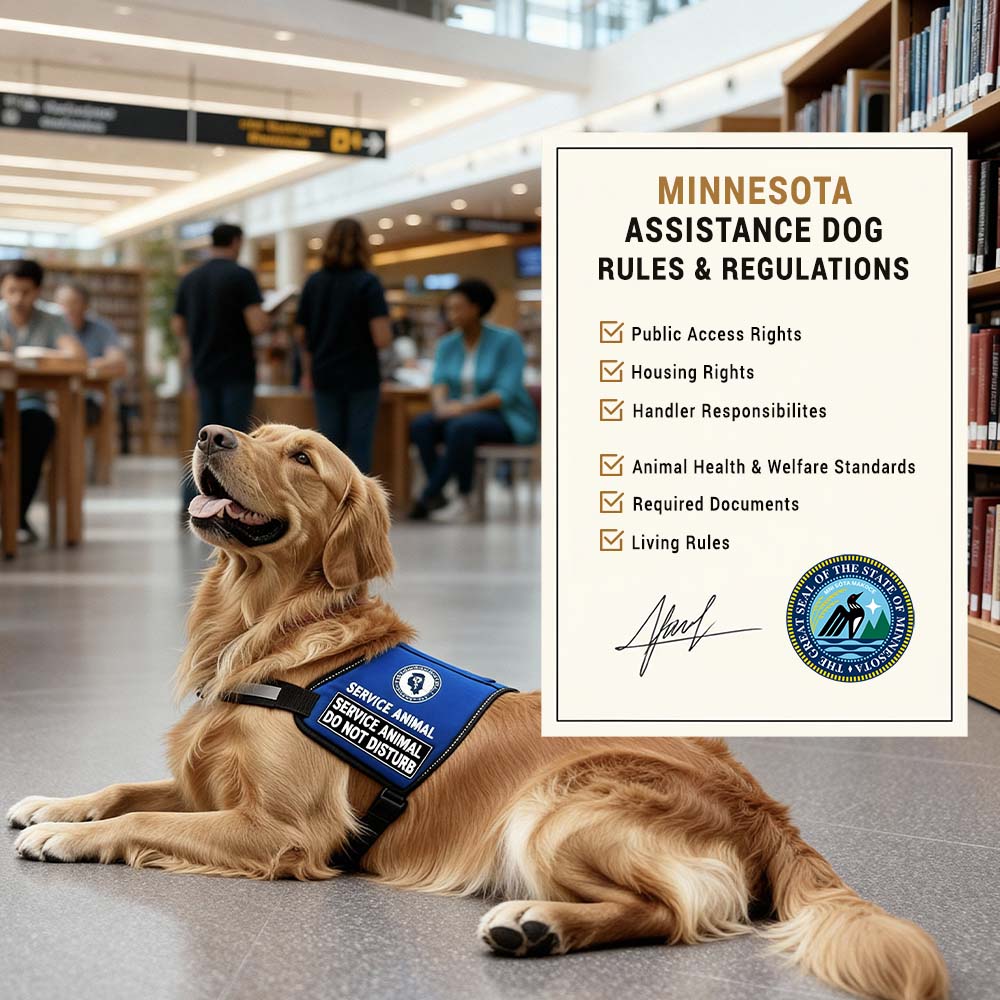
Under the Americans with Disabilities Act (ADA) and Minn. Stat. §256C.02, a service dog is a dog trained to perform tasks directly related to an individual’s disability.
Examples include:
- Guide dogs for the visually impaired.
- Hearing dogs for those who are deaf or hard of hearing.
- Mobility or psychiatric service dogs trained to provide specific assistance such as alerts, grounding, or retrieving items.
Public Access Rights
- Service dogs have full and equal access rights to all public spaces, including restaurants, hotels, housing, workplaces, and transportation, under Minn. Stat. §256C.02(3).
- It is unlawful for any business or landlord to deny access to an individual accompanied by a service dog.
Certification/ID Requirements
- Minnesota does not require registration or certification for service dogs.
- Staff or officials may only ask whether the dog is required because of a disability and what task it performs.
- Misrepresentation of a service animal is illegal under Minn. Stat. §609.833, punishable by fines up to $1,000.
Emotional Support Animals (ESA) & Psychiatric Service Animals (PSA)
Legal Recognition
Emotional Support Animals (ESAs) and Psychiatric Service Animals (PSAs) are only recognised in Minnesota when registered with an accredited organisation that verifies their purpose and legitimacy.
Housing Rights
- Registered ESAs and PSAs are protected under the Fair Housing Act (FHA) and Minnesota Human Rights Act (Minn. Stat. §363A.09).
- Landlords must make reasonable accommodations for registered ESAs and PSAs, even in “no-pet” housing, when valid documentation or registration is provided.
Travel Rights
- Airlines: Only psychiatric service dogs (trained and registered) qualify for in-cabin travel under DOT regulations.
- ESAs are treated as pets for air travel but may still travel in-cabin under specific airline policies.
- Public Transport: Service dogs always allowed; registered ESAs/PSAs may be accepted if calm, leashed, and under control.
Veterinary & Animal Welfare Standards
Vaccination Schedules
- Rabies vaccination is required for all dogs over 3 months old (Minn. Stat. §35.68).
- Dogs must maintain an up-to-date vaccination certificate issued by a licensed veterinarian.
- Core vaccines: distemper, parvovirus, adenovirus, and leptospirosis are recommended.
Neutering/Spaying Regulations
- Minnesota does not require sterilization statewide, but all shelters and rescues must spay/neuter animals before adoption (Minn. Stat. §346.55).
Animal Welfare Acts
Under Minn. Stat. §343.21–.37, animal cruelty laws mandate that owners must:
- Provide adequate food, water, and shelter.
- Protect animals from cruelty, neglect, and hazardous environments.
- Avoid leaving animals in vehicles during dangerous temperatures.
Violations may result in fines, imprisonment, and loss of ownership rights.