
General Ownership & Control
Leash & Muzzle Rules
Lithuania requires dogs to be kept on a leash in public urban areas, including streets, parks, markets, pedestrian zones, and residential districts. Municipalities such as Vilnius, Kaunas, and Klaipėda enforce strict leash regulations to ensure public safety.
Muzzles are required in specific situations, especially for:
- Dogs classified as dangerous or aggressive
- Large dogs riding public transportation
- Dogs in crowded indoor public spaces
Off-leash activity is allowed in designated dog parks or open nature areas, provided the dog is under full voice control. In forests, dogs must be leashed or muzzled depending on municipality rules.
Breed-Specific Bans / Restrictions
Lithuania does not implement national breed bans. All breeds — including pit bulls, rottweilers, mastiffs, and shepherd breeds — are legal to own.
Authorities classify dogs as dangerous based on behavior, not breed. Such dogs may face stricter requirements including mandatory muzzling, registration, or behavioral evaluations.
Licensing & Microchipping
Microchipping is mandatory for all dogs in Lithuania. Owners must register the chip in the national pet database and keep the information updated.
Municipalities may require:
- Annual registration fees
- Proof of rabies vaccination
- Local dog permits for multi-dog households
Rabies vaccination is required for all dogs and must be kept current.
Service Dogs & Assistance Animals
Legal Definitions
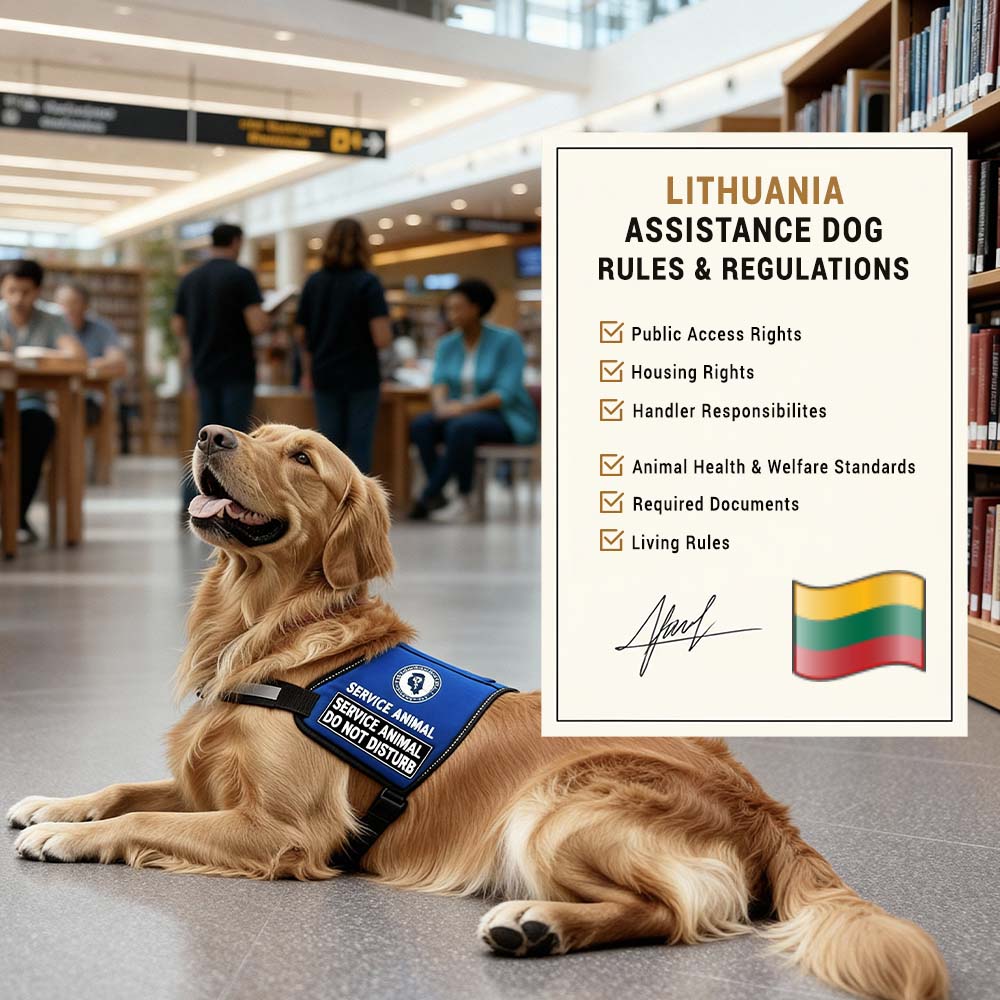
Lithuania recognizes service dogs trained to support individuals with disabilities, including guide dogs, mobility assistance dogs, hearing dogs, seizure-alert dogs, and psychiatric service dogs (PSDs). These dogs must be trained to perform specific disability-related tasks.
Public Access Rights
Service dogs are legally permitted to accompany their handlers into:
- Shops and supermarkets
- Hotels and accommodations
- Restaurants and cafes
- Public transportation (bus, trolleybus, train)
- Government and municipal buildings
- Educational facilities
Businesses cannot refuse entry to a legitimate service dog.
Certification / ID Requirements
While Lithuania has no single national certification standard, service dogs generally carry documentation proving their training status. To avoid public-access issues, handlers should carry:
- Physical ID Card (handler + animal)
- Training/Registration Certificate
- Visible Recognition Gear (vest or harness)
- Prescription Letter (ESA, PSA, or Service Animal letter from a licensed professional)
Emotional Support Animals (ESA) & Psychiatric Service Animals (PSA)
Legal Recognition
ESAs and PSAs in Lithuania are only recognized when registered with an accredited organization. Without registration, ESAs do not gain public-access privileges and are treated as pets.
Housing Rights
Registered ESAs/PSAs may be accepted in no-pet housing at the discretion of landlords. However, fully trained service dogs must be accepted under Lithuanian disability accommodation rules.
Travel Rights
- European airlines serving Lithuania accept certified service dogs.
- PSAs may travel as service animals if accredited and task-trained.
- ESAs follow standard pet travel rules.
- Public transport in Vilnius, Kaunas, and Klaipėda accepts service dogs; ESAs/PSAs vary by operator.
Veterinary & Animal Welfare Standards
Vaccination Schedules
Rabies vaccination is mandatory and must be maintained according to national regulations. Core vaccines — distemper, parvovirus, adenovirus — are strongly recommended and widely practiced.
Neutering / Spaying Regulations
Neutering is not legally required but is recommended to help reduce unwanted litters and manage behavioral issues. Municipal sterilization programs are offered to control stray populations.
Animal Welfare Acts
Lithuania enforces strict animal welfare laws requiring dog owners to ensure adequate shelter, food, water, exercise, and veterinary care. Abuse, cruelty, neglect, or abandonment can result in significant fines or criminal penalties.
The State Food and Veterinary Service oversees compliance and animal welfare enforcement.