
General Ownership & Control
Leash & Muzzle Rules
- Kansas does not have a statewide leash law, but nearly every city and county requires dogs to be leashed or otherwise restrained when in public.
- Wichita, Topeka, and Kansas City all enforce strict leash ordinances. Dogs must be on a leash no longer than 6 feet in public spaces unless in designated off-leash areas.
- Muzzles are not required unless a dog has been legally declared “dangerous” or “vicious” under the Kansas Dangerous Dog Statute (K.S.A. §21-6412).
- Dangerous dogs must be leashed and muzzled in public and confined securely on private property.
Breed-Specific Bans/Restrictions
- Kansas has no statewide breed bans, but several cities enforce local restrictions, including bans on pit bull-type dogs.
- Overland Park, Leavenworth, and Wellington have specific ordinances restricting or banning breeds such as American Pit Bull Terriers, Staffordshire Terriers, and mixes thereof.
- These laws vary by jurisdiction, so it’s essential to confirm local rules before residing or traveling with restricted breeds.
Licensing & Microchipping
- Dogs over 6 months old must be licensed annually with their city or county.
- Proof of current rabies vaccination is required for licensing (K.S.A. §47-837).
- Microchipping is not required statewide, but mandatory for dangerous or impounded dogs and recommended for all pets.
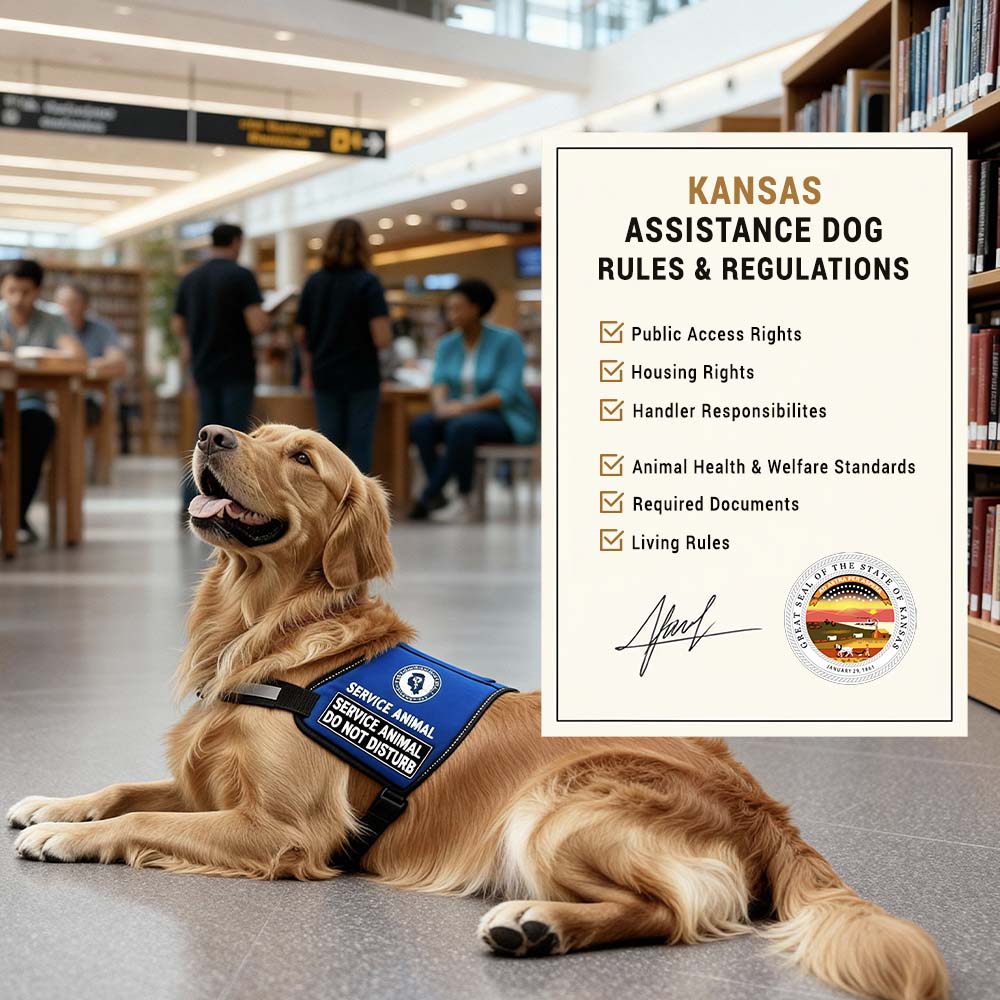
Service Dogs & Assistance Animals
Legal Definitions
Under the Americans with Disabilities Act (ADA) and Kansas Statute §39-1101, a service dog is a dog trained to perform tasks that assist an individual with a disability.
Examples include:
- Guide dogs for visually impaired individuals.
- Hearing dogs for those with hearing loss.
- Mobility and psychiatric service dogs trained to perform essential support tasks (e.g., medical alerts or calming behaviors).
Public Access Rights
- Service dogs are granted full and equal access to all public areas, including restaurants, shops, housing, and transportation, under Kansas Statute §39-1102.
- Denying access to a service dog is illegal and considered discrimination under both state and federal law.
Certification/ID Requirements
- Kansas does not require service dogs to be registered or certified.
- Businesses may only ask:
- Whether the dog is required due to a disability.
- What tasks the dog has been trained to perform.
- Misrepresenting a pet as a service animal is a Class A nonperson misdemeanor, punishable by fines up to $1,000 (K.S.A. §39-1111).
Emotional Support Animals (ESA) & Psychiatric Service Animals (PSA)
Legal Recognition
Emotional Support Animals (ESAs) and Psychiatric Service Animals (PSAs) are only recognised in Kansas when registered with an accredited organisation that verifies their need and legitimacy.
Housing Rights
- Registered ESAs and PSAs are protected under the Fair Housing Act (FHA).
- Landlords must make reasonable accommodations for registered ESAs/PSAs, even in “no-pet” housing, with proper documentation from an accredited source or licensed professional.
Travel Rights
- Airlines: Only psychiatric service dogs (registered and trained) qualify for in-cabin travel under DOT rules.
- ESAs are considered pets for air travel but may still travel in-cabin under some airline policies.
- Trains/Buses/Ferries: ESAs/PSAs may be accepted if registered, calm, and leashed; only service dogs are guaranteed full access rights.
Veterinary & Animal Welfare Standards
Vaccination Schedules
- Rabies vaccination is required for all dogs over 3 months old under K.S.A. §47-837.
- Owners must maintain valid vaccination certificates issued by a licensed veterinarian.
- Other recommended vaccines include distemper, parvovirus, leptospirosis, and adenovirus.
Neutering/Spaying Regulations
- Kansas does not mandate sterilization statewide, but all shelter or rescue adoptions require animals to be spayed or neutered before release.
Animal Welfare Acts
Under the Kansas Pet Animal Act (K.S.A. §47-1701), dog owners must:
- Provide proper food, water, shelter, and veterinary care.
- Avoid cruelty, neglect, and abandonment.
- Prevent exposure to extreme weather conditions.
Violations may lead to fines, loss of ownership, or criminal charges.