
General Ownership & Control
Leash & Muzzle Rules
In Japan, dogs must be kept under strict control in public spaces. Most municipalities require dogs to be leashed at all times when outside the home, including on streets, sidewalks, parks, residential areas, and near public facilities.
Muzzles are not generally required nationwide, but may be mandated for:
- Dogs that display aggressive behavior
- Dogs involved in previous biting incidents
- Dogs subject to local administrative or safety orders
Off-leash activity is typically permitted only in designated dog runs, private dog parks, or enclosed facilities. In most public parks, dogs must remain leashed.
Breed-Specific Bans / Restrictions
Japan does not maintain a nationwide breed ban. All breeds are generally permitted, including large and guardian breeds.
However, individual dogs may be classified as dangerous based on behavior rather than breed. In such cases, local authorities may impose:
- Mandatory muzzling in public
- Strict leash control
- Special confinement or handling requirements
Licensing & Microchipping
Dog ownership in Japan requires municipal registration. All dogs must be registered with the local city or ward office.
Microchipping is mandatory and must be registered in the national animal identification system.
Owners must also comply with:
- Annual rabies vaccination (legally required)
- Rabies vaccination certificate tag attached to the collar
- Updating registration details when ownership or address changes
Failure to register or vaccinate a dog may result in fines.
Service Dogs & Assistance Animals
Legal Definitions
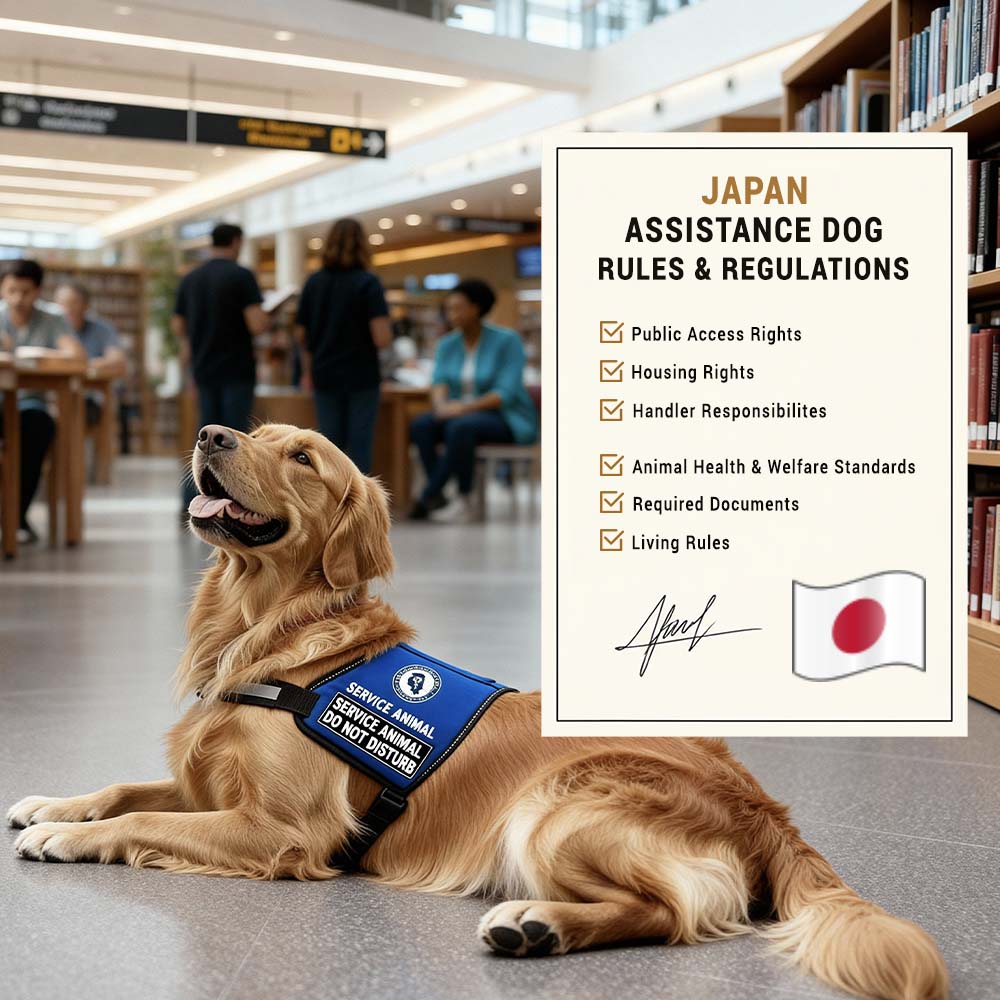
Japan legally recognizes assistance dogs under the Assistance Dogs for Persons with Disabilities Act. Recognized categories include guide dogs, hearing dogs, mobility assistance dogs, and psychiatric service dogs (PSDs) trained to perform disability-related tasks.
Public Access Rights
Certified service dogs must be allowed into public-access locations, including:
- Restaurants and cafes
- Retail stores and shopping centres
- Public transportation (trains, subways, buses, taxis)
- Hotels and accommodations
- Hospitals and medical facilities
- Government and public buildings
Refusal of access to a legitimate service dog may constitute a violation of national accessibility law.
Certification / ID Requirements
Japan requires service dogs to be officially certified. Handlers should carry:
- Official assistance dog identification card
- Certification issued by an accredited training organization
- Visible recognition gear (harness or vest)
- Physical ID Card (handler + animal)
- Prescription Letter (ESA, PSA, or service dog letter)
Emotional Support Animals (ESA) & Psychiatric Service Animals (PSA)
Legal Recognition
Emotional Support Animals (ESAs) and Psychiatric Service Animals (PSAs) in Japan are only recognized when registered with an accredited organization. Without accreditation, ESAs are treated as companion animals and do not receive public-access rights.
Housing Rights
Registered ESAs/PSAs may be accepted in housing depending on landlord, building management, and local housing rules. Fully trained service dogs must always be accepted as disability accommodations.
Travel Rights
- Japanese airlines accept certified service dogs in the cabin.
- PSAs may travel as service dogs when accredited and task-trained.
- ESAs follow standard airline pet rules unless otherwise accepted.
- Public transportation accepts certified service dogs nationwide.
Veterinary & Animal Welfare Standards
Vaccination Schedules
Rabies vaccination is mandatory for all dogs in Japan and must be renewed annually. Core vaccines such as distemper, parvovirus, and adenovirus are strongly recommended.
Neutering / Spaying Regulations
Neutering is not legally required but is strongly encouraged to prevent overpopulation. Many municipalities offer subsidized sterilization programs.
Animal Welfare Acts
Japan enforces animal welfare laws requiring owners to provide adequate food, water, shelter, exercise, and veterinary care.
Abuse, abandonment, or neglect of animals may result in fines or criminal penalties under national law.