
General Ownership & Control
Leash & Muzzle Rules
Italy requires dogs to be kept on a leash in all public spaces, including streets, parks, beaches, historical districts, markets, and public squares. The maximum leash length allowed in public areas is 1.5 meters.
Owners must carry a muzzle with them at all times, even if it is not being worn. Muzzles are required in certain situations, such as:
- Dogs showing aggression
- Large or powerful dogs in crowded areas
- Public transportation (varies by region)
- When requested by law enforcement
Some cities — such as Rome, Milan, Florence, and Naples — also enforce seasonal restrictions in parks and wildlife areas.
Breed-Specific Bans / Restrictions
Italy does not have national breed bans. All breeds, including pit bull-type dogs, rottweilers, mastiffs, cane corsos, and shepherd breeds, are legal.
Dangerous dog classification is based on behavior rather than breed. Local authorities may impose restrictions on an individual dog, including compulsory muzzling or behavioral evaluations.
Licensing & Microchipping
Microchipping is mandatory for all dogs in Italy and must be completed within 60 days of birth or upon adoption. Once microchipped, the owner must register the dog in the regional canine registry (Anagrafe Canina).
Owners are also required to maintain:
- Valid vaccination records
- Updated contact information in the registry
Some municipalities may impose local dog taxes.
Service Dogs & Assistance Animals
Legal Definitions
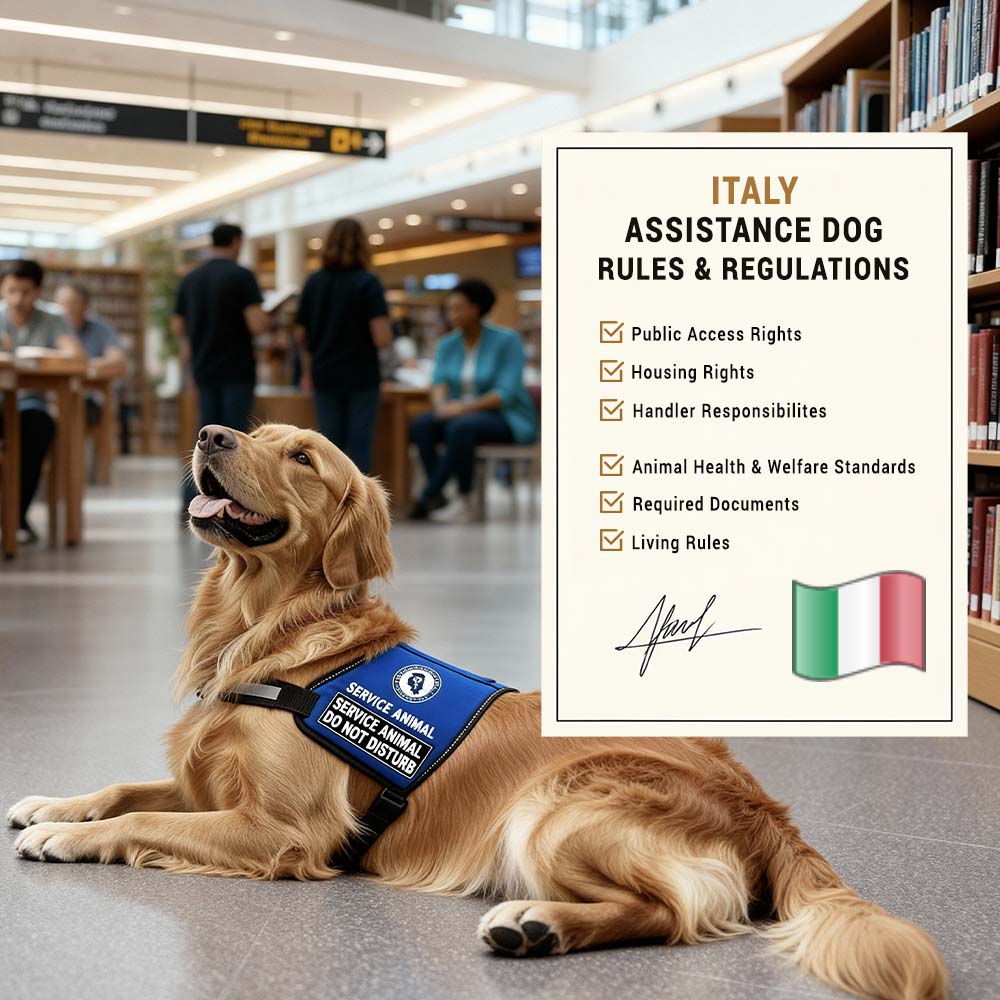
Italy recognizes guide dogs, mobility assistance dogs, seizure-alert dogs, hearing dogs, and psychiatric service dogs (PSDs). These animals must be task-trained to assist individuals with disabilities.
Public Access Rights
Service dogs have full legal access to all public spaces, including:
- Restaurants and cafes
- Hotels and tourist sites
- Shops and supermarkets
- Public transport (metro, buses, trains, ferries)
- Hospitals and government buildings
Businesses may not refuse entry to a legitimate service dog.
Certification / ID Requirements
Service dogs in Italy typically carry identification from accredited training organizations. To avoid issues, handlers should carry:
- Physical ID Card (handler + animal)
- Training/Registration Certificate
- Visible Recognition Gear (vest, harness, or bandana)
- Prescription Letter (ESA, PSA, or Service Animal letter from a licensed professional)
Emotional Support Animals (ESA) & Psychiatric Service Animals (PSA)
Legal Recognition
Emotional Support Animals (ESAs) and Psychiatric Service Animals (PSAs) are only recognized when registered with an accredited organization. Without official recognition, ESAs are treated as pets without special access rights.
Housing Rights
Registered ESAs/PSAs may be accepted in housing that restricts pets, depending on landlord policy. Service dogs are protected under disability accommodation laws and must be allowed in all housing.
Travel Rights
- Italian and European airlines accept service dogs with valid documentation.
- PSAs may travel as service dogs when task-trained and accredited.
- ESAs typically follow standard pet travel rules unless designated otherwise by a carrier.
- Italian public transport (Trenitalia, Italo, metro systems) accepts service dogs; ESAs/PSAs vary by operator.
Veterinary & Animal Welfare Standards
Vaccination Schedules
Rabies vaccination is required for all dogs traveling outside Italy or entering the country. Core vaccines — distemper, parvovirus, adenovirus, and leptospirosis — are strongly recommended.
Neutering / Spaying Regulations
Neutering is not legally mandatory but is encouraged to prevent overbreeding, especially in southern regions where stray populations are higher.
Animal Welfare Acts
Italy enforces robust animal welfare laws requiring owners to provide proper shelter, food, water, exercise, and medical care. Abuse, abandonment, or neglect is punishable by significant fines or imprisonment. Enforcement is overseen by local health authorities (ASL) and animal welfare agencies.