
General Ownership & Control
Leash & Muzzle Rules
- Indiana does not have a single statewide leash law, but most counties and municipalities require dogs to be leashed or under control at all times when off their owner’s property.
- Indianapolis, Fort Wayne, and Evansville all enforce strict leash ordinances — dogs must be on a leash in public spaces, including sidewalks, parks, and trails.
- Muzzles are not required for general dogs but are mandatory for dogs officially declared “vicious” or “dangerous” under the Indiana Code §15-20-1-4.
- Owners are responsible for preventing their dogs from attacking or menacing others; violations can lead to impoundment and fines.
Breed-Specific Bans/Restrictions
- Indiana has no statewide breed bans.
- However, some local municipalities and housing authorities impose breed-specific restrictions, especially on pit bull-type breeds, rottweilers, and doberman pinschers.
- Insurance companies may also deny coverage for specific breeds, so owners should verify local and private policies before moving.
Licensing & Microchipping
- All dogs 6 months and older must be licensed annually through their local animal control agency or county clerk’s office.
- Proof of current rabies vaccination is required for licensing (Indiana Code §15-17-6-1).
- Microchipping is not required statewide, but many cities and shelters strongly encourage or require it for adopted animals.
Service Dogs & Assistance Animals
Legal Definitions
Under Indiana Code §16-32-3-1 and the Americans with Disabilities Act (ADA), a service dog is defined as a dog trained to perform specific tasks that assist a person with a physical, sensory, psychiatric, or intellectual disability.
Examples include:
- Guide dogs for individuals who are blind.
- Hearing dogs for individuals who are deaf.
- Mobility or psychiatric service dogs trained to perform essential assistance tasks.
Public Access Rights
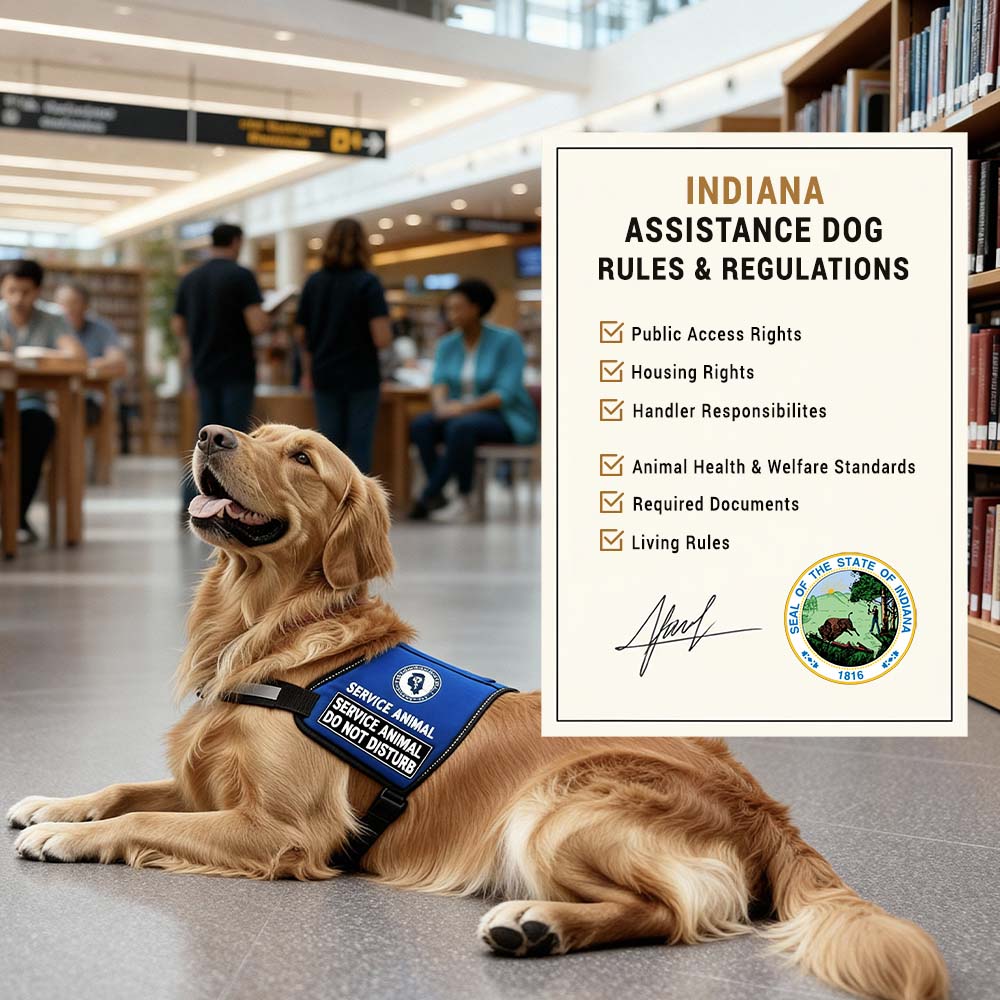
- Service dogs have full and equal access rights under both state law and the ADA.
- They may accompany their handlers in public buildings, transport, restaurants, shops, and housing.
- Denying access to a service dog is considered discrimination under Indiana Code §16-32-3-2.
Certification/ID Requirements
- Indiana does not require service dogs to be certified or registered.
- Businesses may only ask:
- Whether the dog is required because of a disability.
- What task the dog is trained to perform.
- Falsely claiming a pet as a service dog is a Class A infraction punishable by fines and community service (Indiana Code §35-46-3-11.5).
Emotional Support Animals (ESA) & Psychiatric Service Animals (PSA)
Legal Recognition
Emotional Support Animals (ESAs) and Psychiatric Service Animals (PSAs) are only recognised in Indiana when registered with an accredited organisation that verifies their purpose and role.
Housing Rights
- Under the Fair Housing Act (FHA) and Indiana Fair Housing laws, landlords must make reasonable accommodations for registered ESAs and PSAs, even in “no-pet” housing.
- Documentation or registration from an accredited organisation or licensed therapist may be required.
Travel Rights
- Airlines: Only psychiatric service dogs registered and trained through accredited organisations are recognised under DOT rules for in-cabin travel.
- ESAs are treated as pets for air travel but may still fly in-cabin depending on airline policy.
- Trains/Buses/Ferries: Registered ESAs/PSAs may be accepted at the operator’s discretion if leashed, non-aggressive, and under control.
Veterinary & Animal Welfare Standards
Vaccination Schedules
- Rabies vaccination is mandatory for all dogs over 3 months old, as per Indiana Code §15-17-6-1.
- Rabies tags must be worn on the dog’s collar when in public.
- Core vaccinations (distemper, parvovirus, adenovirus, leptospirosis) are recommended by veterinarians statewide.
Neutering/Spaying Regulations
- Spaying and neutering are not mandated statewide, but all dogs adopted from shelters or rescues must be sterilized.
Animal Welfare Acts
Under Indiana Code §35-46-3, the state’s Animal Cruelty Law requires owners to:
- Provide proper food, water, shelter, and veterinary care.
- Avoid abandonment or cruelty.
- Protect animals from harsh weather and dangerous confinement.
Violations can result in misdemeanor or felony charges, depending on severity.