
General Ownership & Control
Leash & Muzzle Rules
Iceland enforces strict control laws for dogs, especially within Reykjavík and surrounding municipalities. Dogs must be kept on a leash in most public areas unless signage explicitly allows off-leash activity. Many cities have designated dog-walking trails and fenced dog parks where dogs may be let off leash.
Muzzles are not widely required but may be mandated for:
- Aggressive dogs or those with a history of biting
- Dogs identified as dangerous by authorities
- Specific situations involving public safety concerns
In rural or wildlife-sensitive areas, dogs may be required to remain leashed year-round to protect livestock, migratory birds, and fragile ecosystems.
Breed-Specific Bans / Restrictions
Iceland does not impose national breed bans. All dog breeds are legal, including large guardian breeds and working dogs. However, individual municipalities may impose restrictions on dogs deemed dangerous based on behavior, not breed.
Dangerous-dog declarations can lead to:
- Mandatory muzzle in public
- Short-leash requirements
- Special handling instructions
- Behavioral evaluations
Licensing & Microchipping
Microchipping is mandatory for all dogs in Iceland and must be recorded in the national pet registry. Additional ownership requirements include:
- Municipal dog licensing (annual fees required)
- Rabies vaccination for travel purposes
- Mandatory registration with local authorities
- Carrying identification when in public
Some municipalities require owners to complete an online test or training module before obtaining a dog license.
Service Dogs & Assistance Animals
Legal Definitions
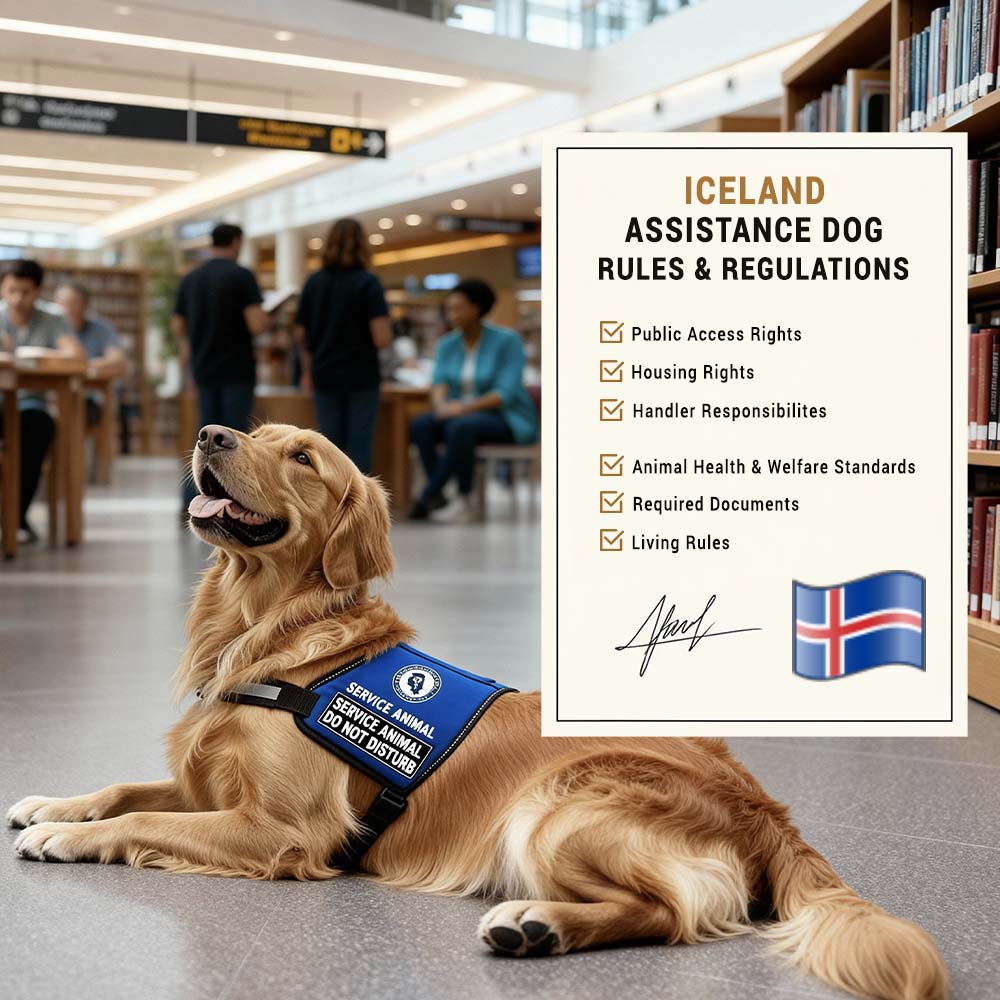
Iceland recognizes several categories of service dogs, including guide dogs, mobility assistance dogs, hearing dogs, seizure-alert dogs, diabetes-alert dogs, and psychiatric service dogs (PSDs). These dogs must be task-trained to assist a person with disabilities.
Public Access Rights
Service dogs must be allowed into all public-access areas, including:
- Shops and retail centers
- Restaurants and cafes
- Hotels and lodging
- Hospitals and medical centers
- Public transportation (buses, taxis, ferries)
- Government and municipal buildings
Denying entry to a legitimate service dog violates Icelandic disability-access rules.
Certification / ID Requirements
While Iceland does not mandate a national service-dog ID, handlers should carry documentation to prevent delays. Recommended items include:
- Service dog identification card
- Training or registration certificate
- Visible recognition gear (vest or harness)
- Physical ID card (handler + service dog)
- Prescription Letter (ESA, PSA, or service dog letter)
Emotional Support Animals (ESA) & Psychiatric Service Animals (PSA)
Legal Recognition
ESAs and PSAs in Iceland are only recognized when registered with an accredited organization. Without accreditation, ESAs have no special rights and are treated as companion animals.
Housing Rights
Registered ESAs/PSAs may be allowed in no-pet housing depending on landlord policy. Fully trained service dogs must always be accepted under Icelandic disability rights.
Travel Rights
- Icelandair and other carriers accept certified service dogs in the cabin.
- Accredited PSAs may travel as service dogs when task-trained.
- ESAs follow standard airline pet rules unless recognized by a specific carrier.
- Public transit accepts service dogs nationwide.
Veterinary & Animal Welfare Standards
Vaccination Schedules
Iceland is rabies-free, and rabies vaccination is not required unless the dog is traveling internationally. Recommended core vaccines include distemper, adenovirus, parvovirus, and leptospirosis.
Neutering / Spaying Regulations
Neutering is not mandatory, but is encouraged to control overpopulation. Many municipalities support responsible breeding programs and require breeder registration.
Animal Welfare Acts
Iceland enforces high animal-welfare standards. Owners must ensure appropriate food, shelter, exercise, socialization, and veterinary care. Mistreatment or neglect is punishable under national law.
The Icelandic Food and Veterinary Authority (MAST) oversees welfare compliance.