
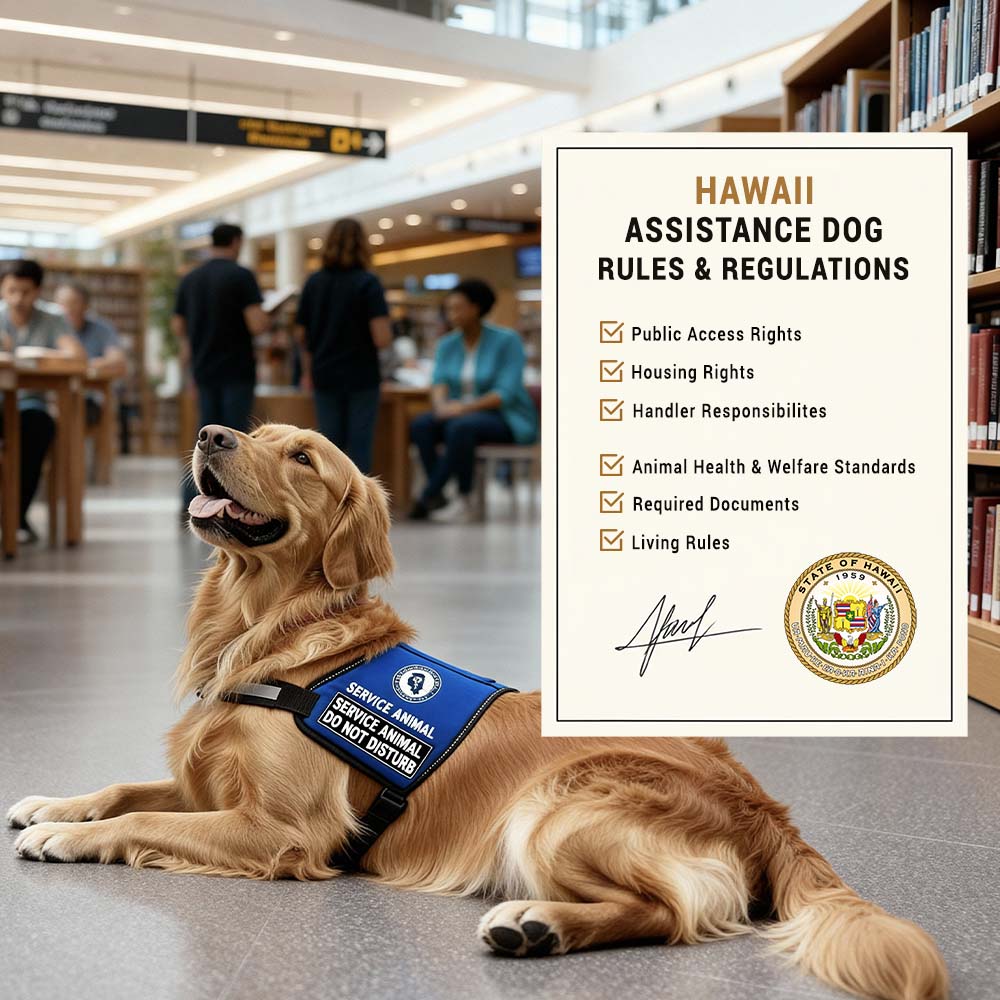
General Ownership & Control
Leash & Muzzle Rules
- Hawaii does not have a single statewide leash law, but each county enforces its own leash and control ordinances.
- Honolulu (Oʻahu): Dogs must be leashed in all public areas, including beaches and parks, unless in designated off-leash zones.
- Maui, Kauaʻi, and Hawaiʻi (Big Island): Similar rules apply — dogs must be on a leash no longer than 6 feet in public spaces.
- Muzzles are not required for most dogs but may be ordered by local authorities if a dog has a history of aggression.
Breed-Specific Bans/Restrictions
- Hawaii has no statewide or county-level breed bans.
- However, dangerous dog laws apply to any breed found to be aggressive, with stricter containment or muzzle requirements for repeat offenders.
- Insurance companies and landlords may have their own breed restrictions, so always confirm before renting or relocating.
Licensing & Microchipping
- All dogs over 4 months old must be licensed annually in their county of residence.
- Proof of rabies vaccination is required to obtain a license.
- Microchipping is mandatory for all dogs in Hawaii under Hawaii Revised Statutes §143-2.5, and the chip must be registered with the county.
Service Dogs & Assistance Animals
Legal Definitions
Under the Americans with Disabilities Act (ADA) and Hawaii Revised Statutes §347-2.5, a service dog is a dog trained to perform tasks directly related to a person’s disability.
Examples include:
- Guide dogs for the visually impaired.
- Hearing dogs for those with hearing loss.
- Mobility and psychiatric service dogs trained to assist with specific tasks.
Public Access Rights
- Service dogs have full access rights to public spaces, housing, and transportation.
- Denying access to a service animal is prohibited under both state and federal law.
- Housing providers must allow service dogs under the Fair Housing Act (FHA) and Hawaii’s Fair Housing regulations (HRS §515).
Certification/ID Requirements
- Hawaii does not require certification or ID for service dogs.
- Handlers can be asked only whether the animal is required because of a disability and what task it performs.
- Misrepresentation of a service animal is a civil offense punishable by fines up to $1,000 and community service (HRS §347-2.6).
Emotional Support Animals (ESA) & Psychiatric Service Animals (PSA)
Legal Recognition
Emotional Support Animals (ESAs) and Psychiatric Service Animals (PSAs) are only recognised in Hawaii when registered with an accredited organisation that verifies their necessity and legitimacy.
Housing Rights
- Registered ESAs and PSAs are protected under the Fair Housing Act (FHA) and Hawaii’s fair housing laws.
- Landlords must make reasonable accommodations for registered ESAs/PSAs, even in “no-pet” housing.
- Verification from an accredited organisation or licensed mental health professional is typically required.
Travel Rights
- Airlines: Only psychiatric service dogs (registered and trained) are recognised for in-cabin travel under DOT regulations.
- ESAs are considered pets but may still travel in-cabin under airline pet policies.
- Inter-island flights (e.g., Hawaiian Airlines) follow federal and state animal import laws — pets must meet vaccination and health requirements, even for short flights.
Veterinary & Animal Welfare Standards
Vaccination Schedules
- Rabies vaccination is required for all dogs in Hawaii.
- Hawaii is a rabies-free state, and strict regulations protect that status — vaccination documentation is required for all resident dogs.
- Other recommended vaccines: distemper, parvovirus, leptospirosis, adenovirus, and parainfluenza.
Neutering/Spaying Regulations
- Spaying and neutering are not mandatory statewide, but highly encouraged through the Hawaiian Humane Society’s sterilization programs.
Animal Welfare Acts
Under Hawaii Revised Statutes §143 and §711-1109, dog owners must:
- Provide sufficient food, shelter, and veterinary care.
- Avoid neglect, abuse, or abandonment.
- Prevent dogs from roaming or attacking people or other animals.
Violations can lead to fines, seizure of the animal, and potential criminal charges.