
General Ownership & Control
Leash & Muzzle Rules
- Georgia law (O.C.G.A. §4-8-29) requires all dog owners to keep their dogs under control and prevent them from running at large.
- Most counties and cities — including Atlanta, Savannah, and Augusta — enforce local leash ordinances, requiring dogs to be leashed in all public spaces unless in a designated off-leash area.
- Muzzles are not required unless a dog has been declared “vicious” or “dangerous” under Georgia’s Dangerous Dog Control Law (O.C.G.A. §4-8-20).
- Dogs classified as dangerous must be leashed (no more than 6 feet) and muzzled in public at all times.
Breed-Specific Bans/Restrictions
- Georgia has no statewide breed bans, but individual municipalities and housing authorities may have restrictions on certain breeds, such as:
- American Pit Bull Terrier
- Rottweiler
- Doberman Pinscher
- Wolf hybrids
- Dangerous dog designations are based on behavior, not breed. However, private housing communities and insurance providers may impose additional restrictions.
Licensing & Microchipping
- All dogs 3 months and older must be licensed annually with the local county or city.
- Proof of current rabies vaccination is required for licensing.
- Microchipping is not required statewide but is mandatory for dogs classified as “dangerous” or “vicious.”
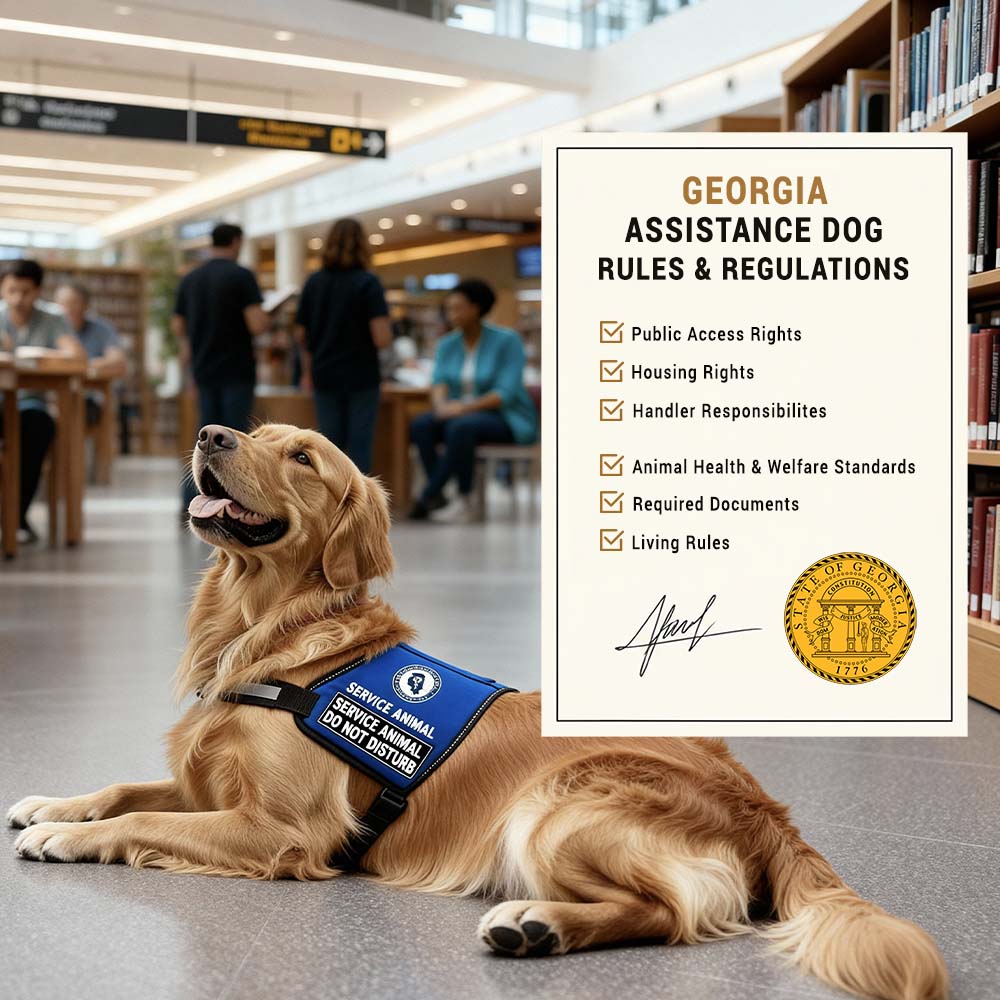
Service Dogs & Assistance Animals
Legal Definitions
Under Georgia law (O.C.G.A. §30-4-2) and the Americans with Disabilities Act (ADA), a service dog is defined as a dog trained to perform specific tasks that assist a person with a physical, sensory, psychiatric, or intellectual disability.
This includes:
- Guide dogs for the visually impaired.
- Hearing dogs for the hearing-impaired.
- Mobility and psychiatric service dogs trained for specific tasks (e.g., alerting to anxiety attacks, retrieving medication).
Public Access Rights
- Service dogs are granted full access to all public accommodations, including restaurants, stores, schools, housing, and public transportation.
- Denying access to a service dog is illegal and punishable under state and federal law.
Certification/ID Requirements
- Georgia does not require registration or certification for service dogs.
- Businesses may only ask two ADA-compliant questions about the animal’s function.
- Misrepresenting a pet as a service animal is a misdemeanor under O.C.G.A. §16-11-107, with fines up to $500.
Emotional Support Animals (ESA) & Psychiatric Service Animals (PSA)
Legal Recognition
Emotional Support Animals (ESAs) and Psychiatric Service Animals (PSAs) are only recognised in Georgia when registered with an accredited organisation that verifies their purpose and legitimacy.
Housing Rights
- Under the Fair Housing Act (FHA), landlords must make reasonable accommodations for registered ESAs and PSAs.
- Proper documentation or accredited registration is required to confirm the animal’s role and handler’s need.
Travel Rights
- Airlines: Only psychiatric service dogs registered through accredited organisations qualify for in-cabin travel under federal DOT rules.
- ESAs are considered pets but may still travel in-cabin if airline policies allow.
- Trains and buses: Only registered service dogs are legally guaranteed access; ESAs/PSAs may be permitted at the operator’s discretion.
Veterinary & Animal Welfare Standards
Vaccination Schedules
- Rabies vaccination is required for all dogs 3 months or older, administered by a licensed veterinarian (O.C.G.A. §31-19-5).
- Core vaccines such as distemper, parvovirus, adenovirus, and parainfluenza are recommended statewide.
Neutering/Spaying Regulations
- Georgia does not require sterilization statewide, but local shelters and rescues must spay/neuter dogs before adoption.
Animal Welfare Acts
Under the Georgia Animal Protection Act (O.C.G.A. §4-11-1), owners must:
- Provide adequate food, water, shelter, and medical attention.
- Protect dogs from cruelty, neglect, and abandonment.
- Avoid leaving pets in vehicles during dangerous temperatures (“hot car law”).
Violations may result in fines, imprisonment, and seizure of the animal.