
General Ownership & Control
Leash & Muzzle Rules
In France, leash and dog-control laws are regulated both nationally and by municipalities. Most cities — including Paris, Lyon, Marseille, Nice, and Bordeaux — require dogs to be kept on a leash in public urban areas, parks, markets, beaches (seasonally), and residential zones. Only designated dog parks or open recreation zones allow off-leash activity.
Muzzles are mandatory for certain dog categories and situations:
- Category 1 dogs (banned breeds) — always
- Category 2 dogs (restricted breeds) — in public spaces
- On public transportation — often required for medium and large dogs
- For dogs with a history of aggression
Breed-Specific Bans / Restrictions
France enforces strict laws for “dangerous dogs,” divided into two categories:
Category 1 (Banned – No breeding, sale, or import):
- Pit Bull–type dogs (not registered as a pure breed)
- Boerboel
- Tosa (non-pedigree)
Category 2 (Restricted – Allowed with conditions):
- American Staffordshire Terrier (pedigree)
- Rottweiler (including crossbreeds)
- Tosa (pedigree)
Category 2 dogs must be muzzled, leashed by an adult, insured, registered at city hall, and meet behavioral evaluation requirements.
Licensing & Microchipping
Microchipping is mandatory for all dogs in France and must be recorded in the national pet registry (I-CAD). Proof of identity and vaccination must be carried by the owner.
Rabies vaccination is mandatory for travel or entry into certain regions. Some municipalities may require dog registration or yearly pet taxes.
Service Dogs & Assistance Animals
Legal Definitions
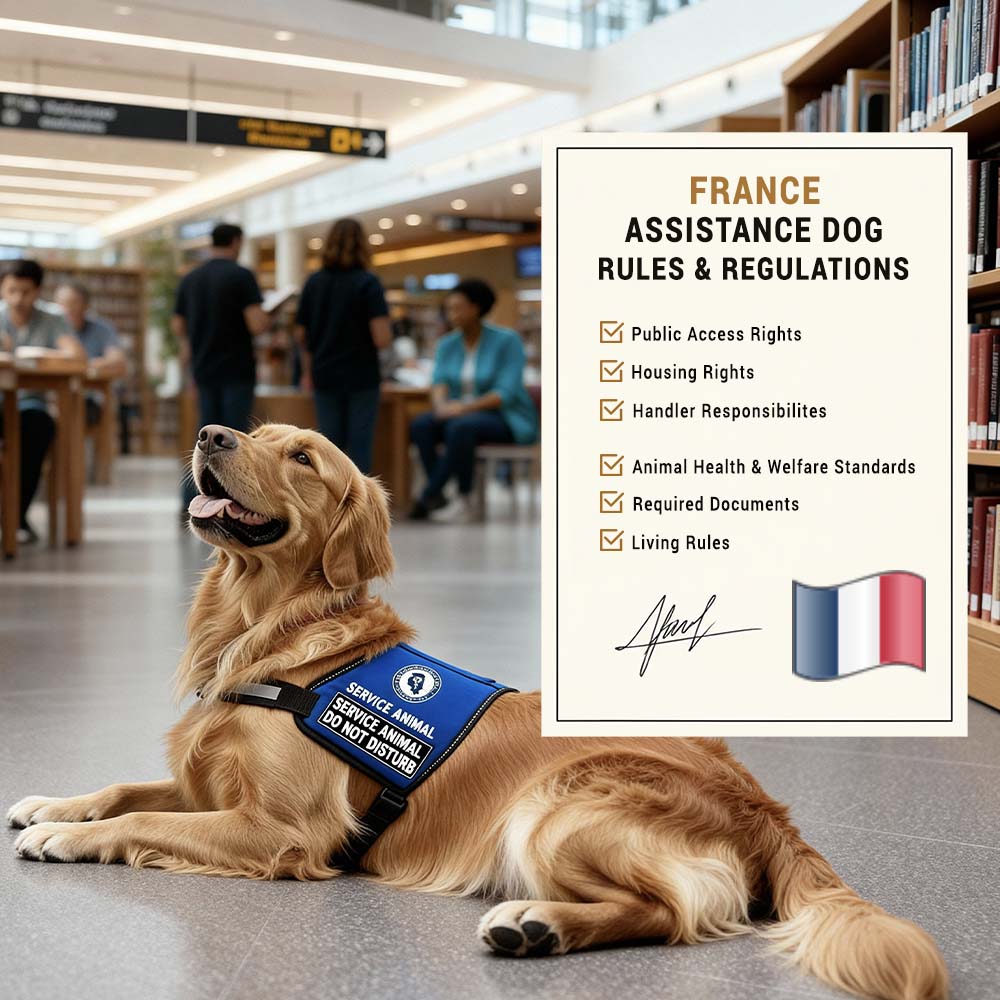
France legally recognizes several types of assistance dogs, including guide dogs for the blind, hearing dogs, mobility assistance dogs, epilepsy-alert dogs, and psychiatric service dogs (PSDs). These dogs must be trained by accredited French or EU-recognized organizations.
Public Access Rights
Service dogs have full access to all public spaces, including restaurants, shops, hotels, public transportation, workplaces, educational institutions, and government buildings. Businesses cannot refuse entry to a service dog.
Certification / ID Requirements
Service dogs in France typically carry documentation issued by accredited training centers. To ensure smooth public access, handlers should carry:
- Physical ID Card (handler + animal)
- Training/Registration Certificate
- Visible Recognition Gear such as a vest or harness
- Prescription Letter (ESA, PSA, or Service Animal letter from a licensed professional)
Emotional Support Animals (ESA) & Psychiatric Service Animals (PSA)
Legal Recognition
In France, ESAs do not receive automatic legal privileges. ESAs and PSAs are only recognized when registered with an accredited organization, which allows consideration in housing and certain travel situations.
Housing Rights
Registered ESAs/PSAs may be accepted in housing that normally restricts pets, depending on landlord policy and documentation. Service dogs are fully protected under disability accommodation laws and cannot be refused.
Travel Rights
- Air France and most European airlines accept service dogs with proper documentation.
- PSAs may travel as service dogs when task-trained and certified.
- ESAs follow pet travel rules unless specifically recognized by the carrier.
- Public transportation systems (SNCF trains, RATP metro/bus) fully accept service dogs; ESAs/PSAs vary by operator.
Veterinary & Animal Welfare Standards
Vaccination Schedules
France requires rabies vaccination for dogs traveling domestically across borders or internationally. Core vaccines (distemper, adenovirus, parvovirus, leptospirosis) are strongly recommended.
Neutering / Spaying Regulations
Neutering is not mandatory but is encouraged to reduce unwanted breeding and manage behavior. Mandatory sterilization applies to Category 1 prohibited-breed dogs.
Animal Welfare Acts
France enforces strict animal welfare laws requiring owners to provide adequate food, water, shelter, exercise, and veterinary care. Cruelty, abandonment, and neglect are criminal offenses. The Ministry of Agriculture and local animal protection authorities regulate enforcement.