
General Ownership & Control
Leash & Muzzle Rules
- Florida law (Florida Statutes §767.04 & §828.27) requires dog owners to keep their pets under control at all times in public spaces.
- While there is no single statewide leash law, most counties and municipalities enforce local leash requirements:
- Miami-Dade, Orlando, Tampa, and Jacksonville require leashes in all public areas, including beaches and parks.
- Some counties have off-leash zones or dog beaches where leashes are not required.
- Muzzles are not mandatory unless a dog has been legally declared “dangerous” or “aggressive” under Florida Statute §767.12.
Breed-Specific Bans/Restrictions
- Florida prohibits breed-specific legislation at the state level, but Miami-Dade County maintains a ban on Pit Bull-type dogs, including:
- American Pit Bull Terrier
- American Staffordshire Terrier
- Staffordshire Bull Terrier
- Other counties may enforce stricter leash or containment laws for dogs with prior aggression incidents.
Licensing & Microchipping
- All dogs 4 months and older must be licensed and vaccinated against rabies.
- Licenses are issued by county animal control agencies and require proof of rabies vaccination.
- Microchipping is not legally required statewide but is mandatory for all dogs declared dangerous and for dogs adopted from shelters or rescues.
Service Dogs & Assistance Animals
Legal Definitions
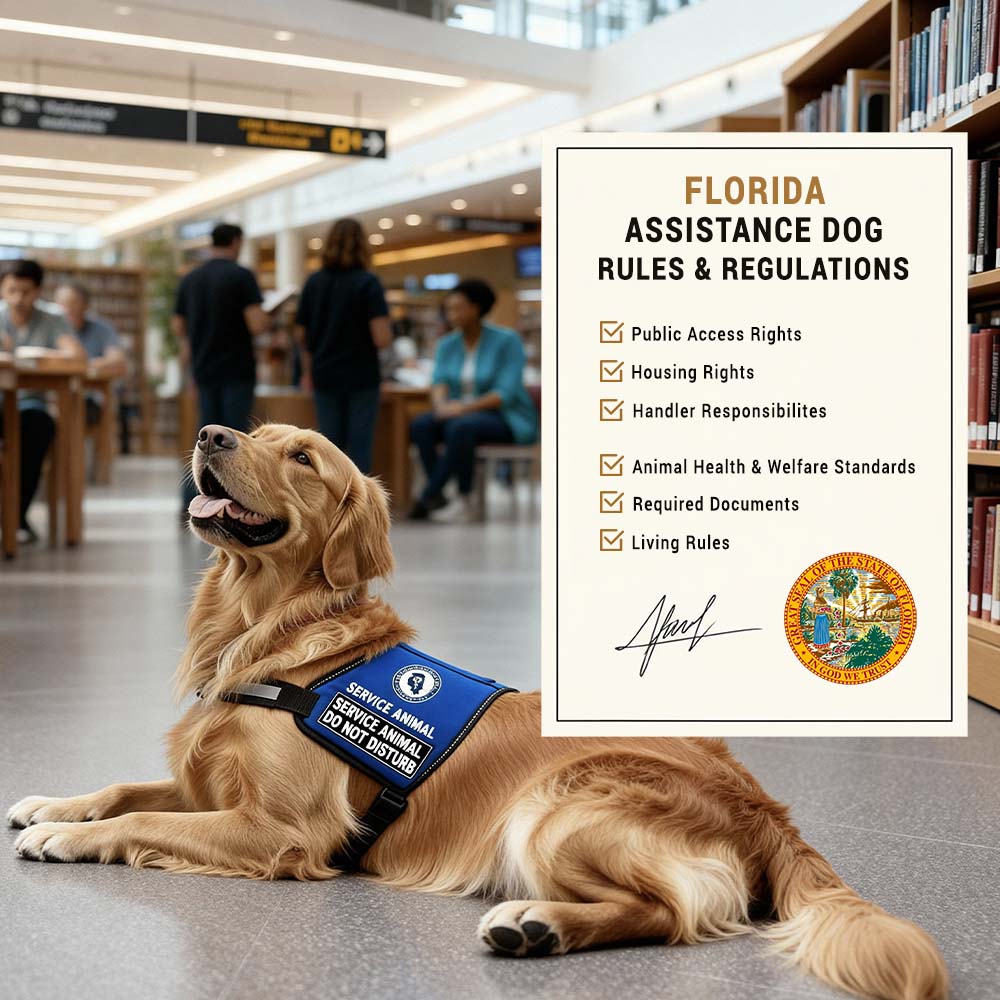
Under the Americans with Disabilities Act (ADA) and Florida Statutes §413.08, a service animal is defined as a dog trained to perform specific tasks that assist a person with a disability.
This includes:
- Guide dogs for visually impaired persons.
- Hearing dogs for individuals with hearing impairments.
- Mobility and psychiatric service dogs trained for specific medical or behavioral support.
Public Access Rights
- Service dogs have full public access rights in Florida, including restaurants, public transport, hotels, workplaces, and housing.
- Denying access to a service dog is a second-degree misdemeanor under Florida law.
Certification/ID Requirements
- Florida does not require state-issued certification or ID for service dogs.
- Businesses may only ask two ADA-approved questions about the dog’s role and function.
- Misrepresenting a pet as a service animal is punishable by a fine of up to $500 and community service under Fla. Stat. §413.08(9).
Emotional Support Animals (ESA) & Psychiatric Service Animals (PSA)
Legal Recognition
Emotional Support Animals (ESAs) and Psychiatric Service Animals (PSAs) are only recognised in Florida when registered with an accredited organisation that verifies their necessity and role.
Housing Rights
- Florida’s Fair Housing Act (Fla. Stat. §760.27) protects the rights of individuals with disabilities to live with registered ESAs and PSAs.
- Landlords may request documentation from an accredited source or licensed professional confirming the need for the animal.
Travel Rights
- Airlines: Only psychiatric service dogs registered through an accredited organisation are recognised under federal DOT rules for in-cabin travel.
- ESAs are treated as pets but may still fly in-cabin if airline policy allows.
- Public transport (buses, trains, ferries): ESAs/PSAs may be allowed if leashed, calm, and registered, though only service dogs are legally guaranteed access.
Veterinary & Animal Welfare Standards
Vaccination Schedules
- Rabies vaccination is required for all dogs over 4 months old, renewed every 1 or 3 years depending on the vaccine type.
- Other recommended vaccinations include distemper, parvovirus, leptospirosis, and adenovirus.
Neutering/Spaying Regulations
- Spaying/neutering is not required statewide but is mandatory for all dogs adopted from public shelters and humane societies.
Animal Welfare Acts
Under Fla. Stat. §828, owners must:
- Provide proper food, water, shelter, and medical care.
- Avoid abandonment or confinement in extreme heat (Florida’s “hot car law”).
- Prevent abuse or neglect; violations can lead to fines, imprisonment, or loss of ownership.