
General Ownership & Control
Leash & Muzzle Rules
- Connecticut does not have a statewide leash law, but most municipalities require dogs to be leashed when off their owner’s property.
- For example, Hartford, New Haven, and Stamford all mandate leashes in public spaces, parks, and sidewalks.
- State law (Conn. Gen. Stat. §22-364) requires owners to keep dogs under control at all times to prevent them from roaming or causing injury.
- Muzzles are not generally required but may be ordered for dogs declared “dangerous” or “vicious” following a biting or aggression incident.
Breed-Specific Bans/Restrictions
- Connecticut has no statewide bans on specific breeds.
- Municipalities may impose breed-related safety requirements, such as mandatory muzzling or containment for aggressive breeds, but breed bans are rare.
- The state focuses on individual dog behavior rather than breed-based restrictions.
Licensing & Microchipping
- All dogs 6 months and older must be licensed annually with the town clerk.
- To obtain a license, owners must show proof of current rabies vaccination and pay a small fee.
- Microchipping is not legally required but is strongly recommended for all dogs. Many local shelters microchip pets before adoption.
Service Dogs & Assistance Animals
Legal Definitions
Under the Americans with Disabilities Act (ADA) and Connecticut General Statutes §46a-44, a service animal is a dog trained to perform tasks that assist a person with a disability.
This includes:
- Guide dogs for the visually impaired.
- Hearing dogs for individuals with hearing loss.
- Mobility and psychiatric service dogs trained to assist with specific medical or emotional tasks.
Public Access Rights
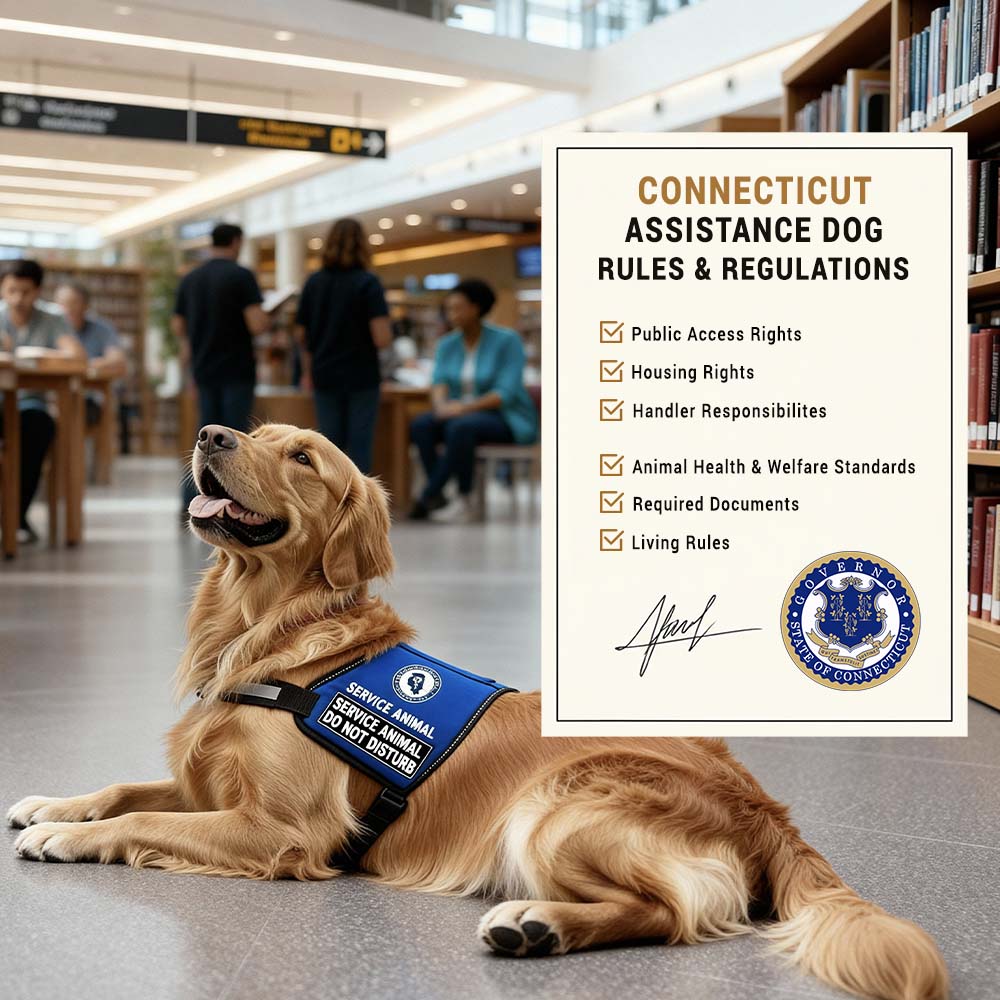
- Service dogs have full access rights to all public accommodations, including restaurants, stores, schools, public transport, and housing.
- It is illegal to deny access to a person with a service dog in Connecticut.
Certification/ID Requirements
- Connecticut does not require certification or ID cards for service dogs.
- Businesses may only ask:
- Whether the animal is required because of a disability.
- What specific task it is trained to perform.
- Misrepresentation of a service dog is considered fraud and punishable under state law.
Emotional Support Animals (ESA) & Psychiatric Service Animals (PSA)
Legal Recognition
Emotional Support Animals (ESAs) and Psychiatric Service Animals (PSAs) are only recognised in Connecticut when registered with an accredited organisation that validates their status and purpose.
Housing Rights
- Under the Fair Housing Act (FHA) and Connecticut Fair Housing laws, landlords must make reasonable accommodations for registered ESAs and PSAs.
- Documentation from a licensed professional or accredited registry must be presented if requested.
Travel Rights
- Airlines: Only psychiatric service dogs (accredited and trained) qualify for in-cabin travel under federal DOT rules.
- ESAs are treated as pets for air travel, but may still be allowed in-cabin depending on airline policies.
- Trains/Buses/Ferries: Registered ESAs/PSAs may be accepted under transport company guidelines if leashed, calm, and properly identified.
Veterinary & Animal Welfare Standards
Vaccination Schedules
- Rabies vaccination is mandatory for all dogs 3 months and older.
- Owners must carry proof of vaccination for licensing and transport purposes.
- Core vaccines (distemper, parvovirus, adenovirus, and parainfluenza) are highly recommended by Connecticut veterinarians.
Neutering/Spaying Regulations
- Spaying/neutering is not legally required, but the state promotes sterilization through the Animal Population Control Program (Conn. Gen. Stat. §22-380e), which offers reduced-cost services.
Animal Welfare Acts
Connecticut’s Anti-Cruelty Laws (Conn. Gen. Stat. §53-247) require owners to:
- Provide adequate food, water, shelter, and veterinary care.
- Avoid leaving dogs in vehicles under extreme temperatures.
- Prevent neglect, abuse, and abandonment.
Violations can result in fines, imprisonment, and seizure of the animal.