
General Ownership & Control
Leash & Muzzle Rules
In China, dog ownership and control rules are primarily enforced at the municipal level. In major cities such as Beijing, Shanghai, Guangzhou, and Shenzhen, dogs must be kept on a leash at all times when in public spaces, including streets, residential compounds, parks, and commercial districts.
Muzzles may be required in certain situations, including:
- Dogs classified as dangerous by local authorities
- Dogs involved in previous biting incidents
- Large dogs entering crowded public areas
- Specific local public-safety directives
Off-leash activity is generally prohibited in urban areas and is only allowed in private property or specifically designated dog parks, where available.
Breed-Specific Bans / Restrictions
China does not maintain a single nationwide breed-ban list. However, many cities enforce local breed and size restrictions.
Common municipal restrictions may include:
- Bans on large or “aggressive” breeds in dense urban districts
- Height or weight limits for dogs within city centers
- Mandatory registration limits (often one dog per household)
Breeds commonly restricted in some cities include:
- Rottweiler
- Doberman Pinscher
- German Shepherd
- Akita
- Pit bull–type dogs
Restrictions vary widely by city and district.
Licensing & Microchipping
Dog ownership in China requires local registration with municipal police or animal control authorities. Requirements vary by city.
Common requirements include:
- Microchipping (mandatory in many major cities)
- Annual dog license renewal
- Rabies vaccination certificate
- Proof of residence
Failure to register or vaccinate a dog can result in fines, confiscation, or mandatory removal from urban areas.
Service Dogs & Assistance Animals
Legal Definitions
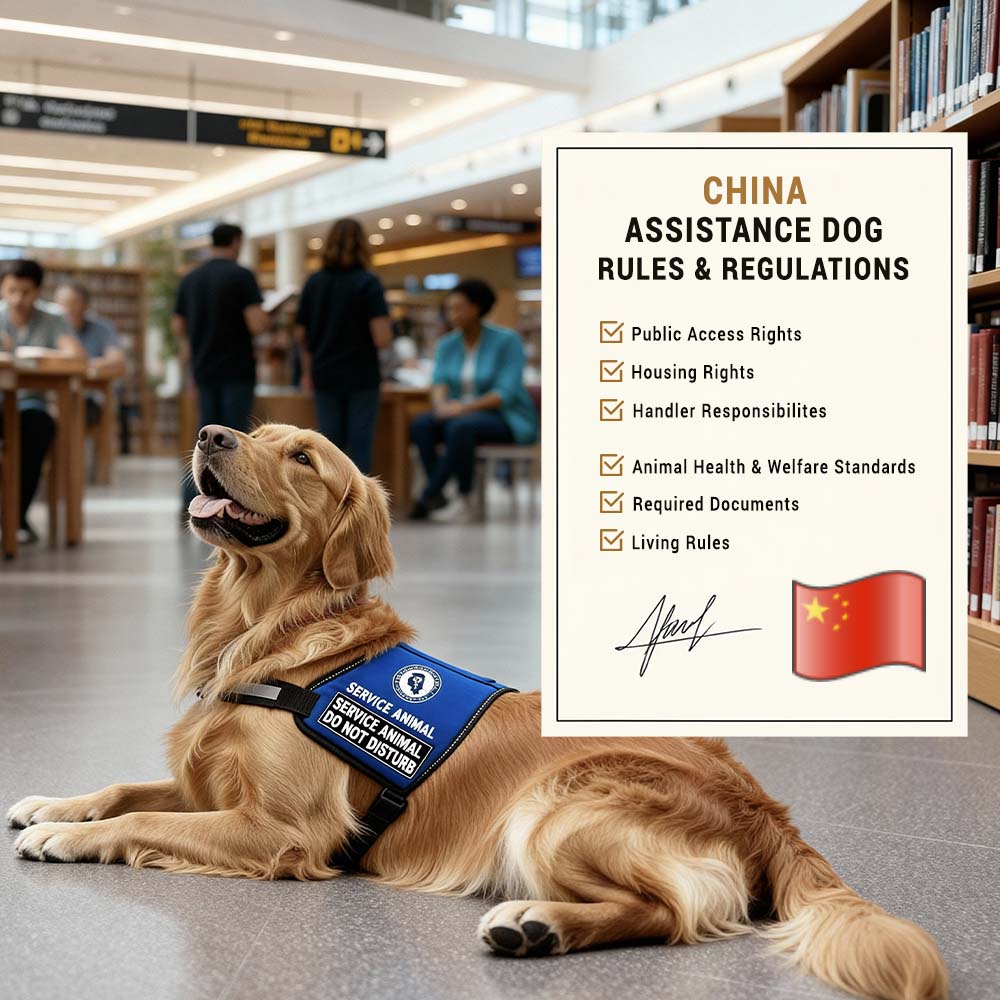
China recognizes assistance dogs for individuals with disabilities, primarily guide dogs for the visually impaired. Other assistance dogs, including mobility assistance dogs and psychiatric service dogs (PSDs), may be recognized when trained and registered through approved or accredited programs.
Public Access Rights
Service dogs may be permitted in public-access areas such as:
- Public transportation (metro, trains, buses, taxis)
- Government buildings
- Hospitals and medical facilities
- Airports and transportation hubs
- Some retail and commercial spaces
Access enforcement may vary by city, and carrying proper documentation is strongly recommended.
Certification / ID Requirements
China relies heavily on documentation for service-dog recognition. Handlers should carry:
- Service dog identification card
- Training or registration certificate from an accredited organization
- Visible recognition gear (vest or harness)
- Physical ID Card (handler + animal)
- Prescription Letter (ESA, PSA, or service dog letter)
Emotional Support Animals (ESA) & Psychiatric Service Animals (PSA)
Legal Recognition
Emotional Support Animals (ESAs) and Psychiatric Service Animals (PSAs) in China are only recognized when registered with an accredited organization. Without accreditation, ESAs are treated as companion animals and are subject to local pet regulations.
Housing Rights
Registered ESAs/PSAs may be accommodated in housing depending on city rules, property-management policies, and landlord approval. Fully trained service dogs are more consistently accommodated.
Travel Rights
- Chinese airlines may accept certified service dogs with advance approval.
- PSAs may travel as service dogs when accredited and task-trained.
- ESAs generally follow standard pet travel rules.
- Public transport acceptance varies by city and operator.
Veterinary & Animal Welfare Standards
Vaccination Schedules
Rabies vaccination is mandatory in China and must be renewed annually. Core vaccines such as distemper, parvovirus, and adenovirus are strongly recommended.
Neutering / Spaying Regulations
Neutering is not legally required nationwide but is encouraged by animal welfare organizations and some municipalities, particularly for urban dogs.
Animal Welfare Acts
China enforces animal welfare protections primarily through local regulations. Owners must provide adequate food, water, shelter, and veterinary care.
Penalties for neglect, abandonment, or unregistered ownership may include fines, confiscation, or restrictions on future pet ownership.