
General Ownership & Control
Leash & Muzzle Rules
- California does not have a single statewide leash law, but every city and county enforces its own local leash regulations.
- In general, dogs must be leashed at all times in public areas, including sidewalks, streets, and parks.
- Los Angeles, San Diego, San Francisco, and Sacramento require leashes no longer than 6 feet.
- Dogs may only be off-leash in designated dog parks or off-leash zones.
- Muzzles are not required for the general public, but may be ordered for dogs declared “dangerous” under local or state law.
Breed-Specific Bans/Restrictions
- California prohibits breed-specific bans at the state level, except for mandatory spay/neuter laws targeting specific breeds in certain municipalities.
- Example: Los Angeles requires pit bull-type dogs to be spayed or neutered.
- Local governments may enforce dangerous dog laws based on behavior, not breed.
Licensing & Microchipping
- Every dog over 4 months old must be licensed with its local animal control department.
- To obtain a license, owners must provide proof of rabies vaccination.
- Since 2020, California law requires microchipping for all dogs adopted from shelters, rescues, or sold through breeders or pet stores.
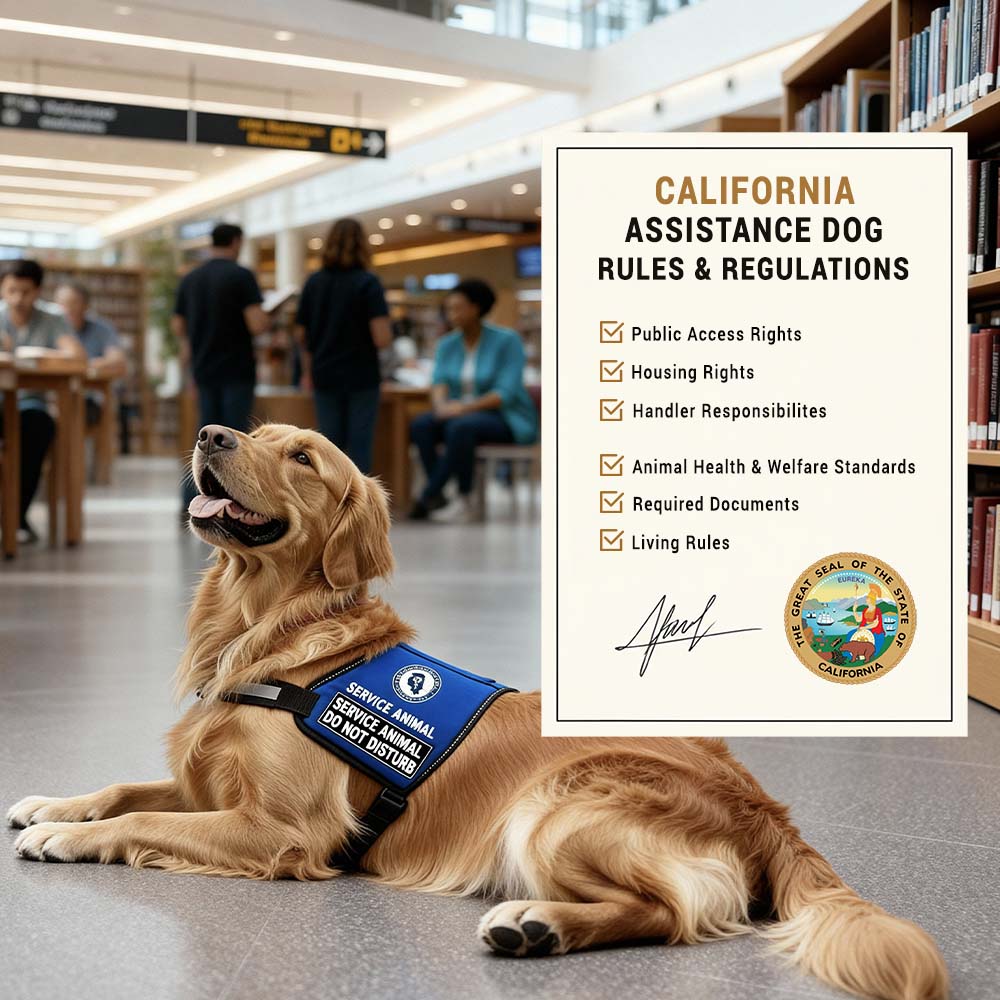
Service Dogs & Assistance Animals
Legal Definitions
Under California Civil Code §54.1 and the Americans with Disabilities Act (ADA), a service dog is defined as a dog trained to perform specific tasks for a person with a disability.
This includes:
- Guide dogs for the visually impaired.
- Hearing dogs for those with hearing disabilities.
- Mobility assistance and psychiatric service dogs trained to perform specific duties.
Public Access Rights
- Service dogs have full and equal access to all public places, including restaurants, hotels, housing, and transportation.
- Denying access to a service dog is a misdemeanor offense under California law.
- Housing providers must accommodate service dogs under the Fair Employment and Housing Act (FEHA).
Certification/ID Requirements
- California does not require certification or ID cards for service dogs.
- However, the state offers voluntary identification tags issued by the California Department of Food and Agriculture (CDFA) for registered service dogs.
- Misrepresenting a pet as a service dog is a misdemeanor, punishable by fines up to $1,000 and/or community service.
Emotional Support Animals (ESA) & Psychiatric Service Animals (PSA)
Legal Recognition
Emotional Support Animals (ESAs) and Psychiatric Service Animals (PSAs) are only recognised in California when registered with an accredited organisation that validates their necessity and registration.
Housing Rights
- Under California’s Fair Employment and Housing Act (FEHA) and federal Fair Housing Act (FHA), landlords must provide reasonable accommodations for registered ESAs and PSAs.
- Proper documentation or registration must be provided to verify the animal’s role.
Travel Rights
- Airlines: Only psychiatric service dogs (registered and trained) qualify for in-cabin travel under federal DOT rules.
- ESAs are considered pets by airlines but may still fly in-cabin depending on airline policy.
- Trains/Buses/Ferries: Most California transit systems (like BART, MTS, Metro) permit registered ESAs/PSAs if leashed, under control, and non-disruptive.
Veterinary & Animal Welfare Standards
Vaccination Schedules
- Rabies vaccination is mandatory for all dogs over 4 months old, per California Health and Safety Code §121690.
- Core vaccines (distemper, parvovirus, adenovirus, parainfluenza, leptospirosis) are recommended by veterinarians statewide.
Neutering/Spaying Regulations
- Many California cities (including Los Angeles and San Francisco) require dogs to be spayed or neutered unless the owner has a breeder or competition exemption.
Animal Welfare Acts
California has some of the strictest animal protection laws in the U.S.:
- California Penal Code §597 prohibits cruelty, neglect, and abandonment.
- Hot Car Law (California Penal Code §597.7) makes it illegal to leave a pet in a vehicle without proper ventilation.
- Animal control officers may legally remove a pet in distress from a vehicle or unsafe environment.