
General Ownership & Control
Leash & Muzzle Rules
Belgium regulates dogs at both the federal and municipal levels. Most cities require dogs to be kept on a leash in public areas, including streets, parks, markets, and transportation hubs. Off-leash is only permitted in designated dog parks or specific zones indicated by local signage.
Muzzles are not generally required for ordinary dogs. However, dogs with a history of aggression or those legally classified as dangerous may be required to wear a muzzle in public. Municipalities may impose stricter rules depending on local safety policies.
Breed-Specific Bans / Restrictions
Belgium has no national breed bans. All dog breeds, including pit bull types, rottweilers, and mastiffs, are legal to own. However, certain municipalities may label specific dogs as “potentially dangerous” based on behavior rather than breed, leading to possible muzzle or training requirements.
Licensing & Microchipping
Microchipping is mandatory nationwide for all dogs in Belgium and must be performed by an authorized veterinarian. All microchip information must be registered in the Belgian Dog Identification Database. Vaccination records should always accompany the dog when traveling within or outside the country.
Some municipalities apply local dog taxes (hondenbelasting / taxe sur les chiens), and owners may be required to register dogs with local authorities.
Service Dogs & Assistance Animals
Legal Definitions
Belgium recognizes service dogs under EU disability and accessibility standards. These include guide dogs, hearing dogs, mobility assistance dogs, seizure alert dogs, and psychiatric service dogs trained to perform specific tasks.
Public Access Rights
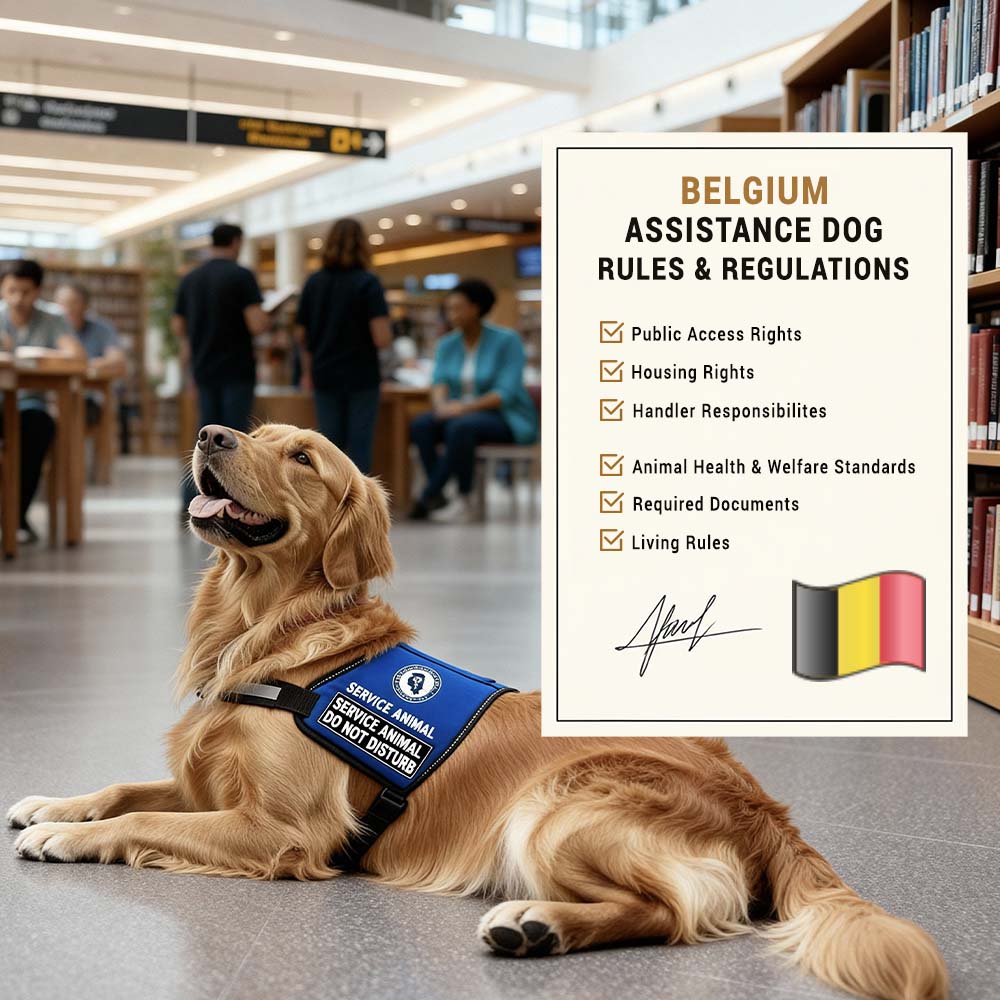
Service dogs have legal access to all public spaces, including public transportation, shops, restaurants, government buildings, hotels, and workplaces. Businesses may ask for evidence that a dog is a trained service animal but may not deny access without valid reason.
Certification / ID Requirements
Service dogs typically carry official documentation from accredited Belgian or EU-recognized training schools. For smooth access, handlers should use:
- Physical ID Card (animal + handler)
- Registration Certificate
- Visible Recognition Gear (vest, bandana, or harness)
- Prescription Letter (ESA, PSA, or Service Animal letter from a licensed professional)
Emotional Support Animals (ESA) & Psychiatric Service Animals (PSA)
Legal Recognition
Belgium does not automatically grant public-access rights to ESAs. Emotional Support Animals and PSAs are recognized when registered with an accredited organization, which allows housing providers and some transportation services to validate documentation more easily.
Housing Rights
Registered ESAs/PSAs may receive accommodations depending on the landlord’s policies and supporting documentation. Service dogs receive full legal protection for housing access under disability laws.
Travel Rights
- European airlines generally accept service dogs with valid documentation.
- PSAs may travel as service animals when task-trained and properly registered.
- ESAs travel under airline pet policies unless otherwise accepted.
- Public transport systems in Belgium (SNCB/NMBS, De Lijn, TEC, STIB/MIVB) allow service dogs; ESAs/PSAs are accepted based on the operator’s specific policies.
Veterinary & Animal Welfare Standards
Vaccination Schedules
Belgium requires all dogs to maintain an up-to-date rabies vaccination if they will travel outside the country or into designated risk zones. Core vaccines include distemper, parvovirus, adenovirus, and leptospirosis. Vet records should be kept available at all times.
Neutering / Spaying Regulations
While neutering is not legally mandatory for all dogs, it is strongly encouraged by veterinarians to reduce animal overpopulation and aggression-related issues.
Animal Welfare Acts
Belgium enforces strong animal protection laws. Owners must provide adequate food, shelter, water, and veterinary care, and protect pets from cruelty or neglect. The Federal Public Service for Animal Welfare oversees enforcement and penalties.