
General Ownership & Control
Leash & Muzzle Rules
Austria has strict regional (state-level) dog-control laws. In most federal states, dogs must be kept on a leash or muzzled in public spaces, depending on the municipality. High-traffic areas, public transport, markets, and busy streets typically require either a leash, a muzzle, or both. Regulations vary between Vienna, Salzburg, Tirol, Styria, and other regions, so owners must follow local ordinances.
Muzzles are mandatory for many dogs when using public transportation throughout most of Austria. Dogs previously involved in aggression may also be required to wear a muzzle at all times in public.
Breed-Specific Bans / Restrictions
Austria has no nationwide breed bans, but individual municipalities may impose restrictions or mandatory muzzle/leashing requirements on certain breeds categorized as “potentially dangerous.”
Vienna and some other regions enforce stricter rules for breeds such as:
- American Staffordshire Terrier
- Bull Terrier
- Rottweiler
- Pit Bull types
- Mastiff breeds
These breeds often require additional training certificates or behavioral evaluations.
Licensing & Microchipping
Microchipping is mandatory nationwide in Austria for all dogs. Owners must also register pets in the national database. A dog tax (Hundeabgabe) may apply depending on the municipality.
Owners must also carry proof of microchip registration and vaccination when requested by authorities.
Service Dogs & Assistance Animals
Legal Definitions
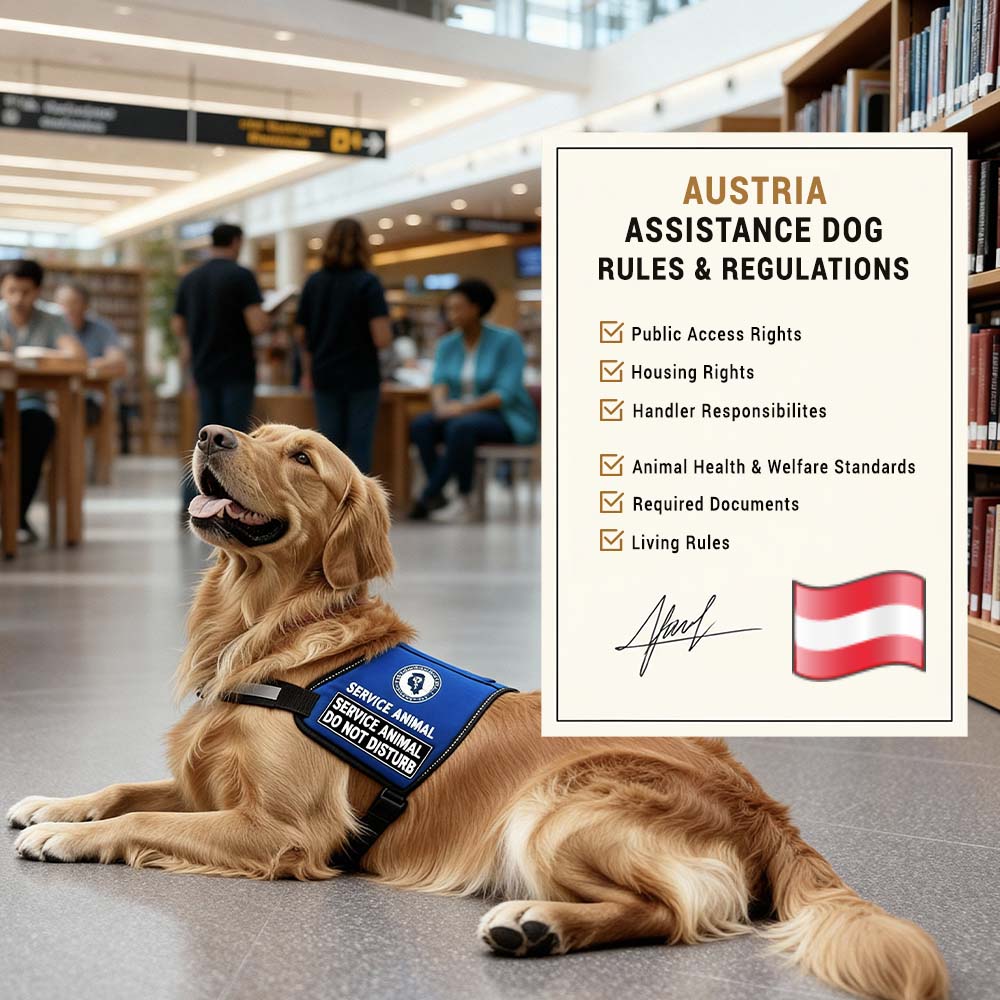
Austria recognizes service dogs according to EU standards—dogs individually trained to perform specific tasks for a person with a disability. This includes guide dogs, mobility assistance dogs, seizure-alert dogs, and psychiatric service dogs.
Public Access Rights
Service dogs have broad access rights and may accompany handlers in public spaces, including restaurants, hotels, government buildings, shops, workplaces, hospitals, and public transport. Businesses may request proof that the dog is a trained service dog.
Certification / ID Requirements
Service dogs in Austria typically carry an official service-dog ID issued by accredited organizations or training centers. For ease of acceptance, handlers should also use:
- Physical ID Card (animal + handler)
- Registration Certificate
- Visible Recognition Gear (vest, bandana, or harness)
- Prescription Letter (ESA, PSA, or Service Animal letter from a licensed professional)
Emotional Support Animals (ESA) & Psychiatric Service Animals (PSA)
Legal Recognition
Austria does not automatically recognize ESAs under public-access law. However, ESAs and PSAs are recognized when registered with an accredited organization, especially for housing and travel considerations.
Housing Rights
Registered ESAs/PSAs may be accepted in no-pet housing at the discretion of housing providers, depending on documentation. Service dogs receive the highest level of legal protection.
Travel Rights
- Service dogs are generally accepted on European airlines.
- PSAs may travel as service dogs when task-trained and properly documented.
- ESAs are treated under pet travel rules unless the airline explicitly recognizes them.
- Public transport and trains in Austria must accept service dogs; ESAs/PSAs follow operator rules.
Veterinary & Animal Welfare Standards
Vaccination Schedules
Dogs must maintain up-to-date vaccinations, including mandatory rabies vaccination for travel. Veterinarians recommend core vaccines for distemper, parvovirus, adenovirus, and leptospirosis.
Neutering / Spaying Regulations
Neutering is not legally required but widely encouraged to prevent overpopulation and reduce behavioral issues.
Animal Welfare Acts
Austria has one of the strongest animal-welfare systems in Europe under the Austrian Animal Welfare Act. Owners must provide proper food, water, shelter, and veterinary care; cruelty, neglect, and abandonment are strictly punished.