
General Ownership & Control
Leash & Muzzle Rules
- Arkansas does not have a statewide leash law, but most cities and counties require dogs to be restrained when off the owner’s property.
- Little Rock, Fayetteville, and Fort Smith have municipal leash laws mandating that dogs remain on a leash in all public areas.
- Dogs classified as dangerous or vicious by local authorities must be kept in secure enclosures and may be required to wear muzzles in public.
- Owners must prevent dogs from “running at large,” a violation that can result in impoundment and fines.
Breed-Specific Bans/Restrictions
- Arkansas has no statewide breed bans, but several municipalities have enacted local restrictions or bans, particularly on pit bull-type breeds.
- Examples include cities such as Beebe, North Little Rock, and Cabot, which restrict or prohibit ownership of pit bulls.
- Breed restrictions may include mandatory muzzling, liability insurance, or special permits for ownership.
Licensing & Microchipping
- Licensing rules vary by city or county. Most require:
- Dogs over 4 months old to be licensed.
- Proof of current rabies vaccination to obtain or renew a license.
- Microchipping is not legally required but is strongly recommended for identification.
Service Dogs & Assistance Animals
Legal Definitions
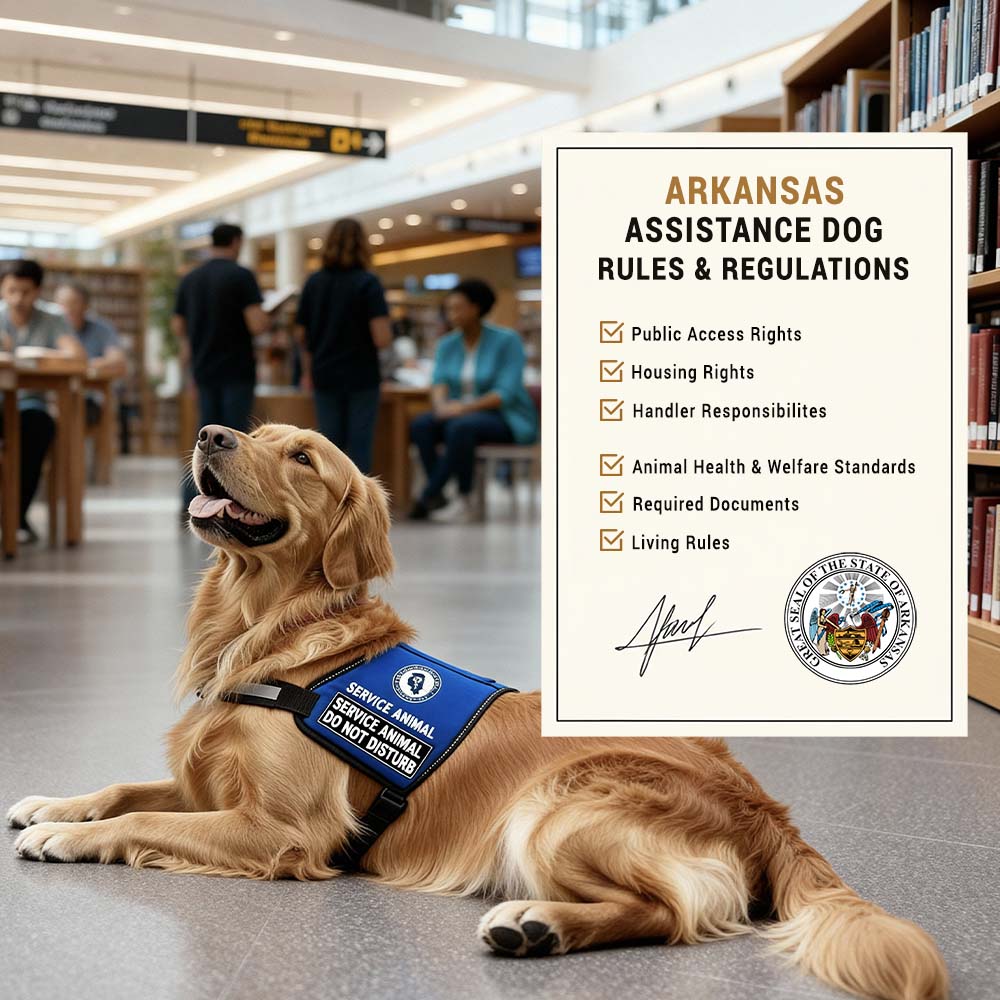
Under Arkansas law (Arkansas Code §20-14-304) and the Americans with Disabilities Act (ADA), a service dog is defined as a dog trained to perform tasks directly related to a person’s disability.
This includes:
- Guide dogs for the visually impaired.
- Hearing dogs for those with hearing disabilities.
- Mobility and psychiatric service dogs trained for specific tasks.
Public Access Rights
- Service dogs have full and unrestricted public access to all areas open to the public — including restaurants, hotels, transportation, and housing.
- Businesses and landlords cannot deny access to a person accompanied by a trained service dog.
Certification/ID Requirements
- Arkansas does not require service dog registration or certification.
- Handlers are not required to carry documentation, but misrepresenting a pet as a service animal is a misdemeanor offense under state law.
Emotional Support Animals (ESA) & Psychiatric Service Animals (PSA)
Legal Recognition
Emotional Support Animals (ESAs) and Psychiatric Service Animals (PSAs) are only recognised in Arkansas when registered through an accredited organisation verifying their need and function.
Housing Rights
- Under the Fair Housing Act (FHA), landlords must make reasonable accommodations for registered ESAs and PSAs, even in “no-pet” housing.
- Proper registration or documentation is required to validate the animal’s role.
Travel Rights
- Airlines: Only psychiatric service dogs (registered through an accredited organisation) are recognised for in-cabin access under DOT rules.
- ESAs are treated as pets but may still travel in-cabin under airline pet policies.
- Buses and trains: Registered ESAs/PSAs may be accepted if properly controlled and meet transport guidelines.
Veterinary & Animal Welfare Standards
Vaccination Schedules
- Rabies vaccination is required for all dogs over 4 months old and must be administered by a licensed veterinarian.
- Other vaccines (distemper, parvovirus, adenovirus, parainfluenza) are recommended by state veterinarians.
Neutering/Spaying Regulations
- Spaying/neutering is not mandated statewide, though some local shelters or rescue programs may require it before adoption.
Animal Welfare Acts
Under Arkansas Code §5-62-101, animal cruelty includes neglect, abandonment, and failure to provide adequate food, water, or shelter.
- Owners must ensure humane treatment of all animals.
- Violations can result in fines, seizure, or criminal prosecution.