
General Ownership & Control
Leash & Muzzle Rules
- Arizona does not have a statewide leash law, but most cities and counties enforce local leash ordinances.
- Phoenix, Tucson, and Scottsdale require dogs to be leashed in all public spaces, including sidewalks, parks, and hiking trails.
- Dogs must be under the owner’s control at all times.
- There are no general muzzle laws in Arizona, except for dogs legally classified as “dangerous” or “aggressive.”
Breed-Specific Bans/Restrictions
- Arizona prohibits breed-specific legislation statewide.
- This means no city or county can ban or restrict ownership of specific breeds (e.g., pit bulls).
- Instead, Arizona law focuses on individual dog behavior, holding owners responsible for bites or attacks under the Arizona Dog Bite Statute (A.R.S. §11-1025).
Licensing & Microchipping
- All dogs over 3 months old must be licensed in their county of residence.
- Proof of current rabies vaccination is required to obtain a license.
- Microchipping is recommended but not mandatory by state law.
Service Dogs & Assistance Animals
Legal Definitions
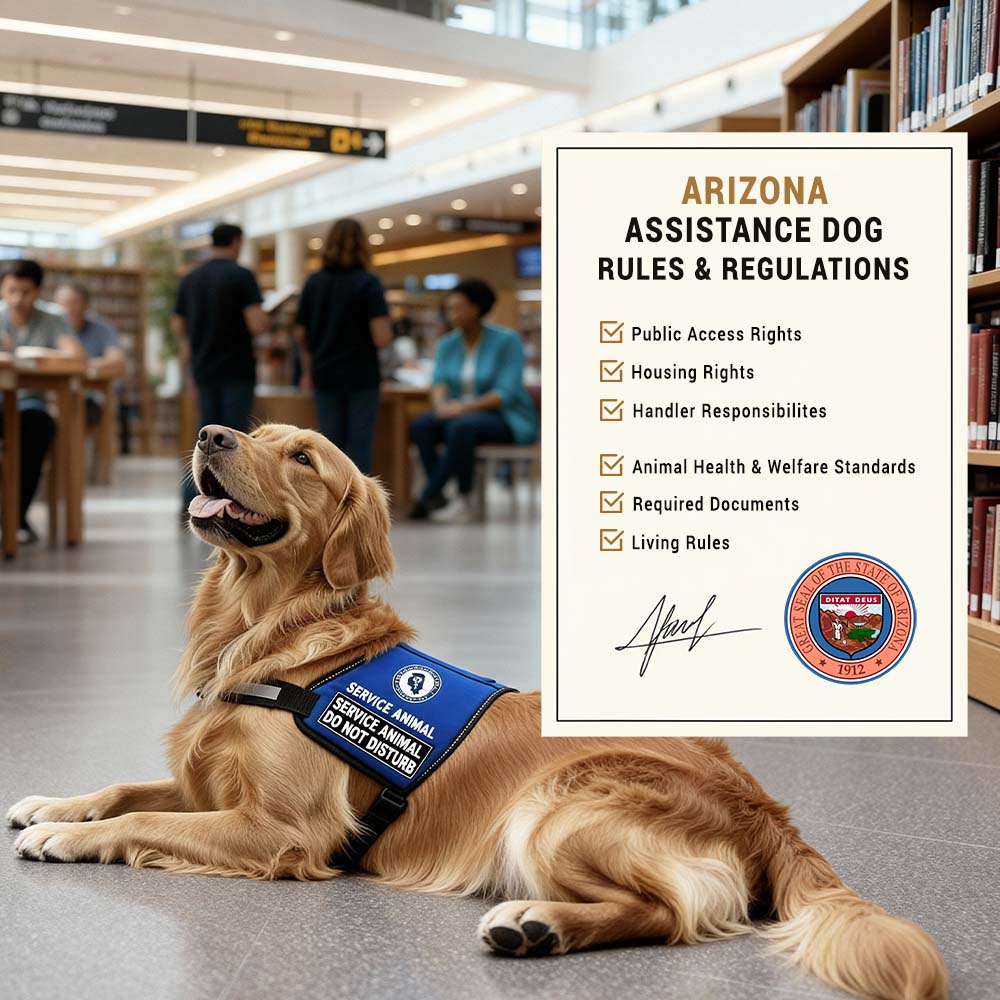
Under the Arizona Revised Statutes (A.R.S. §11-1024) and the Americans with Disabilities Act (ADA), a service animal is defined as a dog individually trained to perform tasks for a person with a disability.
Examples include:
- Guide dogs for the visually impaired.
- Hearing dogs for those who are deaf or hard of hearing.
- Mobility or psychiatric service dogs trained for specific assistance tasks.
Public Access Rights
- Service dogs are permitted in all public places, including restaurants, stores, hotels, workplaces, and public transport.
- Service animals are also protected under the Fair Housing Act (FHA) for housing accommodations.
Certification/ID Requirements
- Arizona does not require registration or ID cards for service dogs.
- Handlers may only be asked two ADA-approved questions:
- Is the dog required because of a disability?
- What task or service has the dog been trained to perform?
- It is a criminal offense in Arizona to misrepresent a pet as a service animal (A.R.S. §11-1024).
Emotional Support Animals (ESA) & Psychiatric Service Animals (PSA)
Legal Recognition
Emotional Support Animals (ESAs) and Psychiatric Service Animals (PSAs) are only recognised in Arizona when registered through an accredited organisation that verifies their purpose and documentation.
Housing Rights
- Registered ESAs and PSAs are covered under the Fair Housing Act (FHA).
- Landlords must make reasonable accommodations for properly documented ESAs/PSAs, even in “no-pet” housing.
Travel Rights
- Airlines: Only psychiatric service dogs (properly trained and registered) qualify for in-cabin travel under DOT rules.
- ESAs are treated as pets for travel but may still fly in-cabin under the airline’s pet policy.
- Trains and buses: Most public transportation allows accredited ESAs/PSAs if they are leashed, well-behaved, and registered.
Veterinary & Animal Welfare Standards
Vaccination Schedules
- Rabies vaccination is required statewide for all dogs over 3 months old.
- Core vaccines (parvovirus, adenovirus, distemper, and parainfluenza) are recommended by veterinarians.
Neutering/Spaying Regulations
- Not mandated by law but encouraged through Arizona’s Animal Welfare and Sterilization Fund programs, which offer low-cost services.
Animal Welfare Acts
Under A.R.S. §13-2910 (Cruelty to Animals), pet owners must:
- Provide adequate food, water, and shelter.
- Prevent cruelty, neglect, or abandonment.
- Avoid confinement in extreme heat without proper ventilation (Arizona’s hot car law).