
General Ownership & Control
Leash & Muzzle Rules
- Alabama’s leash laws are regulated at the county and municipal level. In most cities, including Birmingham and Montgomery, dogs must be leashed when off the owner’s property.
- Owners must also prevent dogs from running at large; loose dogs can be impounded or declared a public nuisance.
- Muzzle laws are not statewide, but individual municipalities may require muzzles for dogs deemed “dangerous” or “vicious” under local ordinances.
Breed-Specific Bans/Restrictions
- Alabama does not have statewide breed-specific bans, but several municipalities impose restrictions or regulations on certain breeds considered aggressive (mainly pit bull-type breeds).
- Examples include:
- Lanett and Center Point – prohibit ownership of pit bull-type dogs.
- Opp and Pleasant Grove – require special permits or containment for restricted breeds.
Licensing & Microchipping
- Dog owners must obtain a dog license from their county or city animal control authority.
- Proof of a current rabies vaccination is required for licensing.
- Microchipping is not mandatory statewide but is strongly encouraged for identification and return in case of loss.
Service Dogs & Assistance Animals
Legal Definitions
Under the Americans with Disabilities Act (ADA), Alabama recognizes service dogs as animals individually trained to perform specific tasks for a person with a disability.
This includes:
- Guide dogs for visually impaired individuals.
- Hearing dogs, mobility assistance dogs, and psychiatric service dogs.
Public Access Rights
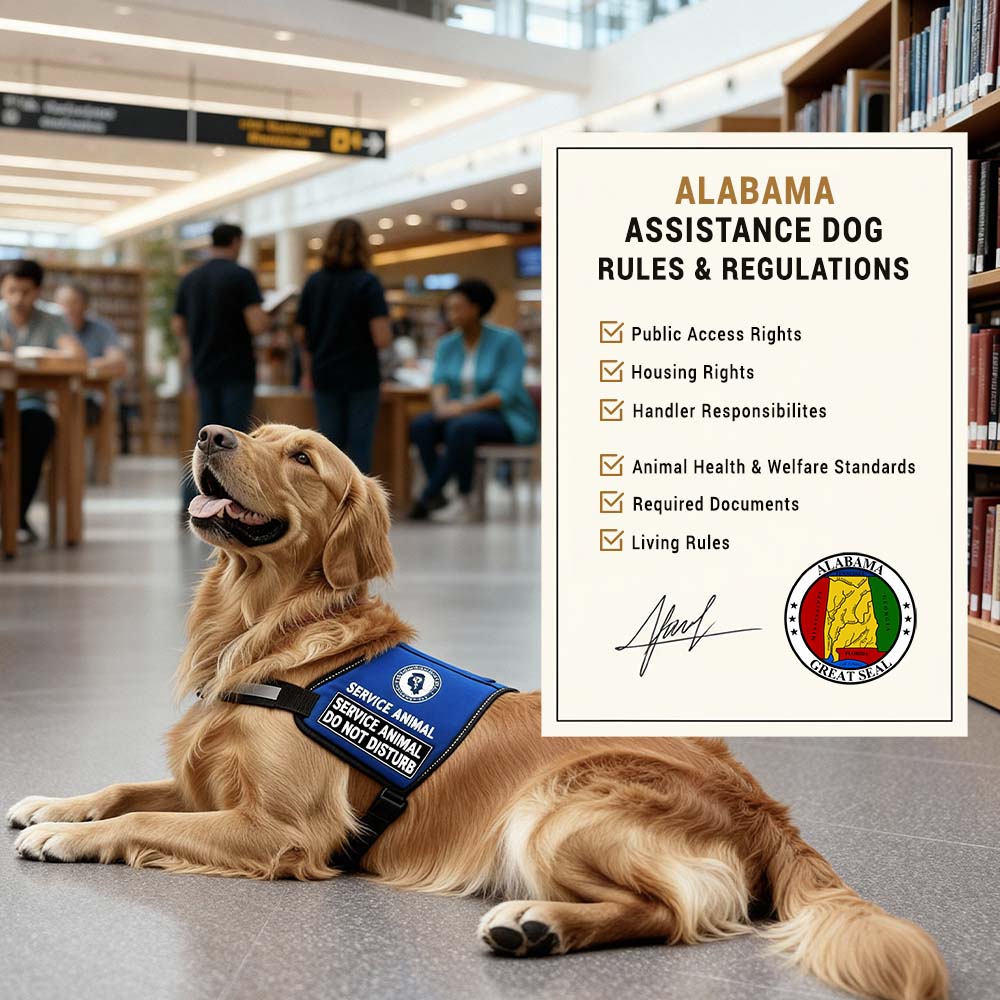
Service dogs in Alabama have full public access rights in restaurants, stores, hotels, housing, and transportation. Businesses cannot deny entry or charge additional fees for service dogs.
Certification/ID Requirements
- Alabama does not require state registration or identification for service dogs.
- Handlers are not legally required to carry paperwork but may voluntarily register with a recognised or accredited service dog organisation for ease of travel and verification.
Emotional Support Animals (ESA) & Psychiatric Service Animals (PSA)
Legal Recognition
Emotional Support Animals (ESAs) and Psychiatric Service Animals (PSAs) are only recognised in Alabama when registered through an accredited organisation that verifies their legitimacy and role.
Housing Rights
Under the Fair Housing Act (FHA), properly registered ESAs and PSAs may be permitted in housing, even in “no-pet” properties, as a reasonable accommodation. Landlords can request supporting documentation.
Travel Rights
- Airlines: ESAs/PSAs may travel according to airline policies. Only properly registered assistance animals are eligible for cabin travel.
- Public Transport: Buses and trains must allow ESAs/PSAs that meet assistance classification requirements.
- Ferries and local transport: Allowed under standard pet or service animal rules depending on accreditation.
Veterinary & Animal Welfare Standards
Vaccination Schedules
- Rabies vaccination is required for all dogs in Alabama by four months of age, with boosters as required by the vaccine used.
- Additional core vaccines (distemper, parvovirus, adenovirus, parainfluenza) are recommended.
Neutering/Spaying Regulations
- Neutering/spaying is not mandatory but widely promoted by shelters and veterinarians.
- Animal adoption programs may require sterilization as part of adoption agreements.
Animal Welfare Acts
Under Alabama Code Title 3 (Animals), owners must:
- Provide adequate food, water, shelter, and care.
- Not confine or abandon animals in unsafe or inhumane conditions.
- Avoid cruelty or neglect; violations can lead to criminal penalties.