
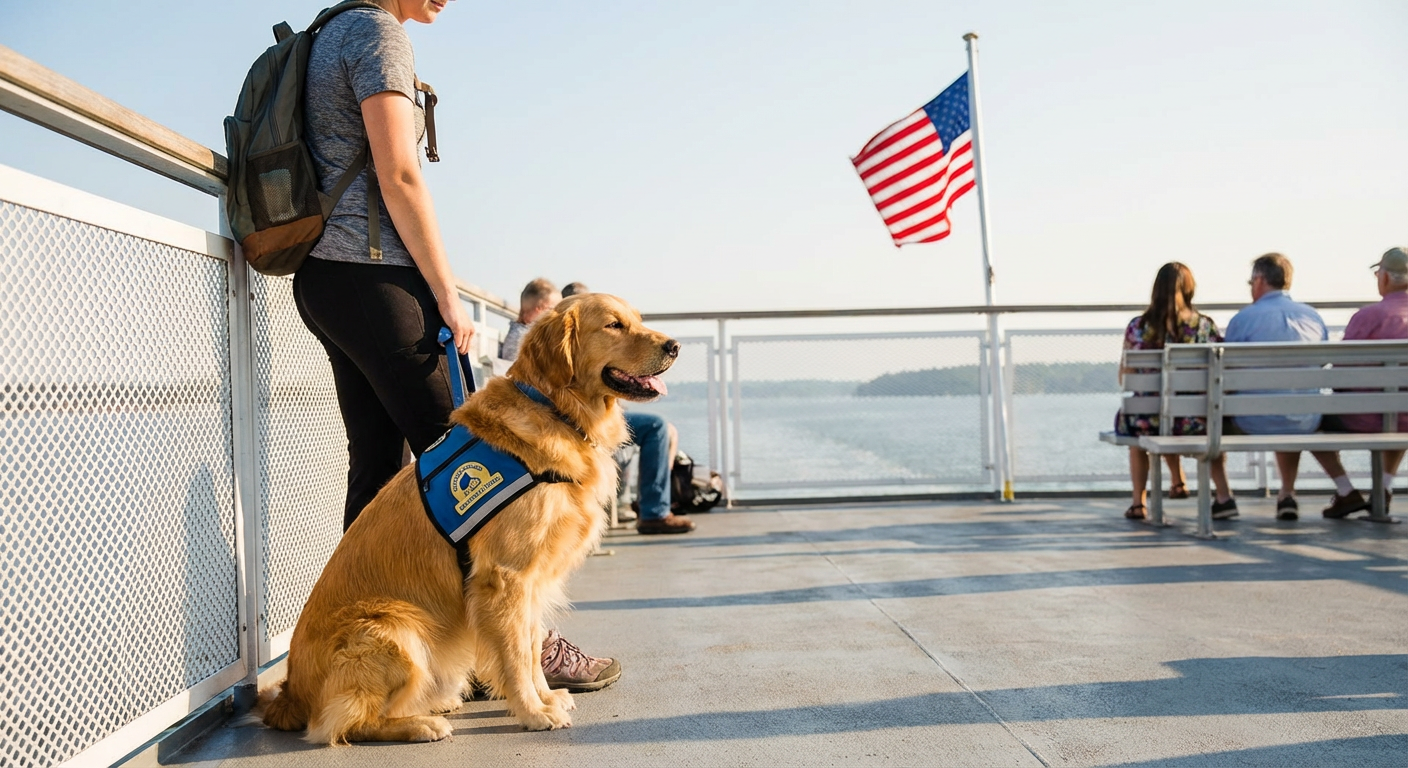
Assistance Dogs on Trains & Ferries (Domestic Travel): Rules, Acceptance, and ESA Workaround
Carrier Requirements & Policies
Acceptance
PSA (Psychiatric Support Animals): Accepted (Dogs and Cats ONLY)
Service Animals: Accepted (Dogs and Cats ONLY)
Quick Checklist (Bring Before Boarding)
Required Documentation & Gear (must bring)
- Physical ID Card for your animal (required).
- Registration Certificate (Service Dog, PSA, or ESA registration).
- Visible Recognition Gear (Service Animal vest, bandana, or harness).
- Your animal must remain leashed or harnessed at all times.
Preferred Documentation (greatly speeds up entry & verification)
- PSA Training Registration Certificate (highly recommended for ESAs).
- Behavior Training Certificate if available.
- Photo ID matching the animal’s registration profile.
🚆 Train Operators (U.S. Domestic Travel)
Amtrak (National Rail – ADA Rules Apply)
- Service Dogs: Accepted.
- Psychiatric Service Dogs (PSDs): Accepted.
- Emotional Support Animals (ESAs): Not accepted under Amtrak policy.
- No documentation is usually required (unless the animal is out of control or creating a disturbance), but having an ESA, PSA or Service Animal Prescription Letter, a registration certificate and ID matching the registration certificate greatly facilitates the acceptance.
- The dog must be leashed or harnessed at all times.
- The dog must remain under control and at the handler’s feet, without blocking aisles.
- Staff may only ask ADA’s two questions:
- “Is this a service animal required because of a disability?” — Answer: “YES.”
- “What task or work is the animal trained to perform?”
Answer: “The animal is trained (or in training) to help me with my disability.”
Sample answer: “The animal helps me with my panic attacks.”
Local & Regional Rail Systems
(NYC Subway, CTA Chicago, MBTA Boston, BART Bay Area, Caltrain, Metra, SunRail, etc.)
- Service Dogs: Accepted.
- PSDs: Accepted.
- ESAs: Usually not accepted, but enforcement varies by system.
- Leash or harness required at all times.
- The animal must remain under control and not interfere with other passengers.
- No documentation required under ADA but having an ESA, PSA or Service Animal Prescription Letter, a registration certificate and ID matching the registration certificate greatly facilitates the acceptance.
- These systems follow the ADA but often apply state-level rules that recognize service animals and PSA in training.
⛴️ Ferries (U.S. Domestic Routes)
All U.S. ferry operators — public or private — fall under ADA Title III. This includes:
- Washington State Ferries
- Staten Island Ferry
- Alcatraz Cruises
- Cape May–Lewes Ferry
- Alaska Marine Highway
- All local harbor ferries and commuter ferries
Acceptance:
- Service Dogs: Accepted everywhere.
- PSDs: Accepted.
- ESAs: Generally not accepted.
- No documentation required under ADA but having an ESA, PSA or Service Animal Prescription Letter, a registration certificate and ID matching the registration certificate greatly facilitates the acceptance.
- No pet fees allowed for Service Animals.
- Dogs must be leashed or harnessed and under control.
- Animals are allowed in indoor and outdoor passenger areas, unless safety rules require otherwise.
ESA Acceptance – The Real-World Practice
Legally, Emotional Support Animals (ESAs) are not recognized under the ADA. Train and ferry operators may refuse ESAs.
However, in real-world practice, many operators are more flexible when the animal:
- Is clearly trained and calm, and
- Is presented with clear identification and training documentation.
Effective Workaround: PSA-in-Training Classification
Many U.S. transportation operators — especially ferries and commuter rail systems — voluntarily accept animals that are presented as “Service Animals in Training” if the animal appears trained and the handler has supporting materials.
This works because:
- Many U.S. states authorize service animals in training to access public transportation.
- Rail and ferry staff often follow these state policies even when not strictly required.
- Staff prioritize safety, control, and clear identification.
✔️ A well-behaved ESA can often be accepted as a PSA in Training when the handler carries:
- A Training Registration Certificate (classifies the dog as a PSA-in-training).
- A printed ID card.
- Visible recognition gear (vest, bandana, or harness).
This does not legally convert an ESA into a Service Dog, but it gives operators an ADA-acceptable reason to treat the animal as a Service Animal in Training.
This method is commonly accepted on:
- Ferries (very lenient).
- Commuter rail systems.
- Regional rail routes.
Less reliable on:
- Amtrak (strict enforcement), but still occasionally allowed with strong documentation and gear.
Summary
- Service Dogs and PSDs are fully protected under U.S. ADA law and must be accepted on all U.S. trains and ferries with no fees and no documentation requirements.
- ESAs may be refused under ADA.
- Many operators accept an ESA presented as a Psychiatric Service Animal in Training when the handler brings:
- A printed ID card.
- A Training Registration Certificate.
- Visible service-animal recognition gear.
- This method greatly increases acceptance and reduces challenges.
Important Notes
- Our Service Animal registration is approved by all airlines, which strengthens documentation when dealing with trains and ferries.
- Physical ID cards and recognition gear speed up verification and reduce questions.
- Dogs must always remain leashed, harnessed, and under full control.