
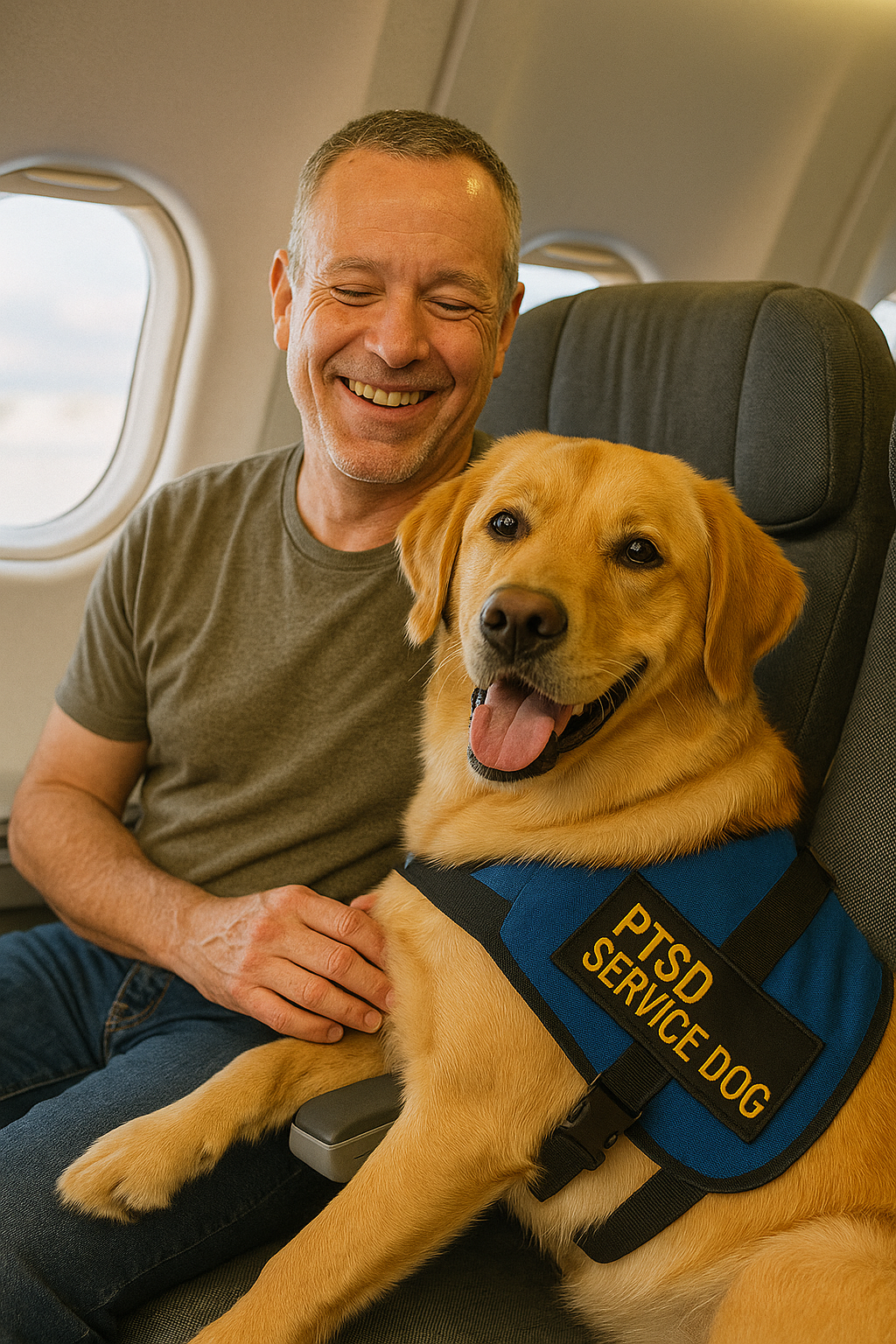
Flying with a service dog can feel overwhelming, especially when you’re managing post-traumatic stress disorder (PTSD) and want to make sure everything goes smoothly. Many handlers ask how to certify a PTSD service dog for airline travel, and the process is a little different depending on whether you’re flying in the U.S., Canada, or Europe. What matters most is being prepared with the right paperwork, training, and proof that your dog is truly task-trained.
In the United States, airlines follow the Department of Transportation (DOT) rules. To fly with your PTSD service dog, you’ll need to complete the DOT Service Animal Air Transportation Form. This form certifies that your dog is trained to perform tasks related to your disability, is well-behaved in public, and is up to date on vaccinations. Airlines cannot ask for an official service dog certificate, but they can require this form before boarding. Some may also ask for an additional relief attestation form if the flight is longer than eight hours.
For Canada, the process can vary depending on the airline. Most major carriers require a letter from a licensed healthcare professional confirming your disability and your need for a service dog. Some also ask for proof that the dog has completed training through a recognized program or meets provincial certification standards, like those used in Alberta or British Columbia. Because requirements differ, it’s always smart to check directly with your airline before you book.
In the UK and EU, the rules focus heavily on whether your PTSD service dog has been trained under a recognized program. Airlines often look for accreditation from organizations linked to Assistance Dogs International (ADI) or the International Guide Dog Federation (IGDF). For international flights, you’ll also need an Animal Health Certificate or EU Pet Passport showing your dog’s vaccinations and microchip details. Without proof of recognized training, many airlines may classify your dog as a pet instead of a service dog.
No matter where you’re flying, your dog should be fully trained for public access. Airlines expect service dogs to stay calm in busy terminals, settle quietly under a seat, and ignore food, people, and other animals. For PTSD service dogs, this also means being reliable with tasks like grounding during panic episodes, waking from nightmares on overnight flights, or creating space in crowded boarding areas. Practicing these skills in advance can make travel day far less stressful.
A good way to prepare is to make a “travel pack” for your PTSD service dog:
- Completed airline forms (DOT form, medical letters, or training proof depending on region)
- Vaccination records and microchip details
- A well-fitted service dog harness or vest to clearly identify your dog
- Travel essentials like a collapsible water bowl, mat, and calming items
While the process may feel like a lot of paperwork, the goal is simple: airlines want to confirm that your PTSD service dog is safe, trained, and ready to work in a high-stress environment. With the right preparation, you and your dog can board with confidence and focus on your journey instead of the logistics.