
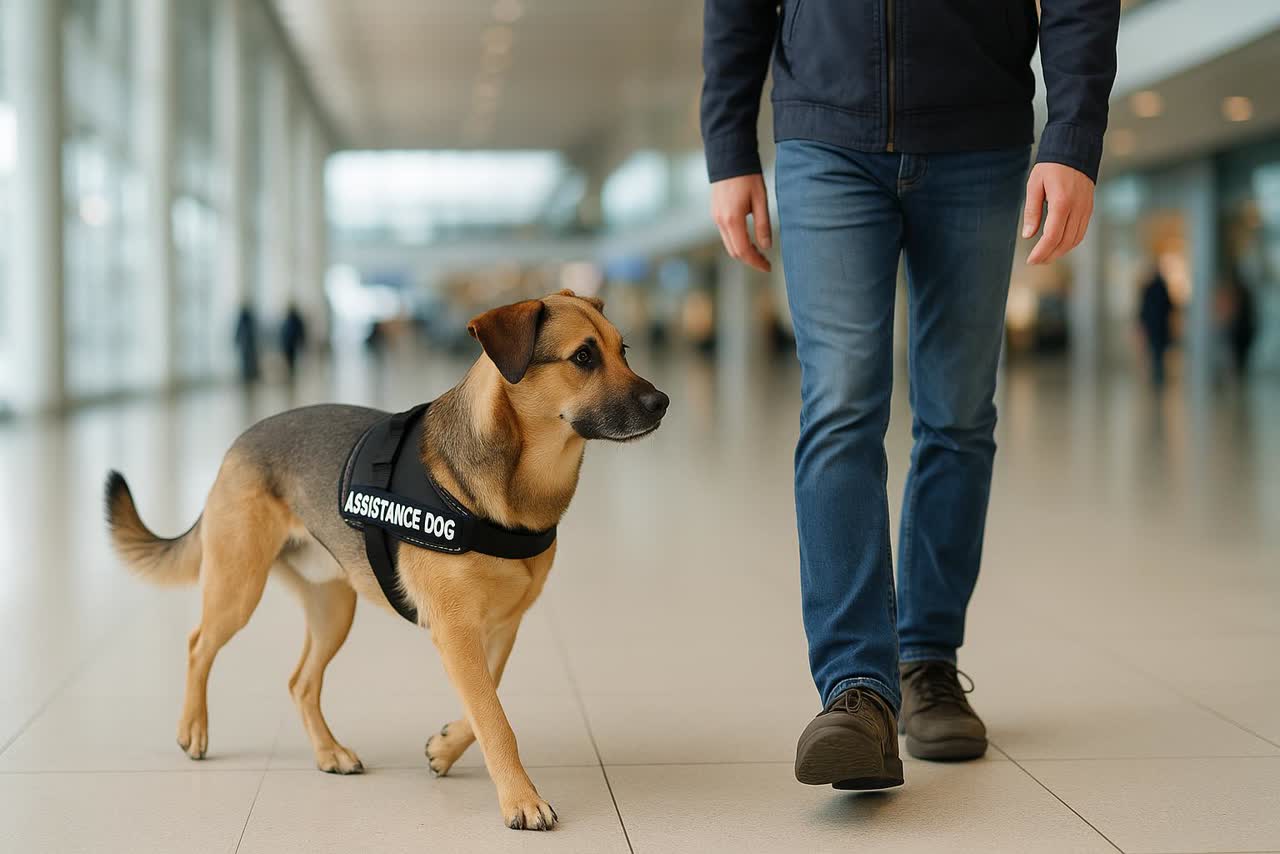
“Assistance dog standards” usually refers to the real-world benchmarks that separate a well-prepared assistance (service) dog from a pet: stable public behavior, task reliability, health and safety basics, and handler control in distracting environments.
Quick Overview
- Behavior standard: Calm, non-reactive, house-trained, and safe in public.
- Task standard: Trained tasks are reliable, relevant to the handler’s disability, and performed on cue (or when needed).
- Public-access standard: The team can navigate crowds, restaurants, stores, and transit without disruption.
- Documentation standard (recommended):Credible training records and clear recognition gear can reduce confusion and delays.
1) What “Assistance Dog Standards” Actually Means
There isn’t one single worldwide rulebook. “Standards” typically means a combination of:
- Training and behavior benchmarks (temperament, neutrality, obedience, impulse control)
- Task performance benchmarks (accuracy, consistency, duration, and real-life generalization)
- Public-access expectations (safety, cleanliness, and non-disruption)
- Handler/team handling skills (leash skills, reinforcement plan, and problem prevention)
In practice, strong standards protect everyone: the handler, the dog, staff at businesses, and the public.
2) Core Behavior Standards (the “public-safe dog” baseline)
If you strip everything down, an assistance dog should look boring in public. That’s a compliment.
- House-trained and able to hold it appropriately
- Neutral to people and animals (no lunging, barking, soliciting attention, or fear-reactivity)
- Non-aggressive and safe to be around in tight spaces
- Comfortable with noise/movement (carts, doors, elevators, traffic, announcements)
- Food neutrality (restaurants and markets are common failure points)
If you want a practical baseline for what successful teams train for, start with restaurant access scenarios: tight seating, dropped food, and high distraction.
3) Task Standards (reliability beats “cool tricks”)
Tasks should be disability-mitigating and dependable under stress. A useful way to evaluate a task is:
- Clarity: Can you describe the task in one sentence?
- Criteria: What does “success” look like (start, finish, duration)?
- Proofing: Does it work in new places, around strangers, and when the handler is stressed?
- Safety: Does the task avoid physical strain and protect the dog’s welfare?
4) Public-Access Standards (how the team moves through the world)
Most conflicts happen during travel and busy public spaces. Good standards include:
- Controlled entry and exit (doors, revolving doors, elevators)
- Loose-leash walking with consistent focus
- Settle/under-table behavior for extended periods
- Stable response to surprise events (loud sounds, sudden movement)
For travel days specifically, build confidence by rehearsing airport security screening routines: waiting in line, removing gear when asked, and re-gearing calmly.
5) Documentation and Recognition Gear (strongly recommended for smoother access)
In the real world, having your “credibility package” ready makes life easier. It won’t replace training—but it can prevent delays and misunderstandings.
- Training logs/certificates (from a trainer or your own structured training plan)
- Recommendation/support letters when relevant to your situation
- Clear recognition gear (vest/patch/leash wrap) that helps staff understand the dog is working
Just keep the messaging accurate: gear and paperwork support smooth interactions, while the dog’s behavior does the heavy lifting.
If you want a clear explanation of what “registration” does (and doesn’t) mean, see service dog registration.
6) What Businesses can Ask (and how to handle it smoothly)
Questions at the door are common. The fastest path is calm, short answers and a dog that’s visibly under control. Here’s a simple refresher on what staff can ask and what to have ready so the interaction stays polite and quick.
7) A Simple Standards Checklist You Can Actually Use
If you want a quick, practical way to judge whether your dog is “there yet,” run this checklist in three different public places (for example: a quiet store, a busy store, and a restaurant/food court). The goal is repeatable success, not a one-off good day.
- Neutrality: ignores strangers and other dogs without tension or fixation.
- Startle recovery: Recovers quickly from sudden noises or movement.
- Positioning: Can tuck under a table or settle beside you without blocking aisles.
- Leash manners: No dragging, weaving, or constant sniffing; the dog stays in a clear working position.
- Task reliability: Performs the core tasks at least 8 out of 10 times on cue, even with distractions.
- Handler control: You can safely manage the dog with one hand if needed (doors, bags, mobility aids).
- Public impact: The dog is quiet, clean, and non-disruptive (the “nobody notices” standard).
If any category is shaky, that doesn’t mean the dog can’t become an excellent assistance dog—it just tells you what to train next.
FAQs
Are assistance dog standards the same as “certification”?
Not necessarily. “Standards” usually means training/behavior benchmarks. “Certification” can mean anything from a private evaluation to a training organization’s graduation criteria. Focus on objective skills: behavior, task reliability, and public-access handling.
Can a handler train their own assistance dog to a high standard?
Yes—many do. The key is structure: clear criteria, consistent proofing, and honest assessment of weaknesses. If you stall, bring in a qualified trainer for targeted coaching.
What’s the fastest way to tell if a dog meets public-access expectations?
Watch the dog in boring-but-hard situations: restaurants, crowded sidewalks, tight store aisles, and waiting in lines. A strong assistance dog looks calm and predictable.
What if my dog is great at tasks but struggles with public distractions?
That’s common. Treat public access like its own skill: start in low-distraction environments, build duration, then gradually add harder locations. A dog that can do a task at home still needs systematic proofing to meet real public-access standards.
Sources
- Assistance Dogs International (ADI)
- IAADP (training/public access resources)
- ADA.gov – Service animals (US overview)
Takeaway
Real assistance dog standards are simple to describe and hard to fake: a stable dog, reliable disability-related tasks, and calm public-access behavior. If you add strong documentation and clear recognition gear, the team’s day-to-day access tends to get smoother—because fewer interactions turn into debates.