
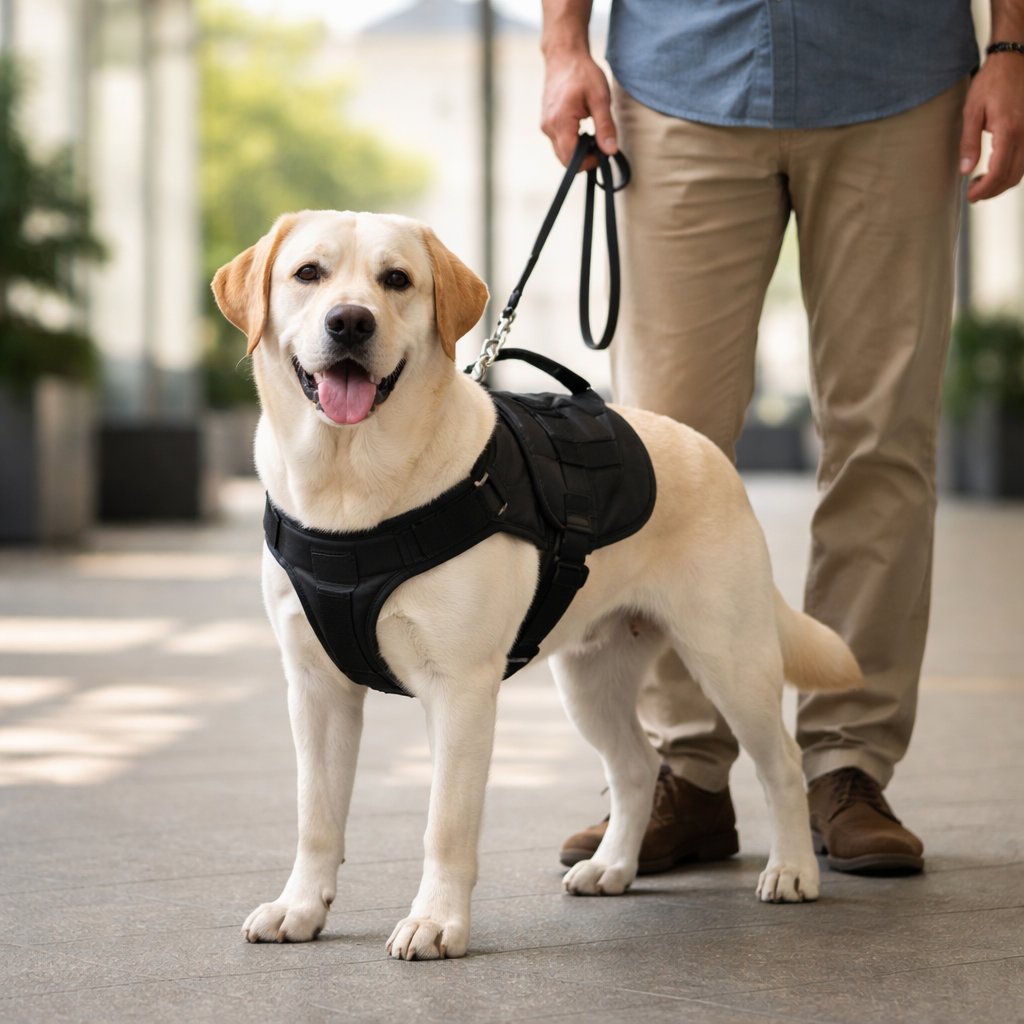
Airport security is one of the most stressful moments of travel for many service dog teams. It’s crowded, loud, full of rushing people, and the procedures can feel unclear if you’ve never done it before.
This guide is a practical step-by-step overview of what usually happens and how to prepare. Procedures vary by country and airport, so treat this as education — not legal advice.
Quick Overview (60 seconds)
- Arrive early so you’re not rushed
- Keep cues simple: heel, sit, stay, leave-it
- Expect your gear to be inspected
- Follow officer instructions calmly and advocate politely if something is unsafe
1) Before You Reach the Checkpoint: Set Your Team Up for Success
Security goes best when your dog arrives already in “work mode.” That means calm neutrality and predictable handling on your part.
.
- Do a relief break first, if possible. A comfortable dog is a focused dog.
- Reduce stimulation: Avoid greetings; keep the dog working.
- Plan your flow: Pockets empty, belt/metal items handled early, leash organized.
- Have documents ready if required in your jurisdiction (paper + digital copy).
If you want a quick refresher on what a service animal is (and what it is not), see: What Is a Service Animal? A Practical Definition.
2) What the Security Staff are Usually Evaluating
Common focus points:
- Is the dog under control and behaving safely?
- Does any equipment need inspection?
- Can screening happen without disrupting the line?
3) Gear & Handling: Keep It Simple
Complicated setups create delays. The best approach is usually the simplest, safest setup.
- Leash control: Keep slack to a minimum; avoid tight tension, which increases stress.
- Harness/vest: May help visually, but gear can still be inspected.
- Don’t hand your leash to strangers unless you explicitly choose to and your dog is trained for it.
- Bring a backup clip (small) in case a buckle fails.
4) Typical Checkpoint Flow (step-by-step)
Exact steps vary, but a common pattern looks like this:
- Approach the officer and follow directions about where to stand.
- Send belongings through (bin/belt). Keep one hand ready to manage the leash.
- Screening for you + dog follows local procedure (often walking through a detector with you; gear may be checked separately).
- Secondary screening may happen if something triggers an alarm or an extra inspection is required.
Your job is to keep your dog’s behavior boring: neutral, stable, responsive.
5) The 5 Cues that Make Security Easy (and how to practice)
These cues are the difference between “smooth” and “chaos”:
- Heel in a tight lane
- Sit-stay while you handle bins
- Leave it around dropped food and distractions
- Settle next to you if the inspection takes time
- Recall-to-heel (dog returns to position immediately if space opens)
Practice the cues in progressively harder environments before you ever need them at an airport (busy sidewalks → train stations → shopping centers, where permitted).
6) What to Say (short scripts)
Short, calm language works best in high-stress lines.
- To staff: “This is my service dog. Tell me the procedure you want me to follow.”
- If someone tries to pet: “Please don’t distract—my dog is working.”
- If you need clarity: “Can you repeat that step once, please?”
7) Common Problems and How to Handle Them
- People distract your dog: Step forward, block with your body, keep moving. Don’t argue.
- Dog becomes overwhelmed: Reduce stimulation (short cues, minimal talking), step out of line if needed, reset, then re-enter.
- Unexpected inspection delay: Ask for a corner/space where your dog can hold a calm, settled position without being stepped on.
- Another animal appears: Increase distance immediately; your priority is maintaining your dog’s neutrality and safety.
For general public behavior rules around working teams, see: Service Dog Etiquette in Public.
8) International Travel Note (why it can feel different)
International airports may have additional procedures, different staff training, and different expectations about documentation and animal handling. The best move is to review rules ahead of time and arrive even earlier than usual.
9) After Security: Decompress and Reset
Don’t rush straight to the gate if you don’t have to. Give your dog a quick reset: water, a short, calm walk, and then settle again.
Checklist: “Did We do it Right?”
- Dog stayed neutral and under control ✅
- Cues were simple and effective ✅
- No greetings, no food scavenging ✅
- You stayed calm and asked for clarification when needed ✅
Bottom Line
Airport security is manageable when you plan for it. Arrive early, keep cues simple, and prioritize calm, controlled behavior over speed.