
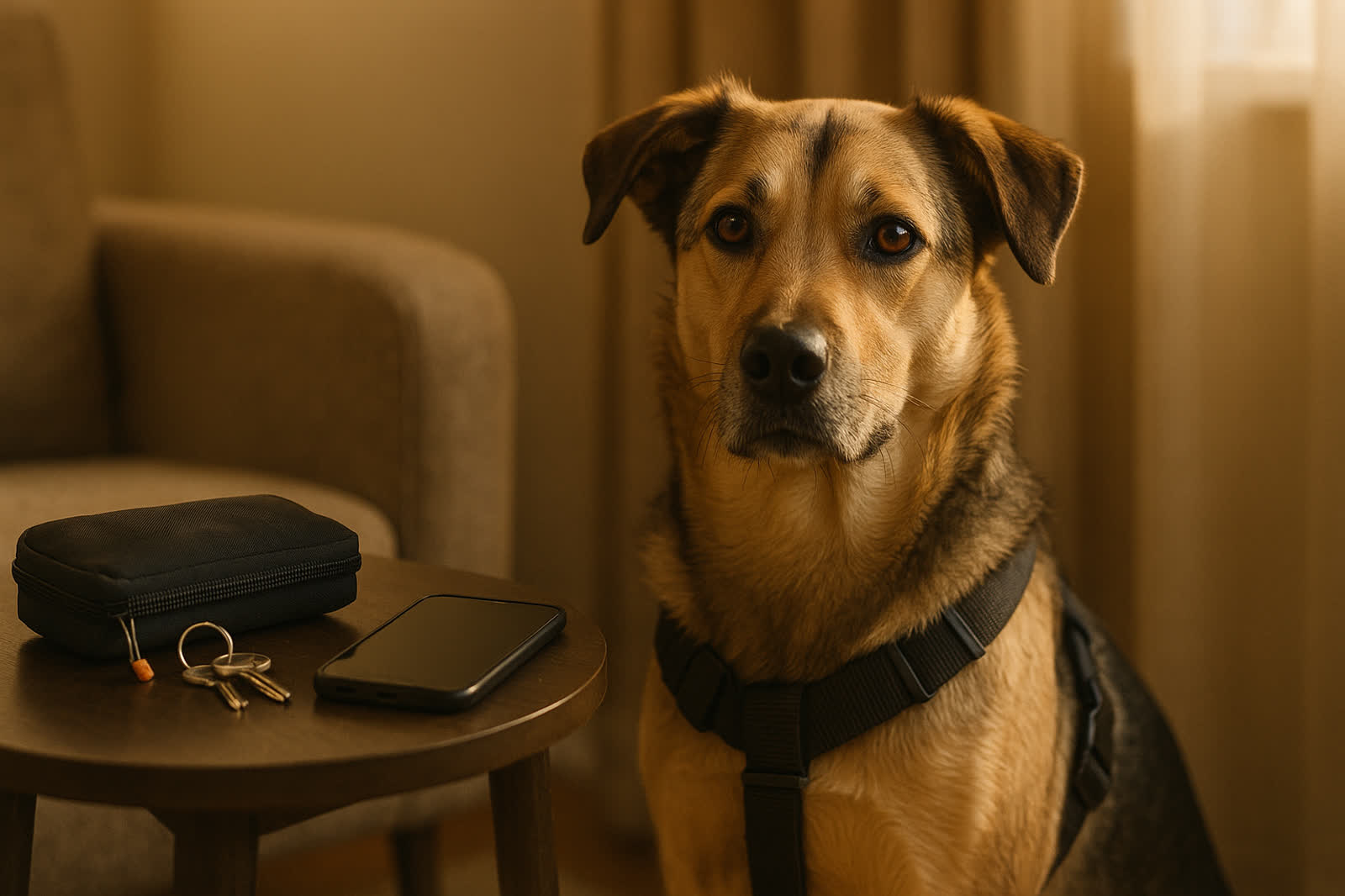
ADHD service dog tasks are trained behaviors that help a handler function more safely and consistently in everyday life—especially when ADHD creates high-cost problems like missed medication, time blindness, losing essentials, shutdowns, or impulsive safety risks. The best tasks are practical and measurable: they address a specific limitation and work reliably across real environments.
Quick Overview
- Pick tasks that mitigate a specific ADHD-related limitation (not just general comfort).
- Common task categories: reminders, retrievals, interruption/redirect, routine chaining, and safety support.
- One reliable task beats five inconsistent “cool” tasks.
- Train with clear cues, proofing, and generalization across distractions.
- Keep credible training records (logs, trainer notes, short videos) for continuity and consistency.
- Recognition gear can reduce friction in public settings, depending on local rules and norms.
What Counts as an ADHD Service Dog “Task” (and why the definition matters)
A task is a trained behavior the dog performs on cue (or in a defined situation) to reduce the impact of a disability-related functional limitation. For ADHD, that often means helping with executive function and safety: starting routines, staying on schedule, preventing dangerous forgetfulness, and recovering from dysregulation.
Because rules and definitions vary by country (and sometimes by state/province), describe tasks in functional terms. Instead of vague labels, use clear descriptions like “dog retrieves medication pouch at alarm” or “dog interrupts skin-picking with a trained nose nudge and then retrieves a fidget.” If you’re comparing categories like service animals vs. emotional support animals, see ESA differences.
ADHD Service Dog Task Ideas (organized by intent)
Below are commonly trained, real-world tasks. Choose the ones that match your patterns and environment (home, school, work, public access).
- Medication routine support: At an alarm, retrieve a medication pouch from a consistent location and deliver it to hand; optionally, hold a “wait” position until the routine is completed.
- Time blindness interruption: Alarm-based nudge at set times to prompt transitions (leave for appointments, start bedtime routine, switch tasks).
- Focus recovery / grounding pattern: A trained sequence (chin rest → deep pressure for a short duration → settle) to help you re-regulate and restart.
- Compulsive behavior interruption + redirect: Interrupt skin-picking/nail biting/doom-scrolling with a trained cue (nose touch), then redirect by retrieving a fidget or guiding to water.
- Item retrieval: Retrieve keys, phone, badge, wallet, medication pouch—reducing panic spirals and derailment.
- Exit/return prompting: A trained “check” behavior at doors (pause + look back) to prompt you to confirm essentials before leaving.
- Routine chaining: A short sequence the dog helps cue (bedtime → meds → bathroom → settle on mat) to reduce decision fatigue.
- Safety buffering: A trained stop/pause on cue (only when appropriate and safe), helpful if distractibility creates street-crossing or crowd-risk problems.
Step-by-Step: Pick the Right Tasks for Your Symptoms (5 steps)
- List your highest-cost ADHD moments. Missed meds, lost essentials, being late, leaving hazards on, shutting down in crowds, and impulsive wandering.
- Turn each moment into a measurable goal. “Take meds within 10 minutes of alarm.” “Leave the house with keys/phone 95% of mornings.”
- Select one dog behavior that directly changes the outcome. Retrieve, nudge, block, target a mat, find an item, guide to a location, apply pressure.
- Define the trigger and cue. Use an alarm, a verbal cue, a location change, or a clear handler action. Keep it consistent.
- Plan proofing. Train at home, then add distractions gradually (hallway → yard → quiet store → busier environments) until it works where you actually need it.
Training Tips that Make ADHD Tasks Reliable in Real Life
- Create a routine station. A consistent “task basket” (med pouch, fidget, water bottle) helps both you and the dog succeed.
- Use “interrupt + redirect.” For habits/compulsions, interruption alone often isn’t enough—teach a replacement action.
- Start short, then build duration. For deep pressure or grounding, build up slowly to avoid stressing the dog.
- Train with your real distractions. If the problem happens on your phone, practice with the phone present and gradually increase difficulty.
- Log sessions. A simple date/task/location/success note prevents “I think it’s working” confusion and helps you troubleshoot.
Public Access Behavior: The Foundation that Makes Tasks Usable
Even brilliant tasks won’t help if the dog can’t remain under control in public spaces. Work on foundations like settling, leash manners, ignoring food/people, and staying focused in crowds. A practical plan for handling real interruptions is a public plan.
Documentation and Recognition Gear: Practical Ways to Reduce Friction
Even when a jurisdiction does not prescribe a specific paperwork format, many handlers benefit from staying organized: training logs, a trainer’s summary (if you work with one), vaccination/health records, and short videos of task performance. In some settings—housing, workplace accommodations, school support, or travel—documentation processes can vary depending on local laws and provider policies.
Recognition gear (like a leash wrap or vest) is often used as a courtesy signal that a dog is working. Whether gear is expected, optional, or restricted depends on local norms and venue rules. If you want a practical overview of pros/cons and what reduces misunderstandings, see credible proof.
Real-World Examples: Match Tasks to Common ADHD Profiles
- “I forget essentials and spiral when I’m late.” Train: keys/phone retrieval + door “check” pause + timed nudge to leave.
- “I hyperfocus and miss meals/meds.” Train: alarm nudge + retrieve pouch + “wait” until completion.
- “I pick at my skin when stressed.” Train: interrupt cue + redirect to fidget + grounding mat settle.
- “I shut down in noisy places.” Train: find exit/quiet spot cue + short grounding pattern.
FAQs
Can a service dog help with ADHD even if I don’t have anxiety?
Yes. Many ADHD-focused tasks are executive-function and safety tasks (reminders, retrievals, interruption/redirect, routine chaining). Grounding tasks can help some handlers, but they’re not the only path.
How many tasks should an ADHD service dog know?
There’s no universal number. Many teams do well with 2–4 core tasks that are highly reliable, plus strong foundational behavior (settle, heel, leave-it, recall).
Are reminder tasks “real” service dog work?
Can I owner-train the tasks for an ADHD service dog?
What tasks are usually hardest to train?
What should I keep in my training records?
Date, location, cue/trigger, success rate, and a short note on distractions. Add occasional short videos of task performance so you can compare progress over time.
Sources
- ADA.gov – Service Animals (requirements and FAQs)
- Assistance Dogs International (ADI)
- International Association of Assistance Dog Partners (IAADP)
- U.S. DOT – Service animals (air travel rules)
Takeaway
ADHD service dog tasks work best when they target your highest-impact problems and are trained to be boringly reliable in real life.
- Pick tasks that reduce a specific functional problem (meds, time blindness, interruption/redirect, retrieval, safety).
- Train with clear triggers/cues and proof across distractions—not just at home.
- Keep practical training records and use recognition gear thoughtfully, in accordance with local rules and norms.