
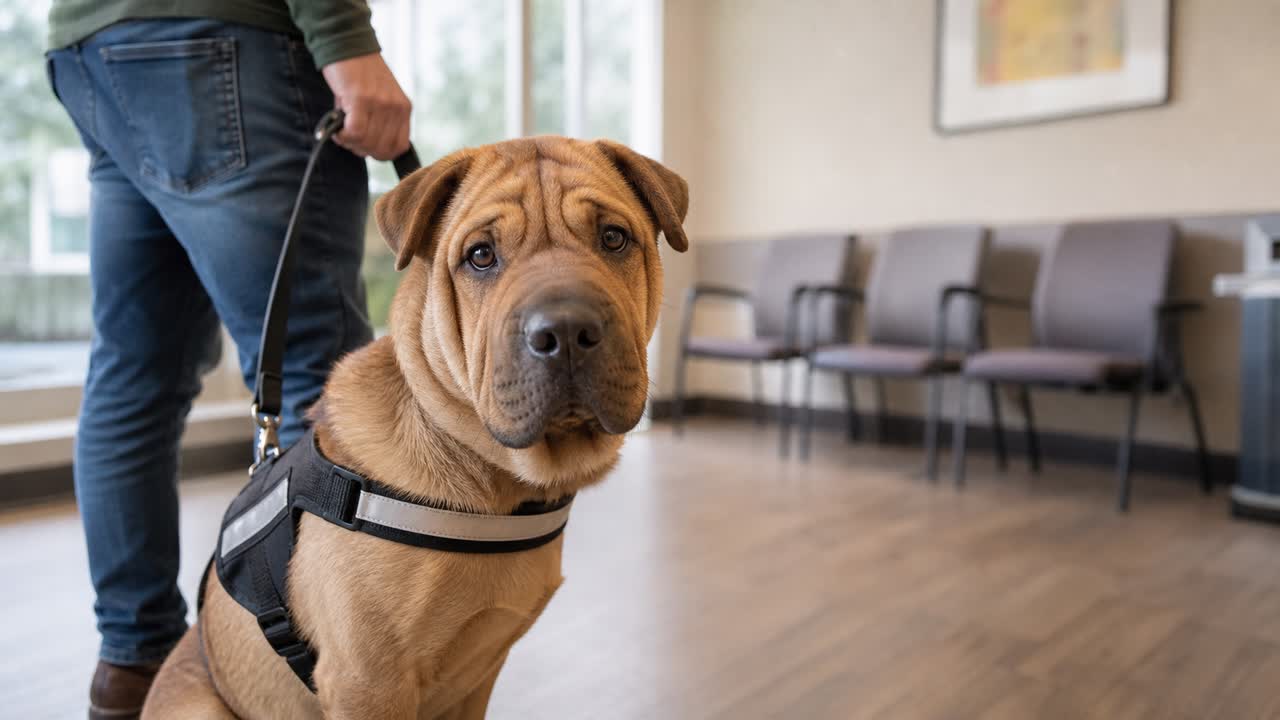
Bringing a service dog to physical therapy visits is usually less about special permission paperwork and more about whether the dog can work safely in a clinical environment. Many handlers rely on their dogs during treatment sessions for mobility support, item retrieval, grounding, alerts, or help with transitions before and after therapy.
That said, physical therapy clinics are a specific kind of public-access setting. There may be treatment tables, exercise bands, shared gym space, close contact with staff, and infection-control routines, all of which make planning important. This article focuses on practical expectations for a service dog at physical therapy visits, not on housing or airline rules.
In most casos, the key questions are whether the dog is a service animal under the ADA, whether it is under control, and whether it can stay out of the way of equipment and other patients.
Quick Overview
- A service dog can often accompany a handler to physical therapy if the dog is task-trained and under control.
- Clinics may manage safety, sanitation, and room flow, but they generally should not impose unnecessary barriers.
- Call ahead when possible so staff can plan for treatment space, not because advance approval is always legally required.
- Your dog should be able to settle quietly near tables, mats, mobility devices, and moving staff.
1) What Matters Most when Bringing a Service Dog to Physical Therapy Visits
The main issue is function. If your dog helps with balance after treatment, retrieves dropped items, provides medical or psychiatric task support, or assists with safe movement through the building, those are practical reasons the dog may be part of the visit.
Therapy clinics are different from retail stores or sidewalks. A dog that can tuck under a chair, stay on a mat, or shift position on cue is much easier to accommodate than a dog that sprawls into walkways or reacts to every new person in the room.
If you are unsure whether your dog’s working role is clearly defined for this type of visit, a service screening can be a useful way to think through task clarity and day-to-day readiness without turning the conversation into a paperwork issue.
2) Call Ahead for Logistics, not to Ask for Unnecessary Permission
It is often smart to call before the first appointment, especially if the clinic has shared treatment areas, hydrotherapy spaces, or tight therapy gyms.
That kind of advanced conversation can help with seating, floor space, and staff expectations. It also gives you a chance to mention anything relevant, such as whether the dog needs space beside a wheelchair, crutches, or a walker. A calm, practical tone usually works better than leading with demands.
For the broader legal framework, it helps to understand the difference between general access expectations and location-specific logistics. Reviewing the site’s regulations and public access guide can help you prepare for those conversations in a grounded way.
3) Focus on Safety around Equipment, Staff, and Other Patients
Physical therapy spaces can be busy. Resistance bands, balance tools, exercise bikes, parallel bars, hot- or cold-therapy equipment, and rolling stools all pose hazards if a dog is not placed carefully. Even a well-trained dog may need extra practice for this environment if it is used to quieter routines.
Your dog should be able to hold a down-stay or settle position while people move around it, talk over it, and occasionally pass close by. For example, retrieving a dropped brace is different from stepping in while a therapist is assisting with a transfer.
Handlers can help by bringing a small mat, choosing compact gear, and positioning the dog so that leashes, paws, and tails do not create trip hazards. If your dog alerts or interrupts, it is worth discussing with the therapist how that task may show up during treatment so nobody is startled when it happens.
4) Be Ready for Practical Questions without Oversharing
Many clinic staff members are familiar with service dogs, but front-desk teams and rotating assistants may be less confident. In public-access settings, businesses may generally ask only limited questions when the need is not obvious. A short, calm explanation usually helps more than a stack of documents.
You do not need to frame the visit around certificates or purchased identification. A simple statement like “My dog is trained to assist me with mobility and retrieval and can stay settled during treatment” is often enough to move the conversation forward.
If a clinic is concerned about hygiene, workflow, or patient comfort, bring the discussion back to specifics: where the dog will stay, how you handle cleanup, and how the dog remains under control. That practical approach is often more persuasive than debating abstract legal points in the lobby.
5) Keep Documentation and Records Practical
For routine public access, many handlers do not need special clinic-specific documents. Still, having organized records can make life easier. Training logs, vaccination records, emergency veterinary information, and a short task summary can all be useful for your own planning and peace of mind.
This is especially true if your treatment schedule is ongoing and multiple staff members may see you over time. Consistency helps. If the clinic has questions, you can respond with clear information about how the dog supports your functioning rather than making the dog’s presence sound optional or decorative.
Documentation needs can look different in other settings, such as housing or travel, so it helps to keep those categories separate. For example, travel-specific planning may involve different expectations than therapy appointments, which is why it is better to treat air travel rules as a separate topic rather than assuming they apply in a clinic.
6) Know when a Clinic might have a Real Concern
Not every concern is discrimination. A clinic may need to address a dog that barks repeatedly, blocks movement during treatment, reacts to other patients, or poses a direct safety risk. Those are behavior and control issues, not proof that service dogs do not belong in therapy spaces.
It is also possible that some treatment areas require a different setup because of sterile procedures, water therapy, or closely managed equipment. Sometimes that means a different room, a different time slot, or a more controlled waiting arrangement for part of the visit.
The strongest position is a practical one: a dog that is calm, clean, responsive, and able to work around therapy routines is easier for a clinic to accommodate confidently. Good preparation does not guarantee a perfect interaction, but it usually lowers friction.
FAQs
Can I bring my service dog to physical therapy?
Often, yes, if the dog meets the service animal standard and remains under control in the clinic environment. The exact visit setup still matters for safety and workflow.
Can a clinic ask what my dog does?
In many public-access situations, only a limited number of questions may be allowed when the need is not obvious. A short explanation of the dog’s trained tasks is usually more helpful than arguing about labels.
Do I need paperwork for a service dog at physical therapy visits?
Usually not as a basic public-access requirement. Still, practical records such as training notes, vaccination information, and emergency contacts can help with smoother ongoing visits.
What if the therapist says the room is too crowded?
Ask whether there is another placement option, room layout, or appointment time that would preserve safe access. Crowding concerns do not automatically mean exclusion is appropriate.
Should my dog wear a vest in the clinic?
A vest is generally optional. Some handlers find clear identification useful for smoother communication, but control, training, and safe behavior matter more than the vest itself.
Sources
Takeaway
A service dog at physical therapy visits is usually most workable when the focus stays on safe access, clear communication, and reliable behavior in a clinic setting. The dog does not need to look official, but it does need to function well in a space built around treatment and movement.
- Call ahead to solve logistics early, especially for shared gyms or tight treatment rooms.
- Prioritize settling, positioning, and equipment safety over appearance-based gear choices.
- Use practical records and calm explanations to reduce friction if questions come up.