
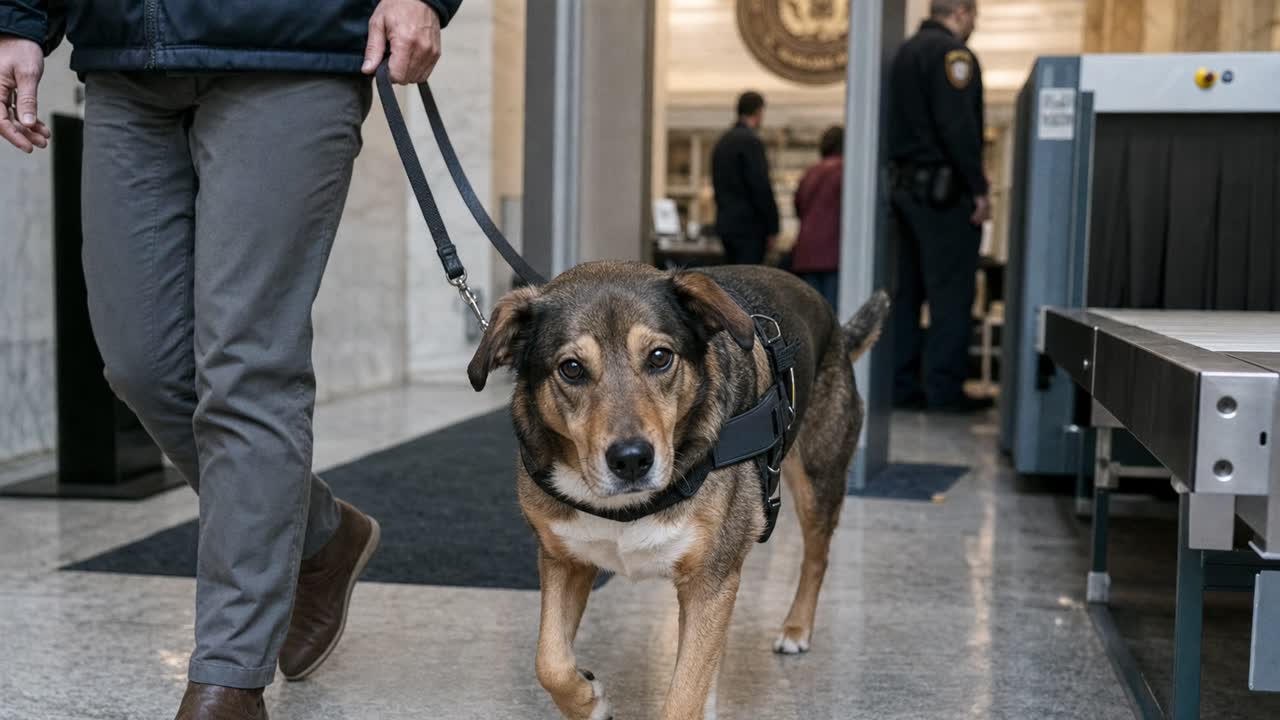
Courthouse access with a service dog usually works best when you think about two layers at once: your legal access rights and the practical reality of a high-security building. Courts often have metal detectors, bag screening, lines, stressed visitors, and strict staff instructions. That means your dog needs to be calm, controlled, and ready to work in a noisy environment.
In most situations, a courthouse should treat a trained service dog much like other public buildings do, but security staff may still ask limited questions or need time to coordinate entry. Reading the broader regulations in advance can help you understand the baseline rules before you arrive.
This article explains what courthouse access with a service dog typically looks like, what to expect at screening, when staff can intervene, and how to reduce friction on a day that may already be stressful.
Quick Overview
- Most courthouses should allow trained service dogs that are under control.
- Security screening can take longer, so arriving early is smart.
- Staff may ask limited-access questions, but should not turn the process into a debate.
- Your dog still has to meet behavior expectations inside the building.
- Bring only practical documentation and focus on clear communication.
- Plan ahead for relief breaks, waiting periods, and backup handling if the day runs long.
1) What does Access Usually Mean in a Courthouse
A courthouse is a public-facing government setting, but it also has extra security and stricter movement control than a store or hotel. In practice, that means your service dog should generally be allowed to accompany you in areas where the public is otherwise permitted, so long as the dog is trained, under control, and not creating a safety problem.
If you are unsure whether your dog is fully ready for that environment, doing a candid service screening for yourself can be more useful than relying on gear or labels. The real issue is whether your dog can work calmly in crowded, distracting, rule-heavy spaces.
2) Expect Security Screening to be the First Friction Point
The hardest part of courthouse access with a service dog is often the entrance, not the courtroom. Metal detectors, belts, phones, bags, and spoken instructions can all compete for your attention while your dog is also processing a tight, unfamiliar space. Build in extra time so you are not rushed into mistakes.
Before the visit, think through how your dog will move through screening, where you will place personal items, and what commands help keep the dog close without blocking officers or other visitors. A quick behavior check mindset is useful here: can your dog wait, pivot, hold position, and recover from sudden noise without unraveling?
3) What Courthouse Staff can Usually Ask
In many public-access situations, staff can ask limited questions focused on whether a service animal, in this case the dog, is mandatory due to a disability and what task or work the dog has been trained to perform. That does not mean every employee will phrase things perfectly, especially in a security setting where they are trying to move people through a line.
Your best response is brief, calm, and repeatable. Long explanations usually create more confusion, not less. You do not need to win an argument at the door. You need to answer clearly, keep the line moving, and preserve your dog’s focus.
4) Behavior Still Matters once You are Inside
Access is not a free pass for disruption. A service dog in a courthouse should stay under control in benches, hallways, elevators, and waiting rooms. Barking, lunging, sniffing people, blocking traffic lanes, or repeatedly breaking position can create legitimate problems in a formal building where people may already be under heavy stress.
That is why it helps to revisit public access rules before an important court date. The goal is not to memorize policy language. The goal is to show up with a dog that can handle a long, constrained day without becoming the center of attention.
5) Plan for the Long Day, not Just the Doorway
Some courthouse visits are quick. Others involve delays, recesses, attorney meetings, and hours of waiting. Pack water, waste bags, any needed medication, and a quiet reward strategy that does not disturb the room. Figure out relief options before the hearing starts, because stepping out unexpectedly can be much harder once proceedings begin.
If you use mobility aids, carry evidence, or need help managing paperwork, think through how all of that interacts with the dog. The practical logistics matter as much as the access principle.
6) What to do If Access is Challenged
If someone at the courthouse questions your access, keep your tone measured. Restate the essential facts, answer the limited questions if appropriate, and ask whether a supervisor or ADA coordinator can help resolve the issue quickly. Most conflicts go better when you stay factual and do not escalate emotionally unless you truly need to.
It can also help to arrive with one simple sentence prepared in advance, so stress does not scramble your wording. That kind of preparation often resolves problems faster than carrying a stack of documents you never actually need.
FAQs
Can I bring a service dog into a courthouse?
In many situations, yes, as long as the dog is trained, under control, and accompanying you in public-access areas of the building.
Will my dog have to go through security screening?
Usually yes. Screening procedures can vary by building, so arriving early gives staff time to explain the process without unnecessary conflict.
Can courthouse staff ask me questions about my dog?
They may ask a few questions about service-dog status and trained tasks. Keeping your answer short and calm usually works best.
Do I need special paperwork for courthouse access with a service dog?
Practical records can be useful for your own planning, but behavior, control, and clear communication are usually more important than carrying flashy paperwork.
What if my court day lasts several hours?
Plan for water, breaks, medication, and a quiet waiting routine. Long courthouse days can tax even solid dogs if you do not prepare.
Can my dog be removed for bad behavior?
If the dog is out of control or creating a genuine disruption, staff may intervene. Strong preparation matters because courthouse settings are less forgiving than casual public spaces.
Sources
- ADA.gov: Service Animals
- ADA.gov: Service Animals FAQ
- National Association of the Deaf: ADA Public Accommodations
- CDC: Dogs
- CDC: Pet Travel Safety
Takeaway
Courthouse access works best when rights and readiness come together. If your dog can handle screening, long waits, and tight indoor control, the day is much more likely to stay focused on your case rather than on your entry.
- Arrive early enough to handle screening without panic.
- Keep answers short, practical, and calm.
- Prepare for a full day inside the building, not just the front door.