
General Ownership & Control
Leash & Muzzle Rules
In Fiji, dogs must be kept under control at all times when in public areas. While there is no single nationwide leash statute, municipal councils and local authorities generally require dogs to be leashed in:
- Urban streets and villages
- Public parks and communal spaces
- Markets and commercial areas
- Public beaches near populated areas
Muzzles are not routinely required but may be mandated for:
- Dogs displaying aggressive behavior
- Dogs involved in previous biting incidents
- Dogs classified as dangerous by local authorities
Off-leash activity is typically limited to private property or rural areas where the dog remains under direct supervision.
Breed-Specific Bans / Restrictions
Fiji does not maintain a publicly listed national breed-ban system. All breeds are generally permitted, provided the dog is not deemed dangerous based on behavior.
However, authorities may impose restrictions on individual dogs, including:
- Mandatory confinement
- Leash or muzzle requirements
- Removal orders if public safety is threatened
Licensing & Microchipping
Dog licensing requirements in Fiji are handled at the municipal level. Some local councils require registration and licensing, while rural areas rely on community oversight.
Microchipping is not universally mandated for domestic dogs, but it is strongly recommended, especially for identification and veterinary care.
Owners are expected to ensure:
- Regular veterinary care
- Up-to-date vaccinations
- Responsible confinement and supervision
Service Dogs & Assistance Animals
Legal Definitions
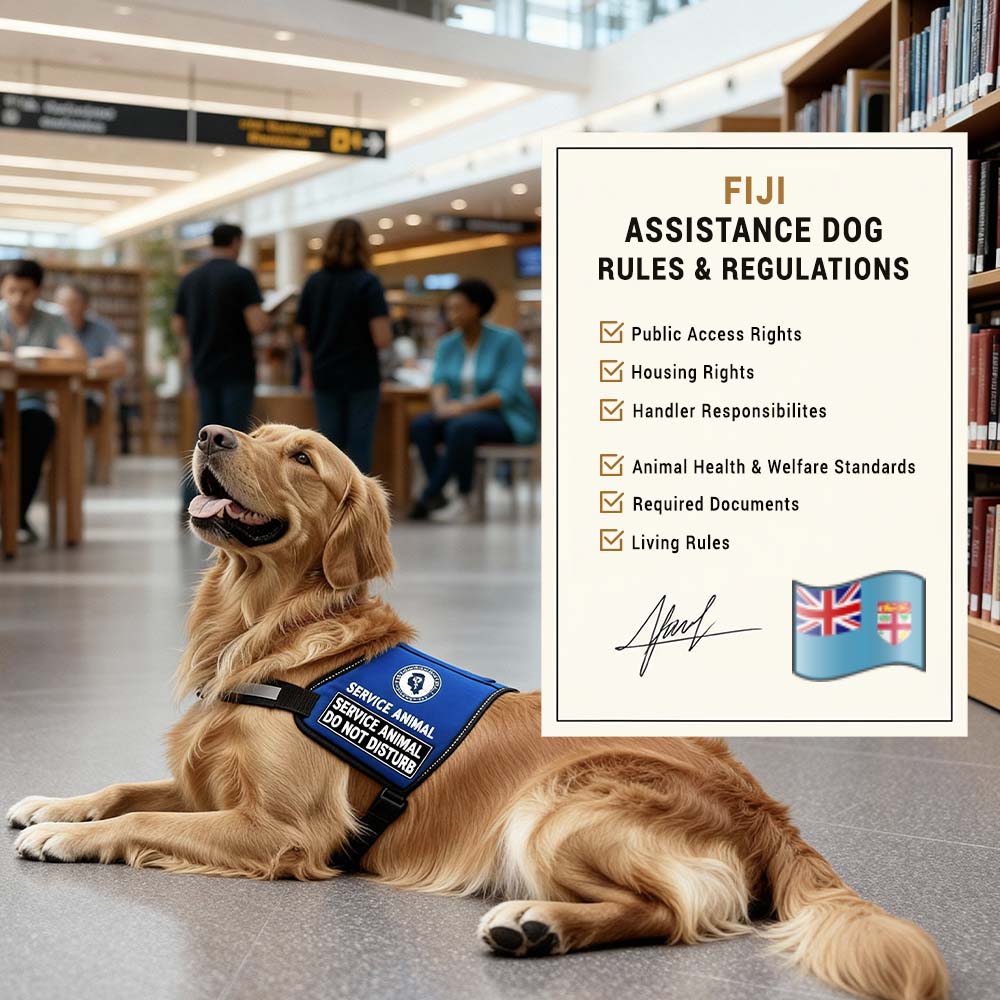
Fiji recognizes assistance dogs trained to support individuals with disabilities. This includes guide dogs, mobility assistance dogs, hearing dogs, seizure-alert dogs, diabetes-alert dogs, and psychiatric service dogs (PSDs) that are trained to perform disability-related tasks.
Public Access Rights
Service dogs are generally permitted in public-access areas, including:
- Government buildings
- Public offices
- Hotels and accommodations
- Public transportation (where available)
- Retail establishments
Access practices may vary in rural areas, but service dogs are widely accommodated when properly identified.
Certification / ID Requirements
There is no centralized national certification system in Fiji. Handlers are encouraged to carry documentation to avoid misunderstandings. Recommended items include:
- Service dog identification card
- Training or registration certificate from an accredited organization
- Visible recognition gear (vest or harness)
- Physical ID Card (handler + animal)
- Prescription Letter (ESA, PSA, or service dog letter)
Emotional Support Animals (ESA) & Psychiatric Service Animals (PSA)
Legal Recognition
Emotional Support Animals (ESAs) and Psychiatric Service Animals (PSAs) in Fiji are only recognized when registered with an accredited organization. Without accreditation, ESAs are treated as companion animals.
Housing Rights
Registered ESAs/PSAs may be accommodated in housing depending on landlord or property-owner policies. Fully trained service dogs must be accepted as disability accommodations.
Travel Rights
- Airlines serving Fiji accept accredited service dogs.
- PSAs may travel as service dogs when task-trained and registered.
- ESAs follow standard airline pet rules unless otherwise accepted.
- Local transport acceptance varies by provider.
Veterinary & Animal Welfare Standards
Vaccination Schedules
Routine vaccinations such as distemper, parvovirus, hepatitis, and leptospirosis are recommended for dogs living in Fiji. Rabies vaccination is not required for domestic dogs unless traveling internationally.
Neutering / Spaying Regulations
Neutering is not legally required, but it is strongly encouraged by animal welfare organizations to control stray populations.
Animal Welfare Acts
Fiji enforces animal welfare standards under national and municipal laws. Owners must provide adequate food, clean water, shelter, veterinary care, and humane treatment.
Neglect, abuse, or abandonment of animals may result in fines or legal action under Fiji’s animal protection regulations.