
General Ownership & Control
Leash & Muzzle Rules
In Australia, dogs must be kept under effective control at all times in public places. Leash rules are primarily set at the state, territory, and local council level, but most councils require dogs to be leashed in:
- Public streets and footpaths
- Parks and recreational areas (unless designated off-leash)
- Shopping precincts and town centres
- Beaches outside approved off-leash hours
Muzzles are not generally required nationwide but may be mandated for:
- Declared dangerous or menacing dogs
- Dogs with a recorded history of aggression
- Restricted breeds under state or territory law
- Dogs subject to council or court-issued control orders
Off-leash exercise is permitted only in council-designated areas and during approved times.
Breed-Specific Bans / Restrictions
Australia enforces national and state-level breed restrictions. The following breeds are prohibited from importation and are restricted or banned in many states and territories:
- American Pit Bull Terrier
- Dogo Argentino
- Fila Brasileiro
- Japanese Tosa
- Presa Canario
Owners of restricted breeds may be required to:
- Use a muzzle in public at all times
- Keep the dog on a short, strong leash
- Register the dog as a restricted breed
- Display warning signage on their property
- Hold liability insurance
Licensing & Microchipping
Microchipping is mandatory nationwide and must be completed before registration with the local council.
Dog owners must also comply with:
- Local council registration (annual or lifetime, depending on region)
- Updating ownership and address details
- Rabies vaccination for international travel only
Failure to microchip or register a dog may result in fines.
Service Dogs & Assistance Animals
Legal Definitions
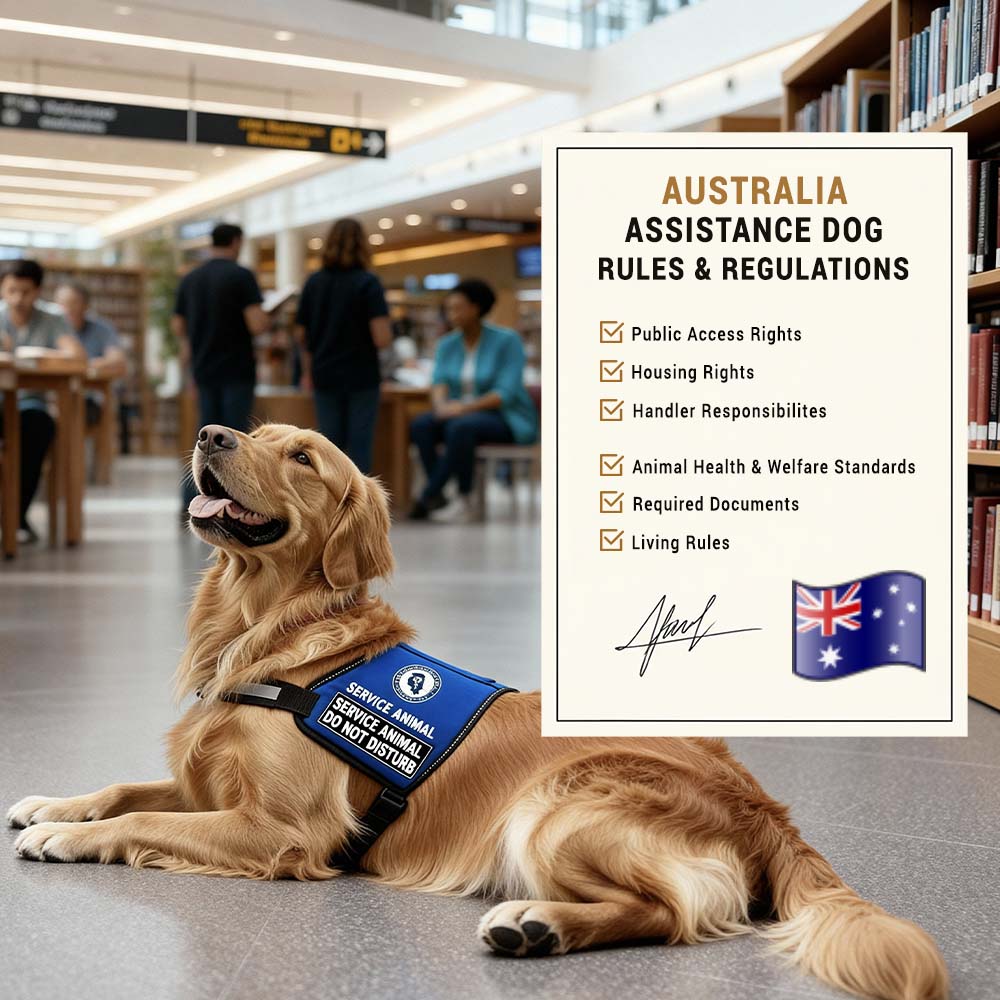
Australia recognizes assistance dogs trained to support individuals with disabilities. This includes guide dogs, hearing dogs, mobility assistance dogs, seizure-alert dogs, diabetes-alert dogs, and psychiatric service dogs (PSDs). Dogs must be task-trained for disability-related assistance.
Public Access Rights
Assistance dogs have full public access rights under federal and state disability discrimination laws and must be allowed into:
- Restaurants, cafes, and food establishments
- Retail stores and shopping centres
- Public transport (buses, trains, trams, ferries)
- Hotels and accommodation
- Hospitals and medical facilities
- Government and municipal buildings
Refusing entry to a legitimate assistance dog may constitute unlawful discrimination.
Certification / ID Requirements
Australia does not operate a single national certification system. However, handlers should carry documentation to avoid disputes. Recommended items include:
- Assistance dog identification card
- Training certificate from an accredited organization
- Visible recognition gear (vest or harness)
- Physical ID Card (handler + animal)
- Prescription Letter (ESA, PSA, or service dog letter)
Emotional Support Animals (ESA) & Psychiatric Service Animals (PSA)
Legal Recognition
Emotional Support Animals (ESAs) and Psychiatric Service Animals (PSAs) in Australia are only recognized when registered with an accredited organization. Without accreditation, ESAs are treated as companion animals and do not receive public-access rights.
Housing Rights
Registered ESAs/PSAs may be accommodated in no-pet housing depending on state law and landlord policy. Fully trained assistance dogs must always be accepted as disability accommodations.
Travel Rights
- Australian airlines accept accredited assistance dogs in the cabin.
- PSAs may travel as service dogs when task-trained and accredited.
- ESAs follow standard airline pet policies unless accepted by the carrier.
- Public transport accepts assistance dogs nationwide.
Veterinary & Animal Welfare Standards
Vaccination Schedules
Core vaccinations recommended across Australia include distemper, parvovirus, hepatitis, and parainfluenza. Rabies vaccination is required only for international travel.
Neutering / Spaying Regulations
Neutering is not federally mandatory, but many states and councils strongly encourage or require sterilization, particularly for restricted breeds.
Animal Welfare Acts
Australia enforces strict animal welfare legislation at both state and federal levels. Owners must provide appropriate food, water, shelter, exercise, enrichment, and veterinary care.
Animal cruelty, neglect, or abandonment may result in significant fines, ownership bans, or criminal charges.