
General Ownership & Control
Leash & Muzzle Rules
Norway enforces strict leash laws to protect wildlife, livestock, and public safety. Dogs must be kept on a leash in most public areas, especially during the nationwide leash period (April 1 to August 20) to protect wildlife during breeding season.
Outside the mandatory leash period, municipalities may still enforce year-round leash requirements in cities such as Oslo, Bergen, Stavanger, and Trondheim.
Muzzles are not widely required but may be mandated for:
- Aggressive or reactive dogs
- Dogs with a history of attacks
- Certain public transport operators
- Dogs classified as dangerous following an incident
Off-leash exercise is allowed only in designated dog parks or open nature areas where local rules permit it.
Breed-Specific Bans / Restrictions
Norway enforces strict breed-specific bans. The following breeds are banned from ownership, import, and breeding:
- Pit Bull Terrier
- American Staffordshire Terrier
- Fila Brasileiro
- Tosa Inu
- Dogo Argentino
- Český Fousek (Norwegian variant restrictions)
Crossbreeds of these banned breeds are also prohibited unless DNA testing proves otherwise.
Dogs may also be restricted based on dangerous behavior, regardless of breed.
Licensing & Microchipping
Microchipping is mandatory for all dogs in Norway. The microchip must be registered with the national Dog Registry (DogWeb or Mattilsynet’s registers).
Additional requirements include:
- Mandatory rabies vaccination for dogs traveling abroad
- Municipal registration (in some cities)
- Carrying waste bags and cleaning up after the dog (strict fines apply)
Failure to microchip or register may result in financial penalties.
Service Dogs & Assistance Animals
Legal Definitions
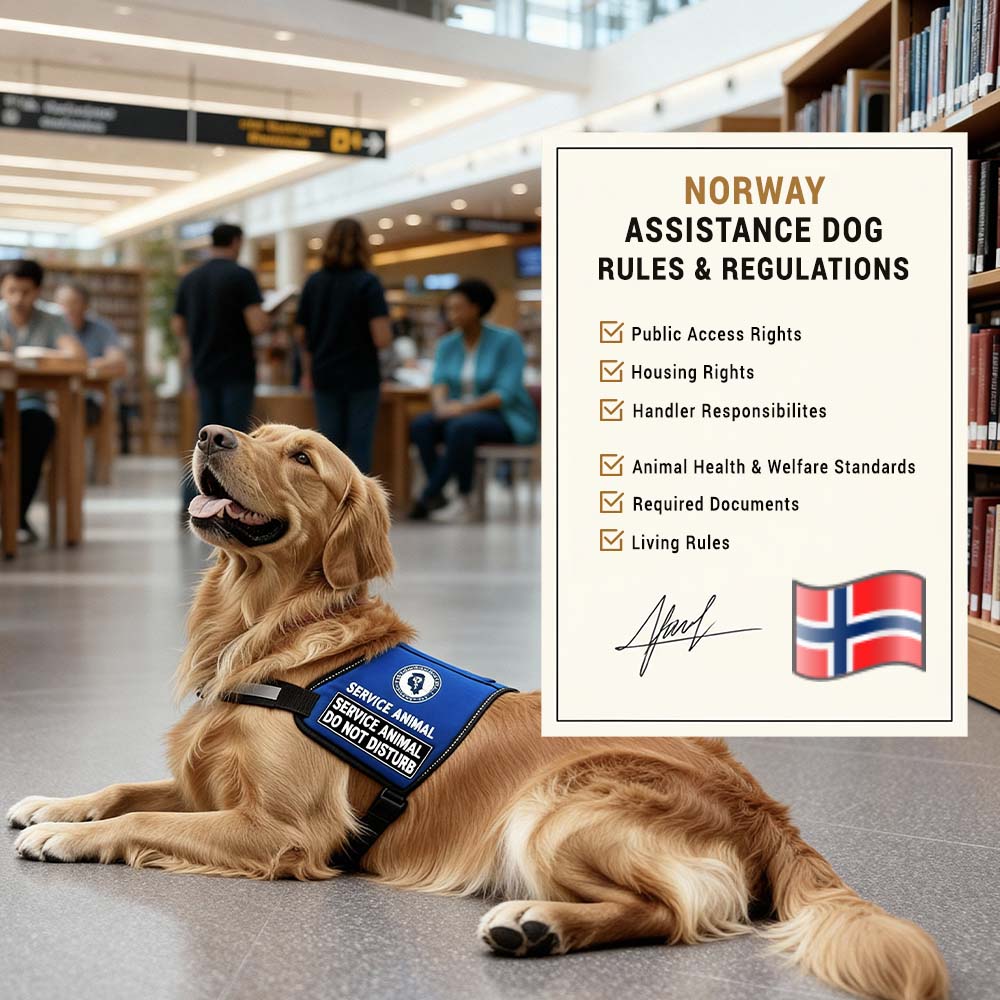
Norway recognizes assistance dogs trained to support individuals with disabilities. This includes guide dogs, mobility assistance dogs, hearing dogs, seizure-alert dogs, diabetes-alert dogs, and psychiatric service dogs (PSDs). These dogs must be professionally trained.
Public Access Rights
Service dogs are granted full access to all public areas, including:
- Shops and retail locations
- Restaurants and cafes
- Hotels and accommodations
- Public transportation (buses, trams, ferries, trains)
- Medical facilities and hospitals
- Government and municipal buildings
Denying access to a trained assistance dog is prohibited.
Certification / ID Requirements
Norway typically requires assistance dogs to have professional documentation. Handlers should carry:
- Official service dog ID
- Training/Registration Certificate
- Visible Recognition Gear (vest or harness)
- Physical ID Card (handler + dog)
- Prescription Letter (ESA, PSA, or Service Animal letter from a licensed professional)
Emotional Support Animals (ESA) & Psychiatric Service Animals (PSA)
Legal Recognition
ESAs and PSAs in Norway are only recognized when registered with an accredited organization. Without registration, they are treated as companion animals with no special access privileges.
Housing Rights
Registered ESAs/PSAs may receive housing accommodations depending on landlord and housing association rules. Fully trained service dogs must always be accepted under disability accommodations.
Travel Rights
- Airlines serving Norway accept certified service dogs with proper documentation.
- PSAs may travel as service dogs when accredited and task-trained.
- ESAs generally follow standard airline pet travel rules.
- Public transport operators accept service dogs; ESAs/PSAs depend on company policies.
Veterinary & Animal Welfare Standards
Vaccination Schedules
Core vaccines recommended in Norway include distemper, parvovirus, adenovirus, and leptospirosis. Rabies vaccination is mandatory only if traveling outside Norway.
Neutering / Spaying Regulations
Neutering is allowed but regulated. Norwegian law discourages unnecessary surgical procedures; therefore, neutering often requires veterinarian justification unless for population control or medical necessity.
Animal Welfare Acts
Norway has some of the strictest animal welfare regulations in Europe. Owners are legally required to provide proper shelter, nutrition, enrichment, mental stimulation, exercise, and prompt veterinary care. Animal abuse or neglect is punishable by large fines or imprisonment.
The Norwegian Food Safety Authority (Mattilsynet) oversees welfare enforcement.