
General Ownership & Control
Leash & Muzzle Rules
In Ireland, dogs must be kept on a leash in all public areas such as streets, parks, beaches, town centres, and shared community spaces. Local councils may impose additional restrictions, especially in high-traffic areas or near wildlife.
Ireland also enforces strict rules for certain breeds classified as “restricted.” These breeds must always be:
- Muzzled in public
- On a strong leash no longer than 2 metres
- Handled by someone over 16 years old
Breed-Specific Bans / Restrictions
Ireland does not ban breeds, but it enforces a restricted-breed list. The following breeds (and their crossbreeds) must be muzzled and leashed at all times when in public:
- American Pit Bull Terrier
- English Bull Terrier
- Staffordshire Bull Terrier
- Bull Mastiff
- Doberman Pinscher
- German Shepherd (Alsatian)
- Rhodesian Ridgeback
- Rottweiler
- Japanese Akita
- Japanese Tosa
- Bandog
Owners of these breeds must comply with handling, leash, and muzzle rules at all times.
Licensing & Microchipping
Microchipping is mandatory for all dogs in Ireland. Owners must ensure the chip is registered in an approved national database.
All dogs over 4 months old require a dog licence, which may be:
- Annual licence
- Lifetime licence
- General kennel licence (for breeders)
Vaccinations — especially rabies for travel — should be kept up to date.
Service Dogs & Assistance Animals
Legal Definitions
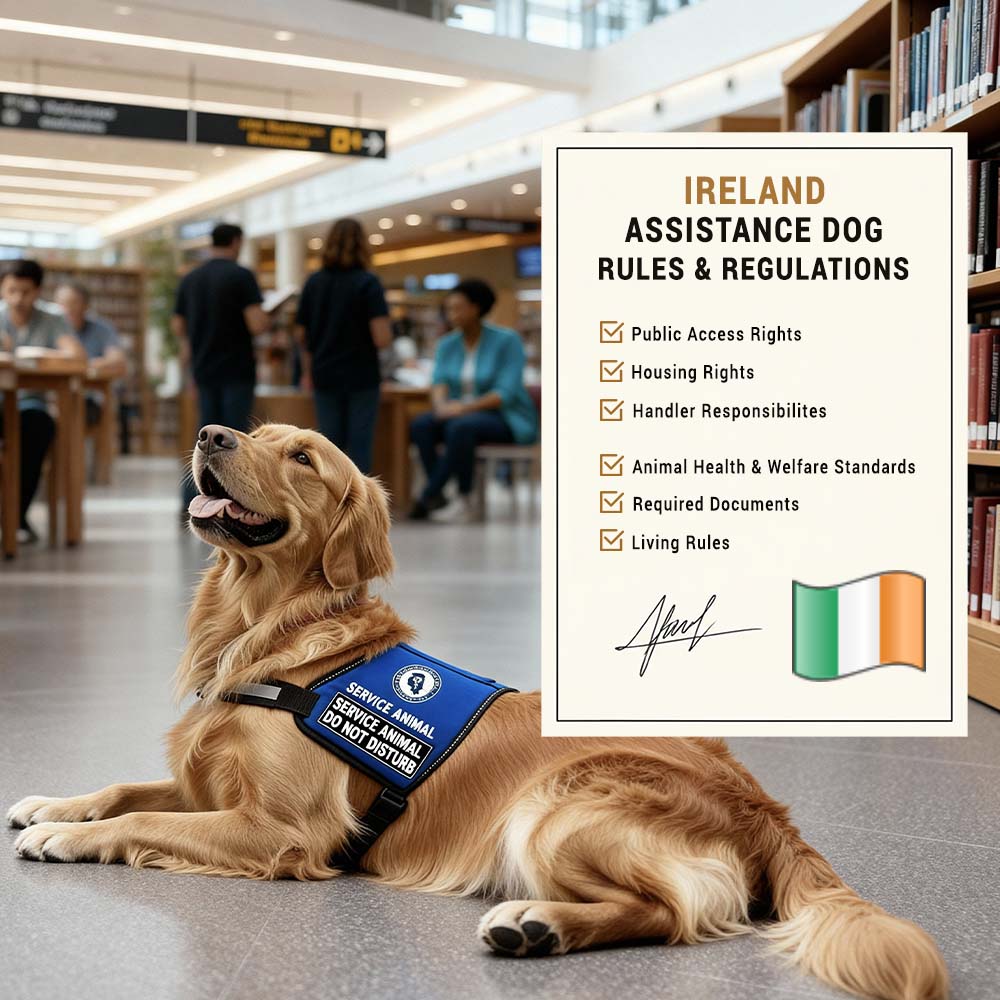
Ireland recognizes service dogs trained to assist individuals with disabilities, including guide dogs, assistance dogs, and psychiatric service dogs (PSDs). These animals must be task-trained to perform specific disability-related functions.
Public Access Rights
Service dogs have full legal access rights to restaurants, cafes, hotels, shops, public transport, workplaces, government buildings, and educational institutions. Businesses cannot refuse a legitimate service dog.
Certification / ID Requirements
Service dogs are typically accompanied by identification and documentation. For smooth access, handlers should carry:
- Physical ID Card (handler + animal)
- Training/Registration Certificate
- Visible Recognition Gear (vest, harness, or bandana)
- Prescription Letter (ESA, PSA, or Service Animal letter from a licensed professional)
Emotional Support Animals (ESA) & Psychiatric Service Animals (PSA)
Legal Recognition
ESAs and PSAs are only recognized when registered with an accredited organization. Without accreditation, ESAs do not receive public-access privileges.
Housing Rights
Registered ESAs/PSAs may be accepted in housing that restricts pets, depending on landlord policies. Legitimate service dogs are fully protected and cannot be refused under Ireland’s disability accommodation standards.
Travel Rights
- Irish airlines and European carriers accept service dogs with proper documentation.
- PSAs may travel as service dogs when task-trained and accredited.
- ESAs generally follow standard pet travel rules.
- Public transport (Dublin Bus, Irish Rail, Luas) allows service dogs; ESAs/PSAs vary by operator.
Veterinary & Animal Welfare Standards
Vaccination Schedules
Rabies vaccination is required for travel, particularly between Ireland and other EU/UK destinations. Core vaccines such as distemper, parvovirus, and adenovirus are strongly recommended.
Neutering / Spaying Regulations
Neutering is not mandated but is widely recommended to control breeding and improve behavior. It is encouraged as part of responsible pet ownership.
Animal Welfare Acts
Ireland enforces strict animal welfare laws under the Animal Health and Welfare Act. Owners are required to provide adequate shelter, food, water, exercise, and veterinary care. Abuse, neglect, or abandonment of animals is a criminal offense.