
General Ownership & Control
Leash & Muzzle Rules
In Hungary, national and local regulations require dogs to be kept on a leash in most public areas, especially in cities such as Budapest, Debrecen, Szeged, and Pécs. Municipal ordinances often specify zones where off-leash activity is allowed, usually fenced dog parks or marked exercise areas.
Muzzles are required in certain circumstances, particularly for:
- Dogs riding public transportation
- Dogs classified as dangerous by local authorities
- Large or strong breeds in crowded public areas
Budapest’s public transport (BKK) typically requires large dogs to wear a muzzle unless transported in a crate.
Breed-Specific Bans / Restrictions
Hungary has no nationwide breed bans. All breeds — including pit bulls, rottweilers, mastiffs, and shepherd breeds — are allowed. Dogs may be classified as dangerous individually based on behavior, not breed.
Licensing & Microchipping
Microchipping is mandatory for all dogs in Hungary. Owners must ensure the chip is registered in the Hungarian Pet Identification System.
Dogs older than 4 months must be microchipped, and rabies vaccination must be kept current. Some municipalities require annual local registration or payment of a dog tax (ebadó), although many cities have abolished it.
Service Dogs & Assistance Animals
Legal Definitions
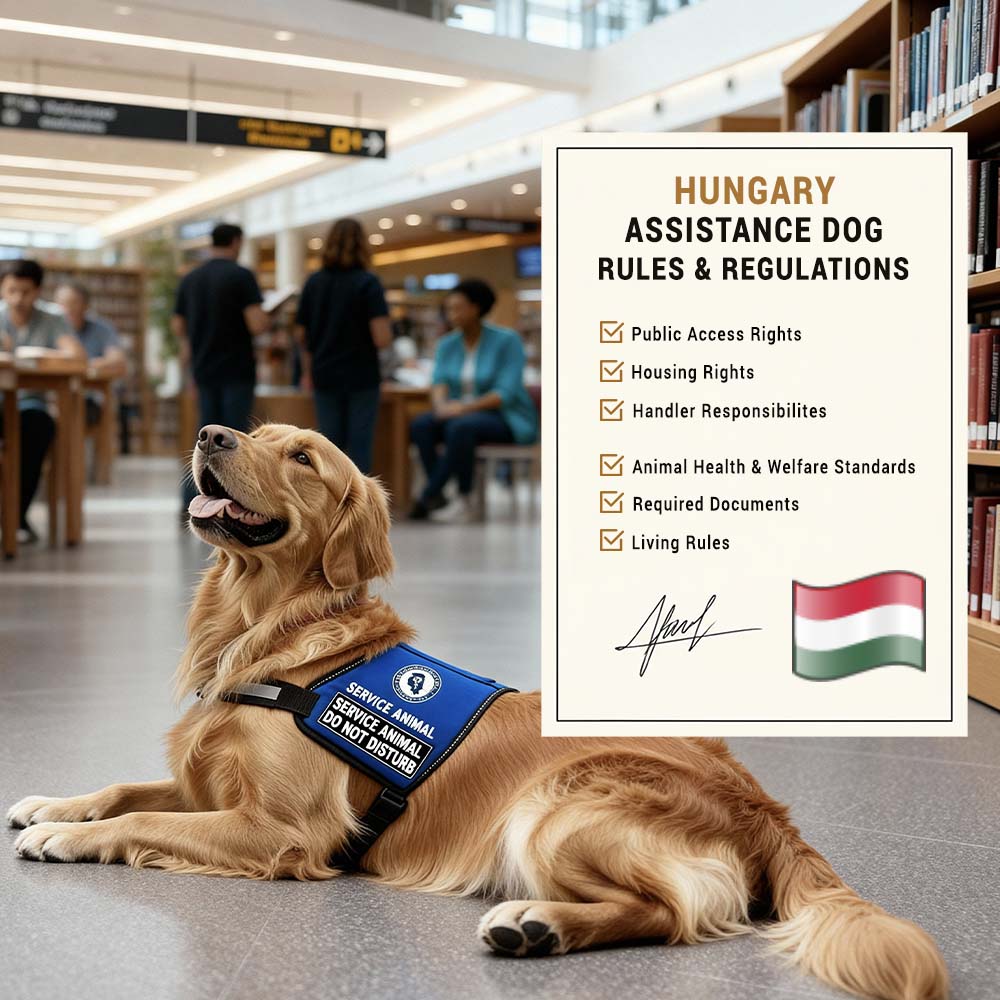
Hungary recognizes several types of service dogs, including guide dogs, mobility assistance dogs, seizure-alert dogs, hearing dogs, and psychiatric service dogs (PSDs). These dogs must be trained by accredited Hungarian or EU-recognized training schools.
Public Access Rights
Service dogs are granted full access to public spaces such as restaurants, hotels, government buildings, shops, hospitals, public transportation, and educational institutions. Businesses cannot legally deny access to a legitimate service dog.
Certification / ID Requirements
Service dogs typically carry identification issued by accredited training centers. To ensure smooth access, handlers should carry:
- Physical ID Card (handler + animal)
- Training/Registration Certificate
- Visible Recognition Gear (vest, harness, or bandana)
- Prescription Letter (ESA, PSA, or Service Animal letter from a licensed professional)
Emotional Support Animals (ESA) & Psychiatric Service Animals (PSA)
Legal Recognition
ESAs and PSAs are only recognized when registered with an accredited organization. Without this documentation, ESAs are treated as pets and are not granted public-access rights.
Housing Rights
Registered ESAs and PSAs may be accepted in no-pet housing depending on landlord discretion and supporting documentation. Service dogs, however, are fully protected under Hungarian disability accommodation law.
Travel Rights
- European airlines accept service dogs with proper documentation.
- PSAs may travel as service dogs when accredited and task-trained.
- ESAs generally follow pet travel rules unless the airline chooses to recognize them.
- Public transportation in Hungary allows service dogs; ESAs/PSAs vary by operator.
Veterinary & Animal Welfare Standards
Vaccination Schedules
Rabies vaccination is mandatory and must be renewed regularly according to Hungarian law. Core vaccines include distemper, parvovirus, adenovirus, and leptospirosis.
Neutering / Spaying Regulations
Neutering is not legally required but is strongly encouraged to reduce overpopulation, especially in rural regions where stray animals are more common.
Animal Welfare Acts
Hungary enforces strong animal welfare protections requiring owners to provide food, clean water, shelter, exercise, and medical care. Abuse, abandonment, and neglect are criminal offenses. The National Food Chain Safety Office (NÉBIH) oversees compliance.