
General Ownership & Control
Leash & Muzzle Rules
In Greece, national and municipal regulations require dogs to be kept on a leash in all public areas, including parks, streets, beaches (during peak season), and residential neighborhoods. Dogs must remain under full control of the owner at all times.
Muzzles are not mandatory for all dogs, but may be required for:
- Dogs with a history of aggression
- Dogs classified as “dangerous” under municipal regulations
- Large dogs riding public transportation
In Athens and Thessaloniki, public transport providers frequently require muzzles for medium and large dogs.
Breed-Specific Bans / Restrictions
Greece has no breed-specific bans. All breeds, including pit bull-type dogs, rottweilers, mastiffs, and shepherd breeds, are allowed. Dangerous dog classifications are based on behavior, not breed.
Licensing & Microchipping
Microchipping is mandatory nationwide for all dogs under Greek law. The chip must be registered in the national pet registry and linked to the owner’s information.
Owners must also maintain:
- Up-to-date rabies vaccination
- Pet passport or veterinary booklet
Municipalities may also require local registration.
Service Dogs & Assistance Animals
Legal Definitions
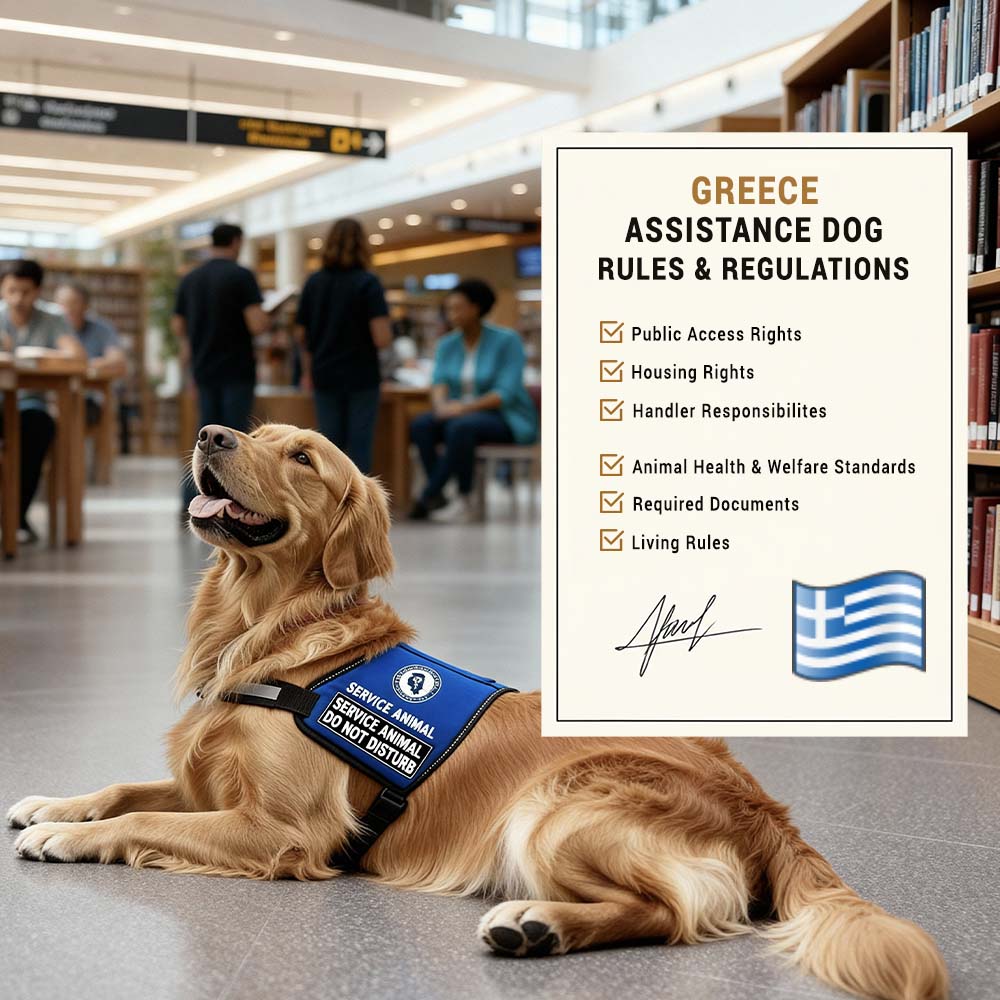
Greece recognizes service dogs trained to assist individuals with disabilities, including guide dogs, hearing dogs, mobility assistance dogs, seizure-alert dogs, and psychiatric service dogs (PSDs). Greek law provides strong protection for guide dogs in particular.
Public Access Rights
Service dogs are permitted in all public spaces, including public transport, hospitals, government buildings, restaurants, hotels, and shops. Businesses cannot refuse access to a legitimate service animal.
Certification / ID Requirements
Service dogs usually carry documentation from accredited training programs. Handlers should use:
- Physical ID Card (handler + animal)
- Training/Registration Certificate
- Visible Recognition Gear (vest, harness, bandana)
- Prescription Letter (ESA, PSA, or Service Animal letter from a licensed professional)
Emotional Support Animals (ESA) & Psychiatric Service Animals (PSA)
Legal Recognition
ESAs and PSAs are only recognized when registered with an accredited organization. Without registration, ESAs are treated as pets and do not hold public-access privileges.
Housing Rights
Registered ESAs/PSAs may be accepted in housing that restricts pets, depending on landlord policies and documentation. Service dogs are legally protected and cannot be refused in rental housing.
Travel Rights
- Aegean Airlines and other carriers accept service dogs with proper documentation.
- PSAs may travel as service dogs if task-trained and accredited.
- ESAs typically follow pet travel rules unless otherwise recognized.
- Greek public transportation (metro, buses, intercity trains) accepts service dogs; ESAs/PSAs vary by operator.
Veterinary & Animal Welfare Standards
Vaccination Schedules
Rabies vaccination is mandatory. Core vaccines (distemper, adenovirus, parvovirus, leptospirosis) are strongly recommended. A valid pet passport or veterinary booklet must be maintained.
Neutering / Spaying Regulations
Neutering is not legally mandatory but strongly encouraged due to Greece’s large stray dog population. Many municipalities support sterilization programs.
Animal Welfare Acts
Greece enforces strict animal welfare legislation requiring owners to provide food, water, adequate shelter, exercise, and medical care. Abuse, neglect, abandonment, or harm to animals is criminally punishable with severe penalties.