
General Ownership & Control
Leash & Muzzle Rules
Germany regulates dog-control rules at both the federal and state (Bundesland) levels. Leash requirements vary by state and municipality, but in most cities — including Berlin, Hamburg, Munich, Cologne, Frankfurt, and Stuttgart — dogs must be kept on a leash in busy public areas, shopping districts, public transport stations, and parks with wildlife.
Muzzles are required for:
- Dogs classified as “dangerous” under state law
- Certain restricted breeds depending on the federal state
- Dogs riding public transportation (varies by region)
- Dogs with documented aggressive history
Some federal states enforce seasonal leash rules in nature areas to protect wildlife (e.g., North Rhine–Westphalia and Lower Saxony).
Breed-Specific Bans / Restrictions
Germany does not impose a federal breed ban, but several states maintain lists of “dangerous breeds” (Listenhunde) with strict ownership rules.
Common restricted breeds include:
- American Pit Bull Terrier
- American Staffordshire Terrier
- Staffordshire Bull Terrier
- Bull Terrier
Depending on the state, restrictions may include mandatory:
- Muzzling and leashing at all times in public
- Temperament tests
- Higher licensing fees
- Owner background checks
- Mandatory neutering
Some states also restrict crossbreeds of listed breeds.
Licensing & Microchipping
Microchipping is mandatory for all dogs in Germany. The chip must be recorded in a German pet database such as TASSO or PETMAXX.
Dog owners must pay an annual dog tax (Hundesteuer), which varies by municipality. Dangerous breeds may incur higher fees.
Rabies vaccination must be kept up to date for all dogs.
Service Dogs & Assistance Animals
Legal Definitions
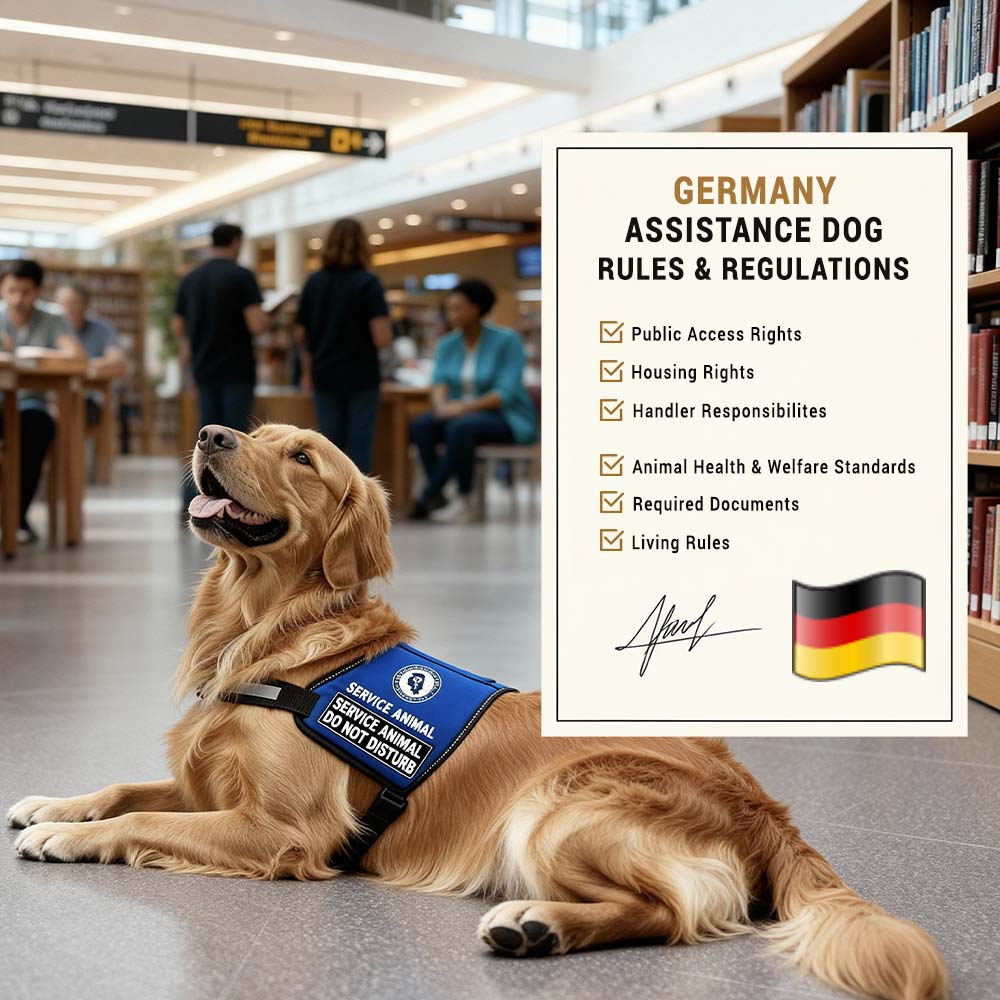
Germany recognizes a wide range of service dogs, including guide dogs, mobility assistance dogs, hearing dogs, seizure-alert dogs, diabetes-alert dogs, and psychiatric service dogs (PSDs). These animals must be task-trained to mitigate a disability.
Public Access Rights
Under German disability law, service dogs receive broad public-access rights to restaurants, hotels, shops, public transportation, workplaces, hospitals, and government buildings. Businesses cannot deny access to a legitimate service dog.
Certification / ID Requirements
While Germany does not have a single federal certification standard, service dogs generally carry documentation from accredited training programs. To avoid access issues, handlers should carry:
- Physical ID Card (handler + animal)
- Training/Registration Certificate
- Visible Recognition Gear (vest, harness, or bandana)
- Prescription Letter (ESA, PSA, or Service Animal letter from a licensed professional)
Emotional Support Animals (ESA) & Psychiatric Service Animals (PSA)
Legal Recognition
Emotional Support Animals (ESAs) and Psychiatric Service Animals (PSAs) are only recognized when registered with an accredited organization in Germany. Without such documentation, ESAs are considered pets and do not have public-access rights.
Housing Rights
Registered ESAs/PSAs may be accepted in no-pet housing at landlord discretion. Service dogs receive full legal accommodation rights under German disability laws.
Travel Rights
- Lufthansa and most EU airlines accept service dogs with proper certification.
- PSAs may travel as service dogs if task-trained and accredited.
- ESAs follow airline pet policies unless the carrier chooses to recognize them.
- German public transport (BVG, DB trains, local buses) allows service dogs; ESAs/PSAs depend on operator policy.
Veterinary & Animal Welfare Standards
Vaccination Schedules
Rabies vaccination is mandatory and strictly enforced. Core vaccines for distemper, parvovirus, adenovirus, and leptospirosis are strongly recommended. Veterinary records should be maintained.
Neutering / Spaying Regulations
Neutering is not legally required, but it is recommended for behavior and population control. Dangerous breeds may require neutering under certain state laws.
Animal Welfare Acts
Germany has some of the strongest animal welfare laws in Europe. Owners must provide adequate food, water, exercise, enrichment, shelter, and veterinary care. Abuse, neglect, and abandonment are criminal offenses.