
General Ownership & Control
Leash & Muzzle Rules
- There is no single, simple “leash law” statute like in many U.S. states, but American Samoa has long treated free-roaming dogs as a public safety issue.
- Territorial dog-control rules and executive orders focus on reducing stray and roaming dogs. Dogs must not be allowed to roam freely and should be confined on the owner’s property or under control when in public. PMC+1
- In practice, if you live in American Samoa and walk your dog in villages or public spaces, you should:
- Keep your dog on a leash and under close control.
- Avoid allowing it to mix with stray dog groups.
- Muzzles are not generally required for ordinary, well-behaved dogs.
- Dogs considered vicious or repeatedly involved in bites/attacks can be restricted or removed under “vicious animal” provisions in the American Samoa Code. PMC
Breed-Specific Bans/Restrictions (Inside the Territory)
- Current territory-level rules focus on stray and dangerous dogs, not on specific breeds.
- There is no widely documented, territory-wide ban on particular breeds for residents keeping dogs already in the territory.
- However, import rules do restrict some breeds (see the Travel subpage).
Licensing & Microchipping
- The American Samoa Code requires licensing of dogs that roam free, and the territory has periodically pushed licensing as part of dog-control campaigns. PMC
- Because of ongoing dog-bite issues, you should treat licensing and identifiable ownership (tags, collar, microchip) as essential:
- Register your dog with local authorities if required by current village or territorial initiatives.
- Keep an ID tag and your contact info on your dog at all times.
- Microchipping is not yet a universal statutory requirement, but many relocation/transport services and welfare organisations strongly recommend microchips for pets in American Samoa. airanimal.com+1
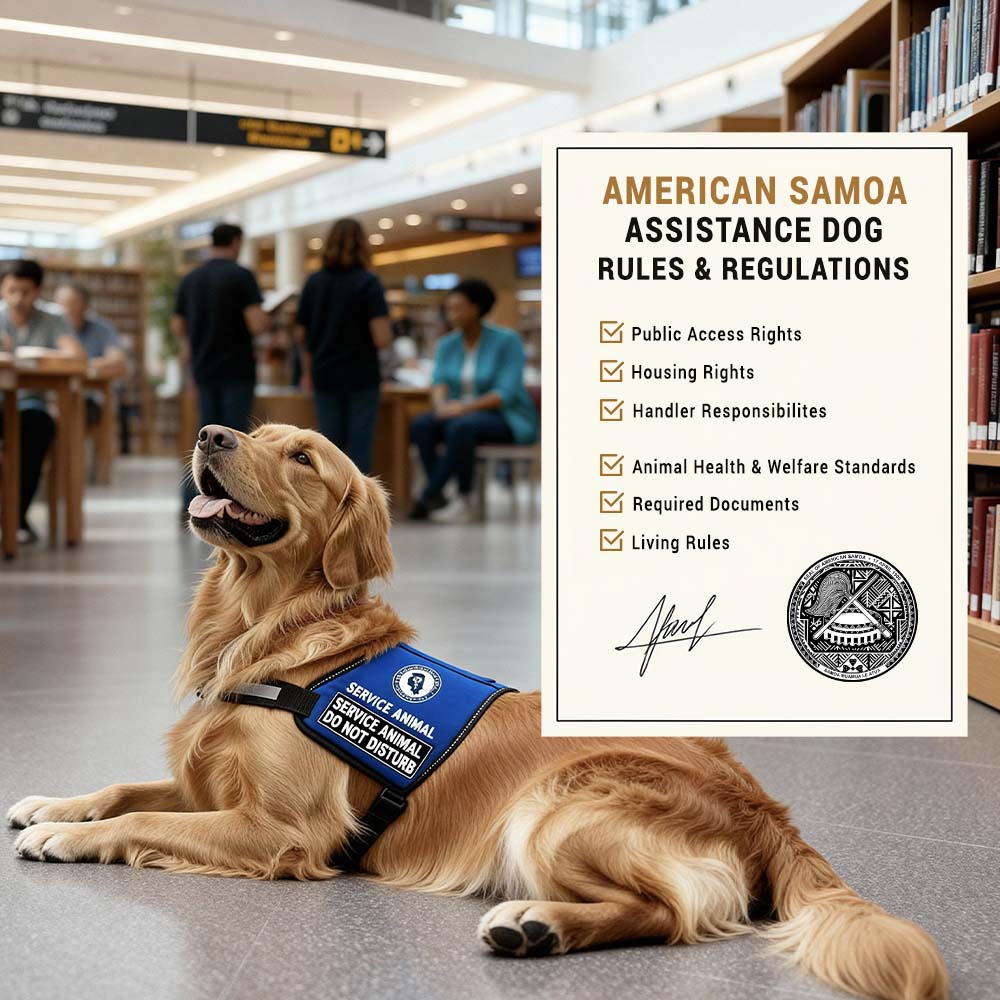
Service Dogs & Assistance Animals
Legal Definitions
- American Samoa is a U.S. territory, so federal ADA rules on service animals apply.
- Under the ADA, a service animal is a dog that has been individually trained to do work or perform tasks for a person with a disability, including psychiatric service dogs. ADA.gov+1
- Examples of tasks:
- Guiding someone who is blind or has low vision
- Alerting someone who is deaf/hard of hearing
- Pulling a wheelchair or assisting with balance
- Interrupting panic attacks or self-harm behaviors, or reminding the handler to take medication
Public Access Rights
- Service dogs are allowed in most public places in American Samoa by virtue of federal ADA rules, including:
- Shops, restaurants, hotels and guesthouses
- Government offices and public facilities
- Public transport and common carriers (buses, taxis/freight vessels that fall under U.S. rules)
- Staff may only ask the two ADA questions (about whether the dog is required because of a disability and what tasks it’s trained to perform).
Certification/ID Requirements
- Under the ADA, no official certification or ID card is legally required for a service dog. ADA.gov+1
- However, because American Samoa is small and procedures at ports, ferries, and facilities can be informal, clear identification greatly reduces friction.
- For your program, you should treat a physical ID card, registration certificate, and visible recognition gear (vest, bandana, or harness) as required when you take a service dog into public or onto transport.
Emotional Support Animals (ESA) & Psychiatric Service Animals (PSA)
Legal Recognition
- ESAs and PSAs in American Samoa rely primarily on federal frameworks (Fair Housing Act, Air Carrier Access Act/DOT rules, Rehab Act). USA Service Dog Registration+1
- In line with your program policy:
- Emotional Support Animals (ESAs) and Psychiatric Service Animals (PSAs) are recognised in American Samoa when they are registered with an accredited organisation that verifies their purpose and documentation.
Housing Rights
- As a U.S. territory, American Samoa is covered by federal Fair Housing Act (FHA) principles.
- In practice, that means:
- A properly registered ESA or PSA can qualify as an assistance animal in housing.
- Landlords and housing providers are generally expected to make reasonable accommodation, even in no-pet properties, provided:
- The animal is under control and not a danger, and
- You can show credible documentation/registration from an accredited organisation.
Travel Rights (High-Level, Within/From the Territory)
- Service dogs: Fully covered by ADA / DOT rules for U.S. carriers.
- PSAs: When trained as psychiatric service dogs and registered appropriately, they are treated as service animals for air travel.
- ESAs: Treated as pets under most airline policies; they may still travel, but under standard pet rules (fees, crate, etc.).
Veterinary & Animal Welfare Standards
Vaccination Schedules
- American Samoa is officially treated as a rabies-free territory. petraveller.com.au+1
- Because of this, imported dogs from rabies-risk regions must meet strict rabies requirements (see travel page), but local dogs may not be routinely vaccinated for rabies unless they travel.
- However, health authorities and relocation guides strongly encourage: airanimal.com+1
- Working with a local veterinarian and keeping core vaccines (distemper, parvo, etc.) up to date.
- Keeping records of any rabies or core vaccinations if you ever plan to leave the territory with your dog.
Neutering/Spaying Regulations
- American Samoa has well-documented issues with stray and free-roaming dogs; public health research and NGOs have strongly encouraged spay/neuter campaigns as a key control measure. PMC+1
- There is no blanket mandatory spay/neuter law for all dogs yet, but:
- Spay/neuter is often required or strongly encouraged for adoptions.
- Import of unaltered pets has been targeted by executive orders aimed at controlling stray populations. Secretary Of America
Animal Welfare Acts
Seek veterinary care after injuries or serious illness
Animal management is governed mainly under American Samoa Code Annotated Title 25 (Environmental Health – Domestic Animals) and related chapters, covering:
Control of dangerous/vicious animals
Environmental health and nuisance prevention
Quarantine and control of pets and livestock FAOHome+1
As a resident, you’re expected to:
Provide adequate food, water, and shelter
Prevent your dog from roaming and forming stray packs