
General Ownership & Control
Leash & Muzzle Rules
- In most provinces and cities, dogs must be kept on a leash in public spaces, including streets, sidewalks, and parks.
- Some municipalities allow designated off-leash areas or dog parks, but dogs must remain under control at all times.
- Muzzle laws vary by province:
- Ontario requires muzzles for certain restricted breeds (e.g., pit bull-type dogs).
- Other provinces may only require muzzles if a dog is declared “dangerous” or has a history of aggression.
Breed-Specific Bans/Restrictions
Breed restrictions in Canada are provincially and municipally regulated.
Common examples include:
- Ontario: Ban on owning or importing pit bull-type dogs (American Pit Bull Terrier, Staffordshire Bull Terrier, American Staffordshire Terrier, or any cross of these).
- Winnipeg (Manitoba): Similar restrictions on pit bull-type breeds.
- Other provinces may impose local dangerous dog bylaws rather than breed-specific bans.
Licensing & Microchipping
- All dogs must be licensed with their local municipality; licences are typically renewed annually.
- Microchipping is strongly recommended across Canada and mandatory in some provinces for dog identification and return if lost.
Service Dogs & Assistance Animals
Legal Definitions
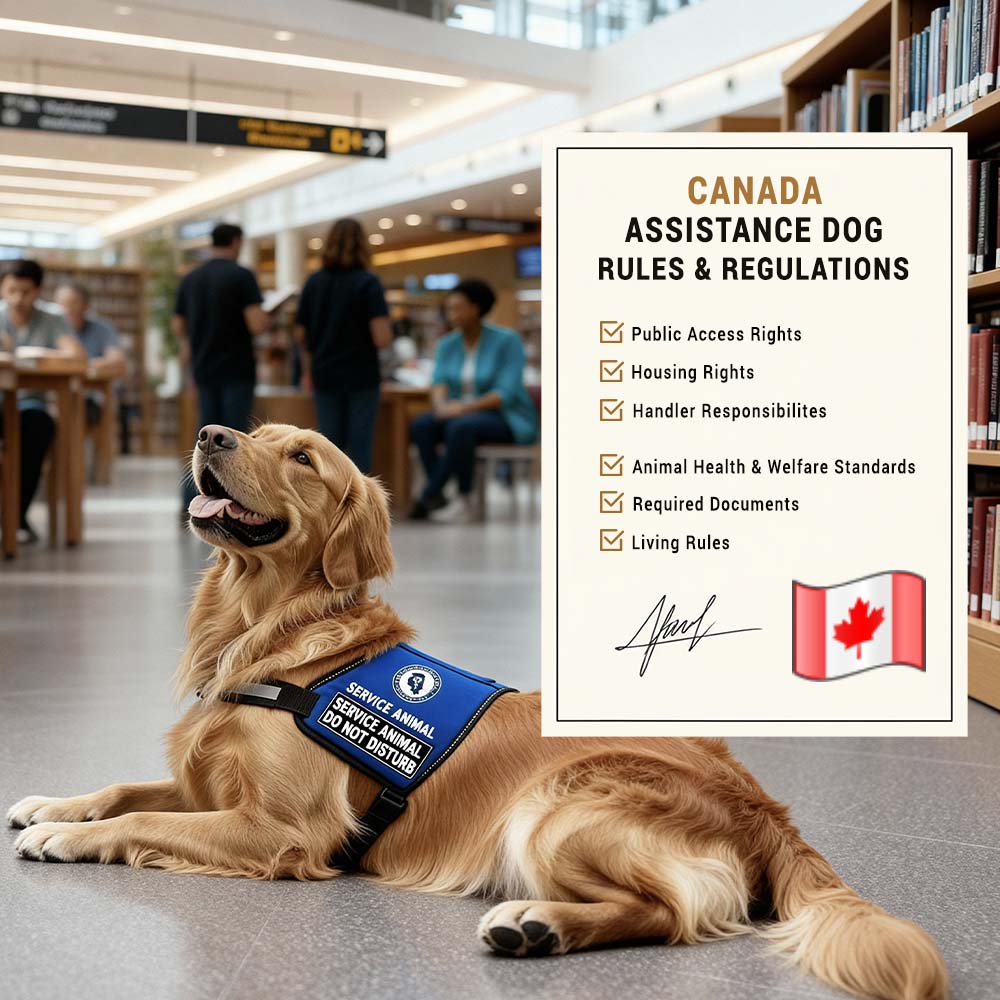
Under Canadian federal and provincial laws, a service dog is an animal specifically trained to perform tasks for a person with a disability.
This includes:
- Guide dogs for individuals who are blind or visually impaired.
- Assistance dogs for mobility, psychiatric, autism, or medical alert purposes.
Public Access Rights
Service dogs have full public access rights throughout Canada, including:
- Restaurants, shops, hotels, and public buildings.
- Public transport such as buses, trains, and ferries.
- Housing (service dogs cannot be denied under no-pet policies).
Certification/ID Requirements
Requirements vary by province:
- British Columbia, Alberta, and Nova Scotia issue official provincial service dog ID cards.
- In other provinces, proof of training from a recognised organisation may be sufficient.
Emotional Support Animals (ESA) & Psychiatric Service Animals (PSA)
Legal Recognition
Emotional Support Animals (ESAs) and Psychiatric Service Animals (PSAs) are only recognised in Canada when registered with an accredited organisation that verifies their role and training.
Housing Rights
ESAs and PSAs may be accepted in rental housing if properly registered, but unlike service dogs, they do not have automatic federal protection under the same laws.
Provincial human rights commissions may support accommodations on a case-by-case basis.
Travel Rights
- Airlines: ESAs and PSAs may travel under airline policies if properly registered, but not all carriers recognise ESAs for in-cabin travel.
- Trains/Buses: Most operators allow ESAs/PSAs under pet or assistance animal policies.
- Ferries: Permitted if under control and compliant with transport safety rules.
Veterinary & Animal Welfare Standards
Vaccination Schedules
- Rabies vaccination is mandatory for all dogs in Canada.
- Core vaccines (distemper, parvovirus, adenovirus, parainfluenza) are recommended nationwide.
Neutering/Spaying Regulations
Neutering/spaying is not legally required, but encouraged by shelters and veterinarians to reduce unwanted litters.
Animal Welfare Acts
Each province enforces its own welfare legislation (e.g., Ontario Animal Welfare Services Act, BC Prevention of Cruelty to Animals Act), which requires owners to:
- Provide food, water, shelter, and veterinary care.
- Protect animals from distress and cruelty.
- Avoid tethering or confinement that causes suffering.