
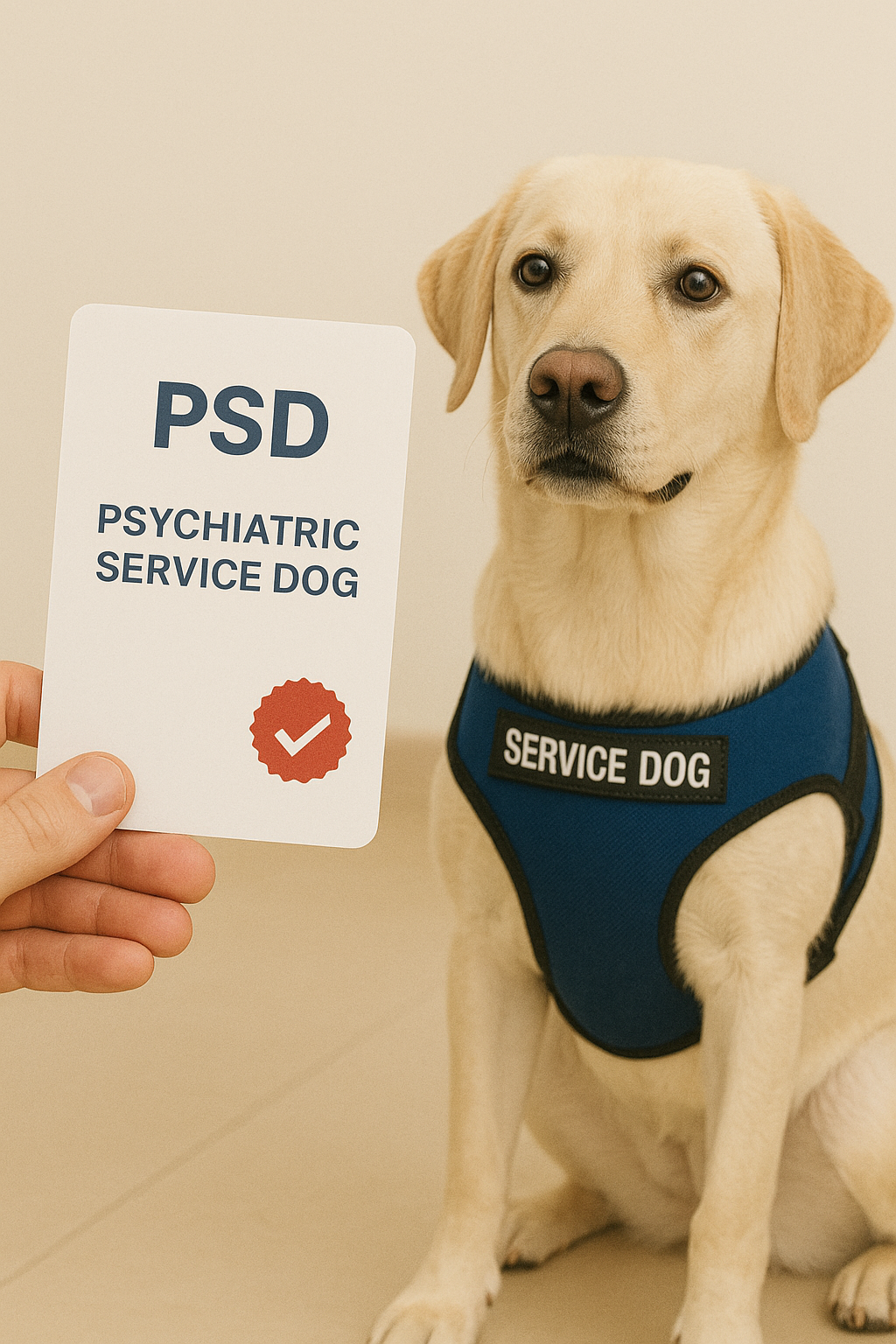
If you’ve been looking into psychiatric service dogs (PSDs), you’ve probably come across the phrase PSD dog certification more than once. It sounds simple enough — get your dog “certified” and you’re ready to go — but in reality, it’s a bit more complex. Certification isn’t just about a piece of paper or a card; it’s about showing that your dog has the skills, behavior, and training to reliably support you in public and at home.
A psychiatric service dog (PSD) is trained to assist people with mental health conditions such as post-traumatic stress disorder (PTSD), severe anxiety, depression, or panic disorders. These dogs aren’t the same as emotional support animals (ESAs). While ESAs provide comfort through their presence, PSDs perform specific, trained tasks that help mitigate the effects of a psychiatric disability. Examples include interrupting self-harm behaviors, providing deep pressure therapy during panic attacks, or waking someone from nightmares.
So what does PSD dog certification actually mean? In the United States, the Americans with Disabilities Act (ADA) does not require service dogs to be officially certified or registered. Instead, certification usually refers to passing a recognized training program or evaluation that proves your dog can perform the tasks you need and behave appropriately in public. For air travel, airlines often require you to complete the DOT Service Animal Air Transportation Form, which includes declaring that your dog is trained and under control — this functions as a type of self-certification.
In Canada, PSD dog certification requirements vary by province. Some provinces, like Ontario, issue service dog ID cards once you demonstrate that your dog is task-trained. Others, like Alberta and British Columbia, have their own government-recognized testing and certification systems. Wherever you are, the common thread is that the dog must be trained to perform disability-related tasks and be safe in public environments.
For the UK and EU, psychiatric service dogs are increasingly recognized but generally must come through a program that meets the standards of Assistance Dogs International (ADI) or the International Guide Dog Federation (IGDF). These organizations set training and behavior benchmarks that serve as the gold standard for certification. In practice, this means that if your dog has been trained by, or to the standards of, one of these accredited bodies, they will be accepted as a qualified PSD in most public and travel situations.
Regardless of the country, the steps to prepare for PSD dog certification are similar. First, the dog needs a solid foundation of obedience and public access skills: calm walking through crowds, ignoring distractions, and settling quietly in busy places. Then, task work must be rock-solid — your dog should be able to perform the psychiatric assistance tasks you need every time, even in stressful environments. Finally, keeping records of training hours, veterinary care, and progress logs will support your case if you need to show proof of training for travel or accommodation.
When people talk about PSD dog certification, what they’re really talking about is demonstrating that your dog is a reliable, safe, and task-trained partner. Whether it’s through a public access test, a provincial ID card, or an airline form, the goal is the same: to show that your PSD meets the standards of a true working dog team.