
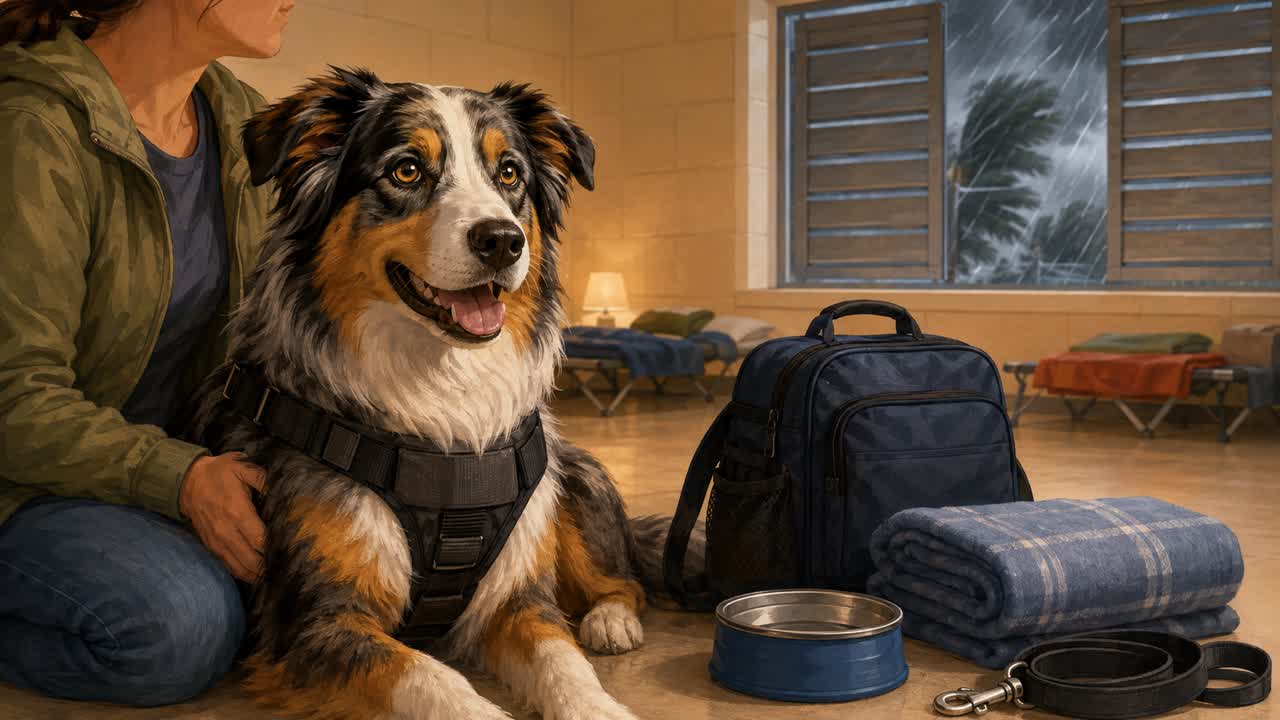
Service dog hurricane shelter planning should begin before watches, warnings, or evacuation orders are issued. Identify accessible shelters, confirm transportation options, prepare several days of supplies, and make a backup care plan in case you can’t care for your dog.
This guide focuses specifically on shelter readiness. It complements broader evacuation planning by addressing intake conversations, shared-space behavior, records, supplies, and continuity of care.
Under the Americans with Disabilities Act (ADA), emergency shelters operated by state or local governments generally must allow a qualifying service dog to accompany its handler. Policies for pets and emotional support animals may differ, so confirm local arrangements in advance.
Quick Overview
- Contact local emergency management before hurricane season to identify accessible shelters and transportation.
- Prepare food, water, medication, waste supplies, and handling equipment in portable containers.
- Keep veterinary, vaccination, medication, task, and emergency-contact records together.
- Practice settling quietly near cots, mobility devices, food lines, and unfamiliar people.
1) Start Service Dog Hurricane Shelter Planning Locally
Do not assume the shelter you remember from a previous storm will open again. Locations, evacuation zones, transportation routes, and intake procedures can change. Contact your city or county emergency-management office and ask where accessible shelters are announced, whether preregistration is available, and how transportation works for residents who cannot drive.
Ask practical questions: Which entrance is accessible? Is there a designated relief area? Where can dog food and medication be stored? Is refrigeration available for temperature-sensitive medication? Who should you contact if an assigned shelter changes?
Review the general regulations that may apply, but rely on current instructions from the agency operating the shelter. Save its phone number and alert channels on paper as well as on your phone.
Choose at least two backup destinations outside the same immediate flood or storm-surge area. These might include another public shelter, an accessible hotel, or a trusted household beyond the evacuation zone.
2) Build a Portable Shelter Kit
Pack the dog’s supplies separately from the handler’s bag so essential items remain easy to reach during intake. Use waterproof containers or resealable bags, and label medication clearly.
- Dog food, portable bowls, water, and a manual can opener if needed
- Prescribed medication, dosage instructions, and veterinary contact information
- Leash, harness or tether, collar, and a backup set of handling equipment
- Waste bags, absorbent pads, cleaning supplies, and a towel
- A familiar mat or compact bed for a defined resting place
- Paw protection and weather-appropriate gear
- A recent photograph showing you and the dog together
Rotate food and medication before they expire. Check the kit at the beginning of hurricane season and again whenever a named storm may affect your area. Optional identification may help with organization or communication, but it does not replace task training or controlled behavior.
3) Organize Records without Treating Them as an Access Pass
Create a compact paper folder and an offline digital copy containing vaccination records, license information required for dogs generally in your jurisdiction, prescriptions, veterinarian details, emergency contacts, and feeding or medication instructions.
A short task description and training log can help a backup caregiver understand the dog’s routine. An optional service check may also help you organize information, but it should not be presented as government approval or as a document that creates ADA rights.
When the dog’s service role is not obvious, staff at an ADA-covered facility may generally ask only whether the dog is required because of a disability and what work or task it has been trained to perform. Reviewing a concise public access guide can help you prepare a calm answer.
4) Prepare for Crowded Shelter Conditions
A hurricane shelter can involve noise, alarms, unfamiliar flooring, tight aisles, children, other animals, and disrupted sleep. Practice the skills most likely to reduce friction: entering through busy doors, settling on a small mat, ignoring dropped food, toileting on cue, and remaining under control around mobility equipment.
The handler remains responsible for feeding, toileting, supervising, and caring for a service animal. Shelter personnel are not ordinarily responsible for providing that care. Identify a trusted person who can assist if your disability, an injury, or illness temporarily prevents you from doing so.
Under ADA guidance, a service dog generally must be harnessed, leashed, or tethered unless that equipment interferes with its work or the handler’s disability prevents its use. In that situation, control must be maintained through voice, signals, or another effective method.
A dog that is not housebroken, or that is out of control when the handler does not take effective action, may be removed. Pack the supplies and practice the routines that make those problems less likely during a stressful stay.
5) Plan the Intake Conversation
At check-in, state plainly that the dog is a service animal required because of a disability. If asked, describe the trained work or task without disclosing your diagnosis. For example, a handler might say that the dog is trained to retrieve essential items, provide mobility assistance, interrupt a disability-related episode, or alert to a medical change.
If a staff member requests a certificate or ID, remain calm. Explain that the ADA does not generally require service-animal certification or special identification for entry. Offer to answer the two permitted questions, and ask for a supervisor or accessibility coordinator if the issue is not resolved.
Write down the shelter name, date, time, staff member’s name, and what was said if a disagreement continues. During an immediate safety emergency, prioritize reaching a safe location. Questions about a specific refusal can be addressed later with the operating agency or an appropriate disability-rights resource.
6) Create Backup Routes and Continuity Plans
Your plan should account for more than one failure point. A shelter may reach capacity, roads may close, cellular service may fail, or you may need medical transportation. Give a trusted contact copies of your destinations, evacuation route, veterinary details, and dog-care instructions.
If evacuation could involve a commercial flight, review the separate air travel guide before the storm. Air travel is governed primarily by the Air Carrier Access Act rather than the ADA, and airlines may have their own advance forms and procedures.
Decide who can safely handle the dog if you are hospitalized. Record the dog’s commands, tasks, feeding schedule, medications, stress signals, and approved veterinarian. Include one local contact and one contact outside the storm region.
Run a short practice evacuation at least once. Load your equipment, travel to a backup destination, use the planned communication method, and note what was difficult. A rehearsal often reveals heavy bags, missing supplies, inaccessible transportation, or instructions that are unclear to another caregiver.
FAQs
What is the first step in service dog hurricane shelter planning?
Contact local emergency management before hurricane season. Confirm how accessible shelters are announced, whether registration is offered, what transportation is available, and whom to call when plans change.
Can an emergency shelter require a service dog certificate?
For public access under the ADA, covered shelter staff generally cannot require certification, registration, or an identification card as a condition of entry. Different rules may apply to animals that do not meet the ADA definition of a service animal.
Can shelter staff ask about my disability?
When the dog’s role is not obvious, staff may generally ask whether the dog is required because of a disability and what trained work or task it performs. They may not ask for your diagnosis or require the dog to demonstrate its task.
Who cares for the dog inside the shelter?
The handler is responsible for the dog’s care and supervision. Arrange a backup handler or caregiver in case illness, injury, or another emergency prevents you from providing care.
Can a service dog be removed from a shelter?
A covered entity may require removal if the dog is out of control and the handler does not take effective action, or if the dog is not housebroken. The decision should be based on the individual dog’s behavior rather than breed assumptions.
Sources
- ADA.gov: Service Animals
- ADA.gov: Service Animals FAQ
- CDC: Dogs
- CDC: Pet Travel Safety
- HUD: Information for Persons with Disabilities
Takeaway
A workable hurricane shelter plan combines early local coordination, portable supplies, practiced behavior, clear communication, and backups for disrupted travel or care.
- Confirm shelters, routes, and transportation before a storm threatens.
- Carry useful care records without treating optional documents as legal access credentials.
- Practice the plan and designate a trusted backup caregiver.