
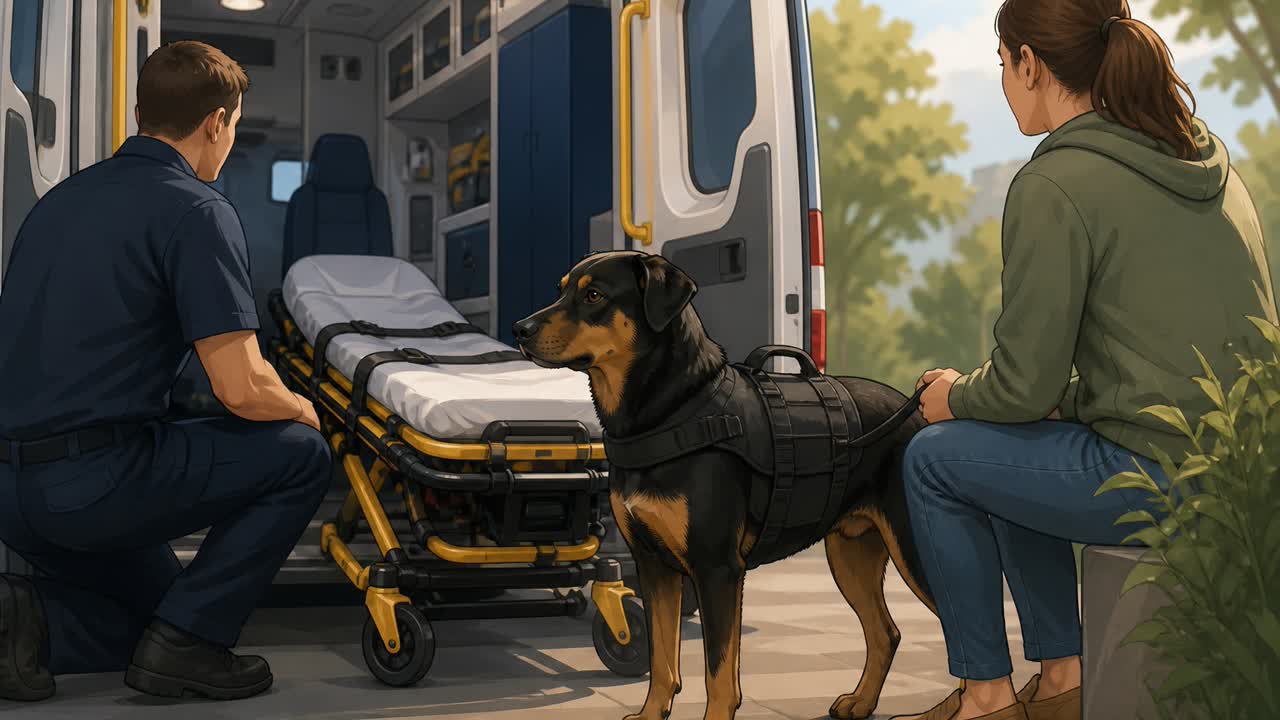
In the United States, a service dog in ambulance transport is usually handled as a practical safety decision, not a paperwork test.
The key point is simple: an ambulance crew’s first duty is emergency medical care. A service dog may be allowed to travel with the handler when it is safe and reasonable, but there are situations where the dog may need to be transported separately, handed to a trusted contact, or held temporarily by another responder.
This article is about emergency medical transport, not airline travel, hotel access, or routine public access disputes. The best preparation is a calm plan: clear task information, emergency contacts, vaccination records, and a realistic backup option if the ambulance cannot safely carry the dog.
Quick Overview
- A service dog is not automatically guaranteed space in every ambulance.
- EMS teams may allow the dog if it does not interfere with care, safety, or required equipment.
- The handler should explain the dog’s task in plain, short language if able.
- Crews generally should not require a certificate, ID card, or registry as the deciding factor.
1) What a Service Dog in Ambulance Transport Changes in an Emergency
Ambulance transport is different from entering a store or riding in a rideshare. The space is tight, the patient may need urgent procedures, and the crew must be able to move quickly. A dog that is calm in ordinary public settings may still create a problem if it blocks access to oxygen, monitors, medications, or the patient’s body.
That does not mean the service dog should be dismissed automatically. Under ADA principles, service animals are recognized because they perform disability-related tasks. For a broader refresher on service animal basics, the knowledge hub can help separate everyday public access from emergency-specific logistics.
The practical question for EMS is usually: can the dog safely remain with the handler while emergency care continues? If yes, the crew may position the dog where it is secure and out of the working area. If no, the crew should look for a safe alternative instead of treating the dog as abandoned property.
2) What Information Helps Responders Make a Fast Decision
In an emergency, long explanations rarely help. A short script is better: “This is my service dog. He is trained to alert before seizures and stay with me after an episode.” That gives responders the information they need without turning the moment into a debate about documents.
Useful preparation can include a wallet card, phone medical ID, emergency contact, veterinarian contact, current rabies record, and a short task list. These records are not a legal magic pass, but they can help responders understand the dog’s role and decide who should care for the dog if the handler cannot communicate.
If you are still clarifying whether your dog’s training and role match service animal expectations, a careful service screening can help organize the facts before a crisis. The goal is not to buy proof for an ambulance crew; it is to understand the dog’s task work, behavior, and support plan.
3) When EMS may Separate the Dog from the Handler
Separation may be appropriate when the dog is out of control, the ambulance is too crowded, the handler needs invasive or urgent treatment, the dog is injured, the dog creates a contamination concern, or the crew cannot safely restrain the dog during transport.
This is why emergency planning matters. The handler can list one or two trusted contacts who can retrieve the dog, along with instructions for leash, food, medication, and veterinary needs. If local EMS or fire services offer non-emergency community outreach, it may be worth asking how they typically handle service animals during transport.
For routine businesses, the ADA’s two-question framework and removal rules are often the starting point. Those public access rules still matter, but ambulance transport adds a medical safety layer that ordinary store access does not.
4) Training and Behavior that Make Transport More Realistic
The strongest practical “documentation” is often the dog’s behavior. A service dog that can settle on cue, ignore medical equipment, tolerate sirens from a distance, remain leashed, and stay close without lunging gives responders more options. Emergency environments are intense, so the dog’s public-access reliability should include noise, strangers, unusual movement, and handler stress.
Handlers can practice low-risk preparation without staging fake emergencies. Examples include settling on a mat in tight spaces, riding calmly in different vehicles, wearing a harness without fuss, ignoring dropped supplies, and responding to a backup handler’s cues.
Optional recognition gear may also reduce confusion, especially when responders arrive quickly and have limited context. A vest or tag is typically not the legal deciding factor, but clear identification can help the crew recognize that the dog has a working role while they focus on the patient.
5) How Ambulance Transport Differs from Hospital and Flight Rules
The ambulance decision is only one part of the chain. Many service dogs can remain with handlers in patient areas, but access may be restricted in places where sterility, infection control, or direct treatment needs make the animal’s presence unsafe.
Air travel is also a separate legal and operational category. If your concern is scheduled transportation rather than emergency care, review the applicable flight rules instead of assuming the ambulance standard will be the same.
The safest mindset is to plan by setting. An ambulance, emergency room, hospital room, aircraft cabin, and apartment building all involve different decision-makers and safety concerns. A prepared handler keeps the dog’s task information consistent while adapting the logistics to the setting.
6) A Simple Emergency Plan for Handlers
Write a one-page plan and keep it easy to find. Include the dog’s name, task description, commands, feeding or medication needs, vaccination status, veterinarian, microchip number if available, and two emergency contacts. Add a note naming who may take custody of the dog if you cannot speak.
Keep the plan calm and factual. Avoid language that claims the dog must always ride in the ambulance no matter what. A better version says the dog is a task-trained service animal and should remain with the handler when it can be done safely without interfering with emergency care.
It is also sensible to prepare for the answer to be no. That can feel stressful, but a backup plan protects both the handler and the dog. If the crew cannot safely transport the dog, they can move faster when they know who to call and what the dog needs.
FAQs
Can a service dog ride in an ambulance with me?
Sometimes. The crew may allow it if the dog can ride safely and does not interfere with emergency treatment, equipment, crew movement, or patient care.
Can EMS ask for service dog papers?
Paperwork is usually not the core issue in an emergency. Responders may need practical information about the dog’s task, behavior, health, and safe handling, but certificates or registry cards should not be treated as automatic proof of legal access.
What if I am unconscious and cannot explain my dog’s role?
Carry a brief emergency card and set up a phone medical ID if possible. Include the dog’s task, your emergency contacts, and who can take custody of the dog if you cannot communicate.
Can the ambulance crew refuse my service dog?
They may separate the dog if transport would be unsafe or would interfere with medical care. The reason should be tied to the actual emergency setting, not assumptions that service dogs are not allowed.
Should my service dog wear a vest during emergencies?
A vest is typically not legally required, but it can help responders quickly recognize that the dog is working. Behavior, task training, and a backup plan matter more than any single piece of gear.
Sources
- ADA.gov: Service Animals
- ADA.gov: Service Animals FAQ
- National Association of the Deaf: Public Accommodations
- CDC: Dogs
- CDC: Pet Travel Safety
- HUD: Information for Persons with Disabilities
Takeaway
A service dog may be able to ride in an ambulance, but the decision depends on emergency medical safety, available space, control of the dog, and whether the crew can treat the patient without interference.
- Prepare a short task explanation and emergency contact plan before a crisis.
- Do not rely on certificates or registries as the main answer in an emergency.
- Train for calm behavior in tight, noisy, high-stress environments whenever possible.